Skip to content
fishing forecast

cachema weakfish

Cynoscion phoxocephalus · Sciaenidae · predator

Sea

Slender croaker with a pointed snout from the eastern Pacific, from the southeastern Gulf of California to Peru. Lives in coastal waters and estuaries, and is fished from the beach and from boats with shrimp and light baits.

Also called: corvina-picuda, corvina-de-focinho-pontudo, sharpnose corvina, cachema weakfish

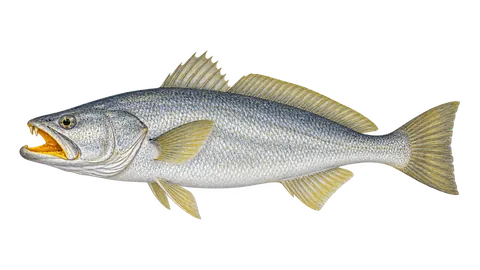
Scientific illustration of Cachema weakfish
common size
25–45 cm
maximum
60 cm
common weight
0.1–0.8 kg
record/max.
— kg
depth
10–60 m
ideal water
22–29 °C
location

Sample location: choose yours to see the forecast for where you fish.

period

Reading the weather across 3 global models and 31 simulations…

the species

everything about the cachema weakfish

overview

who is the cachema weakfish

Small croaker of the eastern Pacific, from the southeastern Gulf of California and southern Mexico to Peru. Lives in coastal waters and on the shelf, over sand and mud bottoms, generally 10 to 60 m according to FishBase (STRI gives 1 to 30 m), and juveniles enter river mouths and shallow estuaries. Adults eat fish, shrimp and other crustaceans. It reaches 60 cm, but the common size is around 25 cm. It has a commercial fishery in several Central American countries and is considered a second-tier sport fish: caught from the beach, at river mouths and from anchored boats, with shrimp, pieces of fish and midwater baits. In Costa Rica there is a legal minimum catch size of about 33 cm.

fun facts

  • In the Incopesca size table (Costa Rica), this is the corvina with the lowest minimum size: 327.4 mm, versus 342 mm for the corvina aguada and 500.3 mm for the corvina agria.
  • In Panama the local names vary: corvina blanca, corvina rolliza and corvinilla; in Honduras, pinchada.
how to recognize it

identification

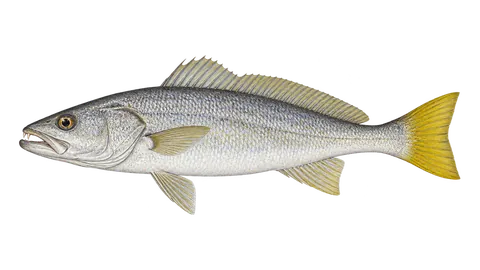
Elongated, compressed, silvery body with a blue-gray back, darkened dorsal and caudal fins and a blackish pectoral axil. The head is pointed, the mouth very oblique, with the lower jaw more projecting and a pair of canines at the tip of the upper jaw; no barbel. The scales are all smooth and the dorsal has 20 to 22 soft rays. The striped corvina (C. reticulatus) has wavy streaks on the back, rough scales and 25 to 29 soft dorsal rays; the yellowtail corvina (C. stolzmanni) has a yellowish tail.

distribution

where found

open on the large map

Does not occur in Brazil. Eastern Pacific, from the southeastern Gulf of California and southern Mexico to Peru, through Guatemala, El Salvador, Honduras, Nicaragua, Costa Rica, Panama, Colombia and Ecuador. Strays to the Galápagos.

Habitat: Coastal waters with sand and mud bottoms; juveniles in river mouths and shallow estuaries, adults in high-salinity estuaries and on the shelf.

calendar and clock

when to fish

best season

time of yearbest: Nov–Apr
JanFebSeaAprMayJunJulAugSepOctNovDec

Fished all year in tropical areas; no documented season. Moon tides and river mouths with clear water concentrate the fish.

best time of day

0h6h12h18h sunrise ~6amsunset ~6pm

Dawn and dusk. Feeds best at dawn, at dusk and at night, when it comes up into the shallows. By day it still takes natural bait on the bottom, especially under cloudy skies or slightly murky water.

weather, water and behavior

what affects the cachema weakfish
sensitivity The little bars show how much each factor affects this species. Five full: it feels it a lot.

cold and cold fronts

Cold upwelling shuts down activity in the shallows.

atmospheric pressure

A front with the sea turning hinders beach and bar-mouth fishing.

moon

Full-moon and new-moon tides move the water and activate the schools.

rain

Heavy rain muddies estuaries and river mouths; afterward, the murkier water can help with natural bait.

water level

Does not apply at sea. In the estuary, the incoming tide brings the fish in.

noise

In the shallows, approach quietly and avoid stomping on the wet sand.

wind

Strong wind raises surf and hinders beach fishing.

tide

Moving tide is best; slack tide tends to be weak.

depth

From the shallows of the beach and the river mouths, at about 30 m over sand and mud.

technique, gear and bait

how to fish

rod
7' to 10', 10 to 20 lb (longer on the beach)
spinning / baitcasting reel
spinning reel 3000 to 4000
line
braid 15 to 25 lb or monofilament 0.28 to 0.35 mm
leader
fluorocarbon 20 to 30 lb, 80 cm to 1 m
hook
circle 1/0 to 3/0

lures

  • jig head 1/4 to 1/2 oz with 8 to 10 cm shad or silicone shrimp
  • small metal spoon
  • light jerkbait

natural baits

  • live or dead shrimp
  • cut fish (sardine, mullet)
  • squid strips

accessories

  • 40 to 100 g sinker on the beach
  • pliers or boga grip
  • bucket of water for live bait

tip from an angler

Look for river mouths and channels between sandbars on the rising tide, and let the shrimp roll along the bottom with a light sinker: the corvina nibbles before it swallows.

what the law says

rules for the cachema weakfish

Summary of the regulations we found, with the source for each. Rules change; before keeping or transporting fish, check with the state environmental agency.

Mexico: up to 5 per species and 10 saltwater fish per day

5 specimens of the species per angler per day, within the limit of 10 saltwater fish

In federal waters of Mexico, recreational sport fishing allows each angler to keep up to 10 marine fish per day, no more than 5 of the same species. The picuda corvina is not among the species reserved for sport fishing (marlins, sailfish, swordfish, tarpon (sábalo), roosterfish and dorado, up to 50 nautical miles from shore, item 0.3 of the standard) and has no quota of its own. Fish over the quota must go back alive, and sport-caught fish may not be sold. From shore you need no permit; from a boat, you do (permits under the Federal Duties Law, Ley Federal de Derechos, item 4.3).

Source: Amendment to NOM-017-PESC-1994 (recreational sport fishing in federal waters of Mexico), published in the DOF on Nov 25, 2013, items 0.3, 4.3, 4.9.1, 4.9.5 and 4.11 (Sagarpa/Conapesca)

Costa Rica: minimum size 32.7 cm

327.4 mm (about 32.7 cm) total lengthconfirm with the agency

The Incopesca Board set the legal first-catch size for the picuda corvina (Cynoscion phoxocephalus, "Corvina Picuda" in the table) at 327.4 mm, equal to the first sexual maturity size given by the institute. The measure applies to all fishing activity and prohibits selling, holding, transporting or processing fish product below it. We did not confirm whether it was updated after 2017: check with Incopesca before keeping small fish.

Source: Acuerdo AJDIP/102-2017 of the Incopesca Board of Directors (session 010-2017, Feb 24, 2017), table of legal sizes at first catch

catch and release
catch and release Releasing the fish alive, quickly and with a wet hand. During a closed season it isn't always allowed: what the regulation says applies.

Hold it by the jaw with a boga or pliers, watching the canines of the upper jaw, and release it quickly, facing the current. In Costa Rica, release those under 32.7 cm.

in the kitchen

White, soft flesh; good fried, baked whole or in ceviche.

calculator

how much it weighs without taking it out of the water

Length-weight relationship W = a·Lb (a = 0.00851, b = 3.01; FishBase (relação peso-comprimento bayesiana, estimativa da própria espécie)). It's an average: a fat or lean fish can vary by 10% to 20%.

estimated weight

—

sources and references

The season weights (months), the time of day and the sensitivities (cold, pressure, moon, wind, rain, tide, strong light, murky water and noise) are the app's editorial estimates, based on the literature below and on the field experience of anglers and guides. They are not official data nor a measurement made for this species, and they may vary by region and year. Closed seasons and legal rules appear in the rules section, with the norm and a link.

  1. scientific FishBase: Cynoscion phoxocephalus (ficha da espécie)Size, length-weight, depth, habitat, distribution, biology, and IUCN status. Page checked on Oct 13, 2026.
  2. scientific FishBase: nomes populares de Cynoscion phoxocephalusNames by country and language.
  3. scientific Robertson, D. R. & Allen, G. R. (2024). Shorefishes of the Eastern Pacific online information system. Smithsonian Tropical Research Institute: Cynoscion phoxocephalusDescription, colors, size (up to 60 cm), depth (1 to 30 m) and distribution (southeastern Gulf of California to Peru; strays to the Galápagos). Page checked Oct 13, 2026.
  4. scientific Chao, L. N. (1995). Sciaenidae. Corvinas, barbiches, bombaches, corvinatas, corvinetas, corvinillas, lambes, pescadillas, roncachos, verrugatos. In: Fischer, W. et al. (eds.). Guía FAO para la identificación de especies para los fines de la pesca. Pacífico centro-oriental. Vol. 3, p. 1427-1518. Roma: FAO.Main FishBase reference for feeding, habitat and description.
  5. official Incopesca (Costa Rica): Acordo AJDIP/102-2017 da Junta Diretiva, tamanhos legais de primeira captura (24/02/2017)Table of fish, crustaceans, mollusks and sharks of the Pacific, with first maturity size and legal first-catch size in millimeters. Article 4: prohibits selling, holding, transporting and processing product that does not meet the sizes. We did not confirm any later update.
  6. official DOF: Modificação da NOM-017-PESC-1994, para regular a pesca deportivo-recreativa em águas de jurisdição federal do México (publicada em 25/11/2013)Species reserved for sport fishing (item 0.3), permits (4.3 and 4.14), rod and hooks (4.6), bait (4.7), daily quotas at sea (4.9.1) and in fresh water (4.9.2), catch and release (4.9.5), closed areas and seasons (4.10) and the ban on selling the fish (4.11). Text checked Oct 13, 2026. The text carries the signature date of Oct 14, 2013; the DOF publication date (Nov 25, 2013) is the one the catalog already uses.
don't confuse

similar species