Colombia: minimum size of 35 cm
35 cm standard length
In the Magdalena, Cauca and San Jorge basin, picuda (Salminus affinis) may only be kept at 35 cm standard length.
Source: Resolución INDERENA nº 025/1971 (AUNAP minimum size table in force)
Salminus affinis · Bryconidae · predator
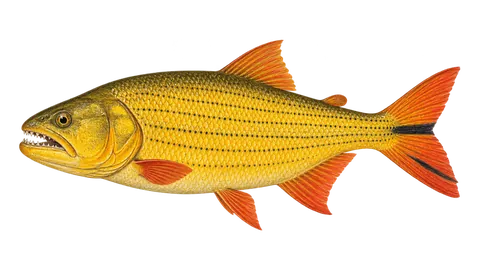
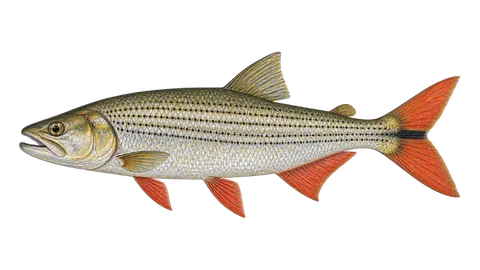
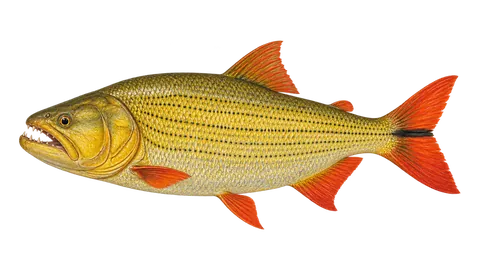
The golden dorado of the Magdalena basin and Colombian Caribbean rivers: silvery, with a red tail cut by a black band. Vulnerable in Colombia, it has a minimum size of 35 cm.
Also called: dourado-do-magdalena, picuda, rubio, dorada


Choose the place and the species. The index, from 0 to 100, combines weather, sun, moon and tide with each fish's habits. Up to 28 days, with each day's confidence.
Reading the weather across 3 global models and 31 simulations…
Each card shows the day's index (0 to 100) and, below it, a strip with the index for each hour, from 0h to 23h. from poor to excellent.
Choose how many fishing days. We compare each stretch by its average index, discount days with a warning or closed season, and show the 3 best.
Line: the middle value of 31 simulations of the American GEFS model. Band: where 8 out of 10 fall. Narrow, firm trend; wide, high uncertainty.
A relative of the Brazilian dourado, but smaller: FishBase records 46.5 cm standard length and 2.3 kg, plus an 80 cm fish caught on a rod in the Nare River, a tributary of the Magdalena. It lives in rivers of the Magdalena-Cauca basin (such as La Miel, Samaná, Sogamoso, San Jorge and Cesar) and in Colombian Caribbean rivers (Sinú and Ranchería), plus the Santiago River in Ecuador. It preys on fish in flowing water. In Puerto Berrío, on the Magdalena, the biggest catches came in January and February, in the year's first low-water period. It is on the Colombian red list as Vulnerable, and in the Ranchería basin as Endangered. In sport fishing it hits spoons, jigs and mid-water lures in rapids, leaping like a dourado.
Elongated, silvery body, scales with small reddish spots, red tail with a horizontal black band that extends a little onto the peduncle, reddish anal fin and a horizontal black band behind the eye, over the gill cover. Has 68 to 79 lateral line scales. It is the only Salminus in the region; in Colombia, the name dorada is also used for another fish, the sardinata (Brycon moorei).
Does not occur in Brazil. Colombia: Magdalena-Cauca basin and Caribbean rivers (Sinú and Ranchería); Ecuador: Santiago River basin. FishBase considers the record in Peru a misidentification.
Habitat: Flowing-water rivers, rapids and pools, in lowland and piedmont areas.
Low water, mainly January and February on the Magdalena; in high water, muddy water scatters the fish.
Daytime, with peaks at dawn and dusk. Hunts by day, with peaks early and late in the afternoon in the rapids.
Little relevance in the region.
Stable weather helps.
Small effect.
Heavy rain muddies the river and shuts down fishing.
Low, clear water: the best scenario.
Moderate: approach the rapids with care.
Little effect.
Mid-water and surface, in the rapids and pool outflows.
lures
natural baits
accessories
Cast above the rapid and retrieve the lure across the fast water. Keep the line tight during the jumps.
Summary of the regulations we found, with the source for each. Rules change; before keeping or transporting fish, check with the state environmental agency.
Conservation: In Colombia, the Libro Rojo (2012) classifies it as Vulnerable (VU) and, in the Ranchería River basin, as Endangered (EN). Prefer to release it.
In the Magdalena, Cauca and San Jorge basin, picuda (Salminus affinis) may only be kept at 35 cm standard length.
Source: Resolución INDERENA nº 025/1971 (AUNAP minimum size table in force)
A strong, jumping fish: remove the hook quickly, support the body and release it facing the current.
White, tasty flesh. Respect the minimum size and, given the species' status, prefer to release it.
Length-weight relationship W = a·Lb (a = 0.00912, b = 3.09; FishBase). It's an average: a fat or lean fish can vary by 10% to 20%.
estimated weight
—
The season weights (months), the time of day and the sensitivities (cold, pressure, moon, wind, rain, tide, strong light, murky water and noise) are the app's editorial estimates, based on the literature below and on the field experience of anglers and guides. They are not official data nor a measurement made for this species, and they may vary by region and year. Closed seasons and legal rules appear in the rules section, with the norm and a link.
The weather comes from three independent global models, cross-checked hour by hour: when they agree, confidence goes up; when they diverge, the band between them shows on the chart. Beyond 16 days, we use the GEFS ensemble of 31 simulations: if 20 of the 31 predict rain, the chance of rain is 65%. Sun and moon are calculated astronomically, with no uncertainty.
The index adds up, weighted for each species: time of day (species curve anchored to real sunrise and sunset), moon (transits, rise and set, phase), pressure (3 h trend and 24 h swing), water temperature (in rivers, estimated from air temperature; at sea, estimated by an ocean model), wind, rain, clouds, tide and the month in the species' cycle.
Accuracy measured in the reference project (4 regions, 93 days, forecast vs. observed): maximum temperature is off by 0.6 °C on average the next day and 1.7 °C at 7 days; rain of 5 mm or more is detected 76% of the time the next day and 57% at 7 days. Detection isn't everything: the false alarm rate isn't published here yet, and 93 days in 4 regions is still a small sample. We now also measure every day, at the app's destinations:
Your location is saved only on this device and feeds the forecast, the map and the "today" on the home page.