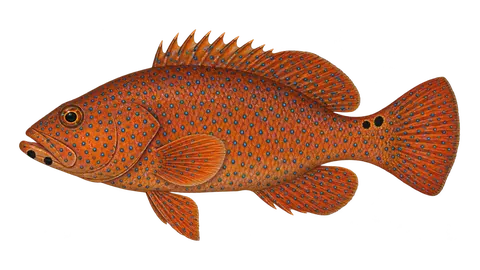
The most common reef grouper in the Caribbean, with reddish-orange spots, hides among reefs and rocks at 1 to 100 m. It takes natural bait and jigs, and has closed seasons in Puerto Rico (December to February) and Mexico (February and March).
Also called: garoupa-pintada, garoupa, red hind, koon, lucky grouper
Choose the place and the species. The index, from 0 to 100, combines weather, sun, moon and tide with each fish's habits. Up to 28 days, with each day's confidence.
location
Sample location: choose yours to see the forecast for where you fish.
period
Reading the weather across 3 global models and 31 simulations…
0—
index Score from 0 to 100 for the fishing conditions of each hour. It reads weather, sun, moon, tide and the species' habits. It doesn't promise fish: it tells you when the water is on your side. 0–24 poor · 25–44 fair · 45–64 good · 65–84 very good · 85–100 excellent.
today
—
confidence —
confidence How much you can trust the weather forecast for the day. It drops with distance and when the models disagree. It is not the chance of catching fish.
models and trend Up to 16 days, three global weather models (the European ECMWF, the American GFS and a high-resolution blend) read hour by hour; when they disagree, the light band on the chart widens. Beyond that it's a trend: 31 runs of the American GEFS model. Confirm when it's 1 week out.
window Consecutive hours with the index near the day's peak and no danger alert. It is the time to have the bait in the water.
hour by hour
slide your finger or mouse over the chart to see each hour
see hour-by-hour table
why this index at —?
next 7 days
choose the day
chart: bar height = day's index · line = variation between models · striped = trend · fainter = less confidence
Each card shows the day's index (0 to 100) and, below it, a strip with the index for each hour, from 0h to 23h. from poor to excellent.
4-week calendar
the fishing month at a glance
plan a trip
what's the best window for the crew?
Choose how many fishing days. We compare each stretch by its average index, discount days with a warning or closed season, and show the 3 best.
trend for the coming weeks
Line: the middle value of 31 simulations of the American GEFS model. Band: where 8 out of 10 fall. Narrow, firm trend; wide, high uncertainty.
the species
everything about the red hind
overview
who is the red hind
The red hind (garoupa-pintada) is the most common grouper in the Antilles and one of the most important in Caribbean landings, by number and by weight. It lives on shallow reefs and rock bottoms, from 1 to at least 100 m, and occurs from North Carolina (USA) to Paraíba, Brazil. It is solitary and territorial: males patrol an area with 1 to 5 females and defend it. It is a hermaphrodite: some fish change from female to male at around 28 cm, and most fish above 40 cm are male. It spawns almost only in spawning aggregations, and Puerto Rico closes fishing for the species from December to February. It eats crabs, shrimp, lobsters, reef fish and octopus. FishBase gives up to 76 cm, with the common size around 40 cm, and calls it an excellent table fish, easy to catch and to spear.
fun facts
Some fish change from female to male at around 28 cm; most fish above 40 cm are male.
It spawns almost only in the spawning aggregations, and Puerto Rico closes the banks where they form.
Divers can easily approach it, which makes it vulnerable to spearfishing.
how to recognize it
identification
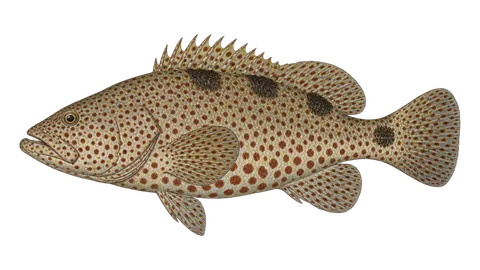
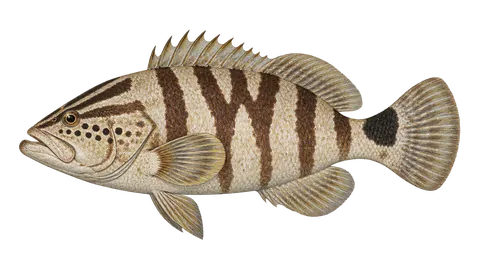
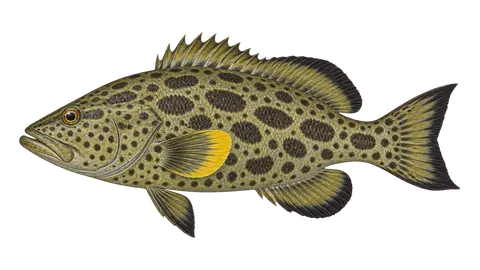
Robust body, greenish gray or light brown on top and white below, covered with widely spaced reddish-orange to brown spots on the head, body and fins, with five faint diagonal bars made of darker spots. No saddle-shaped spot on the caudal peduncle or at the base of the dorsal fin, and the preopercle is evenly serrated. The rock hind (E. adscensionis) has dark saddle-shaped spots; the jabu (Cephalopholis fulva) is smaller and has blue spots.
In Brazil, FishBase places the southern limit of the species in Paraíba, on reefs and hard bottoms of the Northeast. Beyond that, it ranges from North Carolina (USA) to the Antilles, the Gulf of Mexico and the Caribbean.
Habitat: Coral and rock reefs, from 1 to 100 m, in holes and ledges; territorial adults, gathering in aggregations only during the spawning season.
coast
Northeast Coastcoastalshelf
calendar and clock
when to fish
best season
time of year
JanFebSeaAprMayJunJulAugSepOctNovDec
Fished all year on the reef, but there is a closed season in Puerto Rico (December to February, the spawning aggregation season) and in Mexican waters of the Gulf and Caribbean (February and March).
best time of day
Daytime, with peaks at dawn and dusk. Ambush hunter by day, most active at dawn and late afternoon.
weather, water and behavior
what affects the red hind
sensitivity The little bars show how much each factor affects this species. Five full: it feels it a lot.
cold and cold fronts
Tropical reef fish; water below about 22 °C reduces activity.
atmospheric pressure
A churned sea after a cold front shuts down bottom fishing.
moon
Little-known effect; the moon matters for the winter spawning aggregation.
rain
Little effect at depth.
water level
Not applicable at sea.
noise
Fixed territory: the anchor and the hull striking the reef drive it away.
wind
Strong wind makes it hard to hold position over the spot.
tide
Moderate current activates feeding at the reef edge.
depth
From 1 to 100 m; FishBase gives no more common range.
6000 to 8000 reel or 300 to 400 casting reel, with strong drag
line
braid 40 to 65 lb
leader
fluorocarbon 60 to 80 lb, 1 m
hook
circle 4/0 to 7/0
lures
jig, 60 to 150 g
jig head with large shad next to the rock
natural baits
caranguejo
shrimp
lula
sardine or small fish
accessories
descender (fish descender)
running sinker
long-nose pliers
luvas
tip from an angler
Natural bait held still beside the hole with the drag almost locked: when you hook it, lift the fish in the first few meters, or it goes back into the hole and cuts the line on the rock.
what the law says
rules for the red hind
Summary of the regulations we found, with the source for each. Rules change; before keeping or transporting fish, check with the state environmental agency. Conservation: Not on the Brazilian national list (Portaria GM/MMA nº 1.667/2026). In Brazil it only reaches the Northeast coast, and we found no specific Brazilian federal rule for it.
Puerto Rico (federal waters): closed from 1/12 to the end of February
fishing and possession banned from 1/12 to the last day of February01/12 to 28/02
In federal waters around Puerto Rico, west of 67°10′ W, it is prohibited to fish for or have aboard red hind (the garoupa-pintada) from December 1 to the last day of February, and the Abrir La Sierra and Tourmaline banks, spawning aggregation areas for the species, are closed to fishing in the same period. Fish caught and landed before the closure begins may be kept.
Puerto Rico: closed season for the cabrilla grouper from 1/12 to 28/02
capture prohibited from 1/12 to 28/0201/12 to 28/02confirm with the agency
In Puerto Rican waters, it is an offense to violate the closed season for the cabrilla grouper (Epinephelus guttatus), from December 1 to February 28 each year or in the period set by the Secretary. Commercial fishers, sellers and fish markets have until December 7 to sell off their stock. The text consulted is the 2010 version; confirm with DRNA whether a more recent version exists.
Puerto Rico (federal waters): up to 5 per person per day
5 per person per day (groupers, snappers and wrasses combined); 15 per boat with 3 or more people
In federal waters around Puerto Rico, a recreational angler may keep at most 5 fish per day, counting groupers, snappers and wrasses combined (up to 15 per boat when there are 3 or more people aboard). The red hind counts within the groupers and has no separate limit.
Mexico: grouper closed season from Feb 1 to Mar 31
catch prohibited from Feb 1 to Mar 3101/02 to 31/03
In Mexico, capture of all grouper species, a group in which NOM-065 includes the red grouper or cabrilla roja (Epinephelus guttatus), is banned from February 1 to March 31 in federal waters of the Gulf of Mexico and the Caribbean off Tabasco, Campeche, Yucatán and Quintana Roo, up to the Belize border. During that period, using bottom longline is also banned.
Mexico: up to 3 kg of groupers per day for domestic-consumption fishing
3 kg per angler per day, no sale
In federal waters of the Gulf of Mexico and the Caribbean, domestic-consumption fishing for groupers and associated species, a group that lists the red grouper (Epinephelus guttatus), allows at most 3 kg per angler per day. The fish is only for the angler's and family's consumption and may not be sold; only equipment operated by the angler alone is allowed. Gillnets and spearguns (harpoon) are prohibited.
Mexico: up to 5 per species and 10 saltwater fish per day
5 specimens of the species per angler per day, within the limit of 10 saltwater fish
In recreational fishing in Mexican federal waters, each angler may keep up to 10 marine fish per day, no more than 5 of the same species. The red hind (garoupa-pintada) has no limit of its own in the rule. Fish over the limit go back into the water alive, and a retained fish may not be sold. Anyone fishing from a boat needs a permit from Conapesca.
catch and release Releasing the fish alive, quickly and with a wet hand. During a closed season it isn't always allowed: what the regulation says applies.
If it comes from more than 15 to 20 m it may have barotrauma: release it with a descender. Support the belly and do not hold it only by the mouth. In Puerto Rico, from December to February, every fish caught must go back into the water.
in the kitchen
White, highly prized flesh, called an excellent table fish by FishBase. FishBase records ciguatera cases: on Caribbean reefs, follow local guidance on size and area before eating.
calculator
how much it weighs without taking it out of the water
Length-weight relationship W = a·Lb (a = 0.01148, b = 3.04; FishBase (relação peso-comprimento bayesiana, estimativa da própria espécie)). It's an average: a fat or lean fish can vary by 10% to 20%.
estimated weight
—
sources and references
The seasonal weights (months), timing and sensitivities (cold, pressure, moon, wind, rain, tide, strong light, murky water and noise) are the app's editorial estimates, drawn from the literature below and from the field experience of anglers and guides. They are not official data nor a measurement made for this species, and they may vary by region and year. Closed seasons and legal rules appear in the rules section, with the norm and a link. Common sizes and weights are ranges around the common length reported by FishBase, with weight calculated from the length-weight relationship. The maximum weight of 25 kg that FishBase publishes for 76 cm is much higher than the length-weight relationship predicts for that size (about 6 kg); treat it with caution.
scientificFishBase: nomes populares de Epinephelus guttatusNames by country and language. Garoupa and garoupa-pintada appear as Portuguese names; the app adopts garoupa-pintada to separate the species from the true grouper (Epinephelus marginatus).
The weather comes from three independent global models, cross-checked hour by hour: when they agree, confidence goes up; when they diverge, the band between them shows on the chart. Beyond 16 days, we use the GEFS ensemble of 31 simulations: if 20 of the 31 predict rain, the chance of rain is 65%. Sun and moon are calculated astronomically, with no uncertainty.
The index adds up, weighted for each species: time of day (species curve anchored to real sunrise and sunset), moon (transits, rise and set, phase), pressure (3 h trend and 24 h swing), water temperature (in rivers, estimated from air temperature; at sea, estimated by an ocean model), wind, rain, clouds, tide and the month in the species' cycle.
Accuracy measured in the reference project (4 regions, 93 days, forecast vs. observed): maximum temperature is off by 0.6 °C on average the next day and 1.7 °C at 7 days; rain of 5 mm or more is detected 76% of the time the next day and 57% at 7 days. Detection isn't everything: the false alarm rate isn't published here yet, and 93 days in 4 regions is still a small sample. We now also measure every day, at the app's destinations:
where are you going fishing?
Your location is saved only on this device and feeds the forecast, the map and the "today" on the home page.