

coney
Cephalopholis fulva
A reef grouper (garoupinha) covered with blue spots, common on the rocky shores and corals of the Northeast. It changes color, lives in harems and takes small natural bait.
- common size
- 20–30 cm
- maximum
- 44 cm
- common weight
- 0.1–0.5 kg
- record/max.
- 1.2 kg
- depth
- 1–150 m
- ideal water
- 24–28 °C
how to recognize it
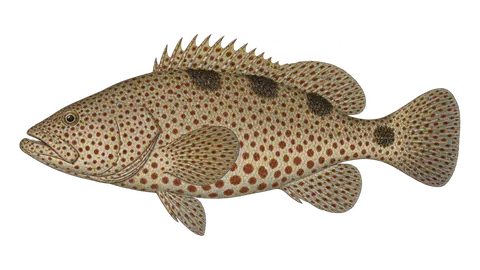
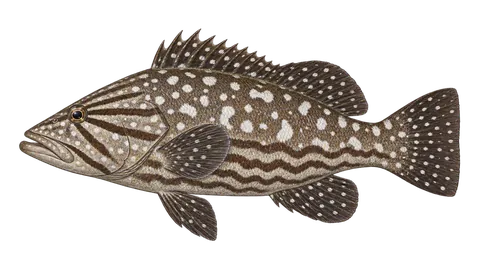
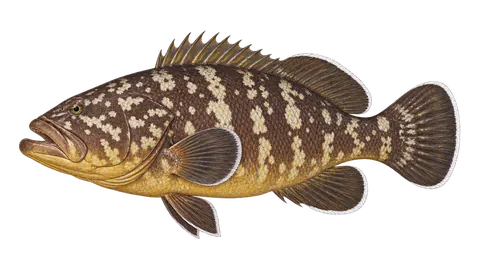
Body red, orange or brownish, sometimes bright yellow or two-tone, covered in blue dots with black edges. Two black spots at the top of the tail peduncle and two at the tip of the chin. Tail with a rounded edge and angled tips. The rock hind (garoupa-gato) has red spots on a pale background; the true grouper (garoupa-verdadeira) and the badejo-mira are much larger and lack blue dots.
Also called: jabu, piraúna, catuá, garoupinha, garoupa-pintada-da-bahia, coney
don't confuse with:
where found
open on the large mapWhere to look: Coral reefs and rocky shores of clear water, with holes, ledges and crevices.
In Brazil, from the Northeast to the South, common on reefs and rocky shores of the Northeast and Bahia.
coast
states
Ceará, Rio Grande do Norte, Paraíba, Pernambuco, Alagoas, Sergipe, Bahia, Espírito Santo, Rio de Janeiro, São Paulo, Paraná, Santa Catarina
when to fish
next 7 days
Loading the next 7 days…
best season
Fished year-round on the Northeast reefs.
best time of day
Dawn and dusk. Most active at dawn and dusk; by day it usually stays in its hole.
what affects the coney
cold and cold fronts
A tropical reef fish; cold water reduces its activity.
atmospheric pressure
A churned sea after a cold front makes the rocky shore difficult.
moon
Small effect.
rain
Minor; a storm on the rocky shore is a danger.
water level
Surf muddies the reef water for days.
noise
Wary: footsteps on the rocks and a motor in the shallows make it hide in its hole.
wind
A strong sea wind makes the rocky coast dangerous.
tide
Moving tide brings food to the mouth of the hole.
depth
From the shallows down to about 40 m for most catches.
how to fish
lures
- small jig head with shad
- jig 20 to 40 g
natural baits
- shrimp
- fish or squid strip
- piece of sardine
tip from an angler
A small bait right at the mouth of the hole: the jabu bites and goes back in, so hold firm on the first pull.
- rod
- shore: 7' to 9', 15 to 30 lb; boat: 6', 12 to 25 lb
- spinning / baitcasting reel
- spinning reel 3000 to 4000
- line
- braid 20 to 30 lb
- leader
- fluorocarbon 30 to 40 lb, 50 cm
- hook
- hook 1/0 to 2/0 or circle 1/0
accessories
- small sinker
- alicate
catch and release
A shallow hole-dwelling fish: remove the hook quickly and release it near the rock. If it came from deeper than 20 m, use a descender.
rules for the coney
Rules change; before keeping or transporting fish, check with the state environmental agency.
Mexico: grouper closed season from Feb 1 to Mar 31
catch prohibited from Feb 1 to Mar 3101/02 to 31/03 details
In Mexico, catching all grouper species, a group in which the official standard includes the jabu (cherna cabrilla), is prohibited from February 1 to March 31 in federal waters of the Gulf of Mexico and the Caribbean off Tabasco, Campeche, Yucatán and Quintana Roo, up to the Belize border. Bottom longlines are also prohibited during the period.
Puerto Rico (federal waters): up to 5 per person per day
5 per person per day; 15 per boat with 3 or more people details
In federal waters around Puerto Rico, beyond 9 miles from the coast, the recreational angler may keep a maximum of 5 fish per day from groupers, snappers and parrotfish combined (up to 15 per boat when there are 3 or more people aboard). The limit does not apply to anyone with a commercial license from Puerto Rico or the U.S. Virgin Islands.
Conservation: Not on the national list (Portaria GM/MMA 1.667/2026). We found no specific federal rule for this species.
how much it weighs without taking it out of the water
estimated weight
—
how we calculate
Length-weight relationship W = a·Lb (a = 0.01175, b = 3.04; FishBase (estimativa bayesiana, comprimento total)). It's an average: a fat or lean fish can vary by 10% to 20%.
more about the coney
The jabu is a small grouper of the western Atlantic, from South Carolina and Bermuda to southern Brazil. It lives on coral reefs and rocky shores of clear water, usually down to 40 m, and spends the day in holes and under ledges. It eats small fish and crustaceans, and sometimes follows morays to catch the prey they flush out. It is born female and turns male at about 20 cm; each male defends a territory with several females and spawns with them at sunset. On the central coast of Brazil it reaches 43 cm and 24 years of age. It is common in rocky-shore and boat fishing with small natural bait.
Family: Epinephelidae · predator
fun facts
- Born female, turns male at about 20 cm; each male has a harem.
- Sometimes hunts together with morays, taking advantage of the prey they flush out of the holes.
in the kitchen
White, delicate flesh, good fried or in moqueca. Ciguatera has been recorded in the Caribbean.
similar species
sources and references (9)
The season weights (months), the time of day and the sensitivities (cold, pressure, moon, wind, rain, tide, strong light, murky water and noise) are the app's editorial estimates, based on the literature below and on the field experience of anglers and guides. They are not official data nor a measurement made for this species, and they may vary by region and year. Closed seasons and legal rules appear in the rules section, with the norm and a link.
- scientific FishBase — Cephalopholis fulva (ficha da espécie)Names, distribution, biology, length-weight relationship, country list and references. Page checked October 13, 2026. Size and age for the central coast of Brazil (16° to 21°30' S) come from the population traits section of the profile. FishBase also lists Uruguay, with a marginal record that we did not include. The maximum weight was estimated from the length-weight relationship.
- official Portaria GM/MMA nº 1.667, de 27 de abril de 2026 — Lista Nacional Oficial de Espécies da Fauna Ameaçadas de Extinção (peixes e invertebrados aquáticos)Most recent national list. The species is not on it (search by scientific name in the text published in the DOU, checked on October 13, 2026).
- official ICMBio/SALVE — Ficha de Cephalopholis fulva (avaliação nacional do risco de extinção)National assessment by ICMBio, published in 2024. DOI verified on Crossref.
- scientific IUCN Red List — Cephalopholis fulva (avaliação global: Pouco Preocupante, LC, 22/03/2018)Global assessment. Link given on the FishBase entry (Red List, version 2025-2).
- scientific Heemstra, P. C.; Randall, J. E. (1993). FAO species catalogue. Vol. 16. Groupers of the world (family Serranidae, subfamily Epinephelinae). FAO Fisheries Synopsis 125(16). Roma: FAO.
- scientific Carpenter, K. E. (org.) (2002). The living marine resources of the Western Central Atlantic. Vol. 2: Bony fishes part 1 (Acipenseridae to Grammatidae). FAO Species Identification Guide for Fishery Purposes. Roma: FAO.Chapter Serranidae (Heemstra, P. C.; Anderson, W. D.; Lobel, P. S.).
- official México — NOM-065-SAG/PESC-2014, para regular o aproveitamento das espécies de mero e espécies associadas no Golfo do México e no Mar do Caribe (DOF de 03/07/2015)Text published in the Official Journal of the Federation, in a copy from the Secretaría de Economía. Item 4.1 (list of grouper species), 4.8 (minimum size of red grouper) and 4.13 (fishing for domestic consumption).
- official México — Acordo que modifica a veda de todas as espécies de mero no Golfo do México e no Caribe (DOF de 03/03/2017; acordo original de 14/02/2007)Sets the closed season from February 1 to March 31, since 2018, in federal waters off Tabasco, Campeche, Yucatán and Quintana Roo. We found no later amendment; confirm each season with Conapesca.
- official Code of Federal Regulations, 50 CFR Part 622, Subpart S — Regulations specific to the Puerto Rico Management Area (NOAA Fisheries, EUA)Consolidated text in the eCFR, checked October 13, 2026: §622.438 (prohibited species), §622.439 (area and time closures) and §622.444 (quotas). It applies in federal waters, beyond 9 miles from the coast.