

- common size
- 35–55 cm
- maximum
- 70 cm
- common weight
- 0.6–2.5 kg
- record/max.
- 4.1 kg
- depth
- 1–35 m
- ideal water
- 15–21 °C

the right time
to be on the water
Choose the place and the species. The index, from 0 to 100, combines weather, sun, moon and tide with each fish's habits. Up to 28 days, with each day's confidence.
Loading the forecast…
—
Looking for alerts within 30 km…
Looking for what anglers have logged near here…
what you need to fish herelicense, certification and boat documents
fish likely at this spot
Tap a fish to see its forecast.
hour by hour
slide your finger or mouse over the chart to see each hoursee hour-by-hour table
why this index at —?
choose the day
the fishing month at a glance
what's the best window for the crew?
Choose how many fishing days. We compare each stretch by its average index, discount days with a warning or closed season, and show the 3 best.
trend for the coming weeks
Line: the middle value of 31 simulations of the American GEFS model. Band: where 8 out of 10 fall. Narrow, firm trend; wide, high uncertainty.
everything about the chilean flounder
how to recognize it
Flattened fish with both eyes on the left side, which faces up: brown, with light and dark blotches that change with the bottom; underside white. Large mouth with strong teeth. Short pectoral fins (about half the head length on the eyed side) and a double-truncate tail. Long dorsal fin with 72 to 77 rays. It is the flounder found on the coast of Peru and Chile; Brazilian flounders are other species of the same genus.
Also called: linguado-do-pacífico, linguado-fino
don't confuse with:
where found
open on the large mapWhere to look: Sand and mud bottoms of the shallow shelf, beaches, bays and channels between sandbanks.
Does not occur in Brazil. Southeastern Pacific, from Ecuador to Chile.
when to fish
best season
On the coast of Peru and central Chile, beach fishing usually produces more in the warmer months, from spring to late summer.
best time of day
Daytime, with peaks at dawn and dusk. Ambushes prey during the day, with more activity at dawn and late afternoon.
what affects the chilean flounder
cold and cold fronts
Strong cold upwelling water reduces activity in the shallows.
atmospheric pressure
Rough sea hurts beach and boat fishing.
moon
Little effect.
rain
It hardly ever rains on the Peruvian coast; in Chile, muddy river water hurts the fishing.
water level
Not applicable at sea.
noise
Moderate in shallow, clear water.
wind
Calm to moderate sea is ideal for working bottom baits.
tide
The rising tide on beaches and channels brings the flounder into the shallows.
depth
1 to 15 m for beach and boat fishing.
how to fish
lures
- 10 to 30 g shad on a jig head, worked on the bottom
natural baits
- small live fish (pejerrey, anchoveta)
- muy-muy
- squid strips
tip from an angler
With live bait, wait: the flounder grabs the bait and swallows it slowly. Set the hook only when the line runs tight.
- rod
- beach: 3.6 to 4.2 m, 60 to 150 g; boat: 6'6" to 7'0", 12 to 25 lb
- spinning / baitcasting reel
- spinning reel 4000 to 6000
- line
- braid 15 to 30 lb or monofilament 0.30 to 0.35 mm
- leader
- fluorocarbon 0.40 to 0.50 mm
- hook
- circle or wide gap 1/0 to 4/0
accessories
- sinker, 40 to 120 g
- large landing net
catch and release
Hold it supporting the whole body, without squeezing the belly, remove the hook with pliers and release it belly down, letting it sink on its own.
rules for the chilean flounder
Rules change; before keeping or transporting fish, check with the state environmental agency.
Peru: minimum size 38 cm
38 cm (total length) details
In Peru the minimum catch size for flounder is 38 cm total length, with a 25% juvenile tolerance. It is prohibited to extract, transport and sell below the size; amateur anglers must release the smaller ones.
Source: Resolución Ministerial nº 00328-2022-PRODUCE (Peru), which amends Annex I of R.M. nº 209-2001-PE
Conservation: Old global assessment. Peru has a minimum size. For Chile, we have not confirmed a minimum size in force for recreational fishing.
how much it weighs without taking it out of the water
estimated weight
—
how we calculate
Length-weight relationship W = a·Lb (a = 0.00631, b = 3.15; FishBase (estimativa bayesiana com dados da espécie e do gênero, comprimento total); peso máximo calculado por esta relação). It's an average: a fat or lean fish can vary by 10% to 20%.
more about the chilean flounder
The Pacific flounder is a paralichthyid, the family of left-eyed flounders, from Ecuador to Chile. It lives on soft sand and mud bottoms of the shallow shelf, from 1 to 35 m, and ambushes small fish and crustaceans while buried and camouflaged. It reaches 70 cm. In Peru it is one of the most expensive and sought-after fish, the basis of classic ceviche, and it is caught with nets, lines and spearfishing. Amateur anglers find it in beach and boat fishing, using live bait and artificials worked on the bottom.
Family: Paralichthyidae · predator
fun facts
- It hatches like a normal fish, with one eye on each side; in the larval stage, the right eye migrates to the left side.
- It changes the pattern of spots on the upper side to match the bottom.
in the kitchen
White, firm and delicate flesh, among the most prized in Peru: ceviche, tiradito, fried and grilled.
similar species
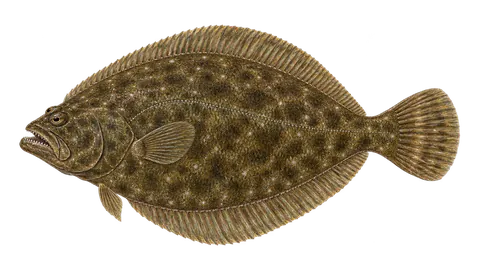
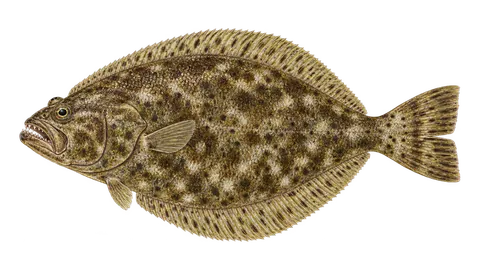
sources and references (4)
The season weights (months), the time of day and the sensitivities (cold, pressure, moon, wind, rain, tide, strong light, murky water and noise) are the app's editorial estimates, based on the literature below and on the field experience of anglers and guides. They are not official data nor a measurement made for this species, and they may vary by region and year. Closed seasons and legal rules appear in the rules section, with the norm and a link.
- scientific FishBase — Paralichthys adspersus (ficha da espécie)Names, distribution, biology, length-weight relationship, country list and references. Page checked on Oct 13, 2026.
- scientific IUCN Red List — Paralichthys adspersus (avaliação global: Pouco Preocupante, LC, 02/05/2008)Global assessment. Link given on the FishBase entry (Red List, version 2025-2).
- official Resolução Ministerial nº 00328-2022-PRODUCE (Peru) — tamanho mínimo de captura do lenguadoPublished in El Peruano on 02/10/2022: 38 cm total length and 25% tolerance. The previous value was 50 cm (R.M. nº 209-2001-PE).
- official Ministério da Produção do Peru (PRODUCE) — Pesca y Consumo Responsable: tallas mínimas de capturaOfficial minimum size table for consumers, checked on 13/10/2026. The page does not indicate the rule behind each value.
how we calculatewhere each number comes from
The weather comes from three independent global models, cross-checked hour by hour: when they agree, confidence goes up; when they diverge, the band between them shows on the chart. Beyond 16 days, we use the GEFS ensemble of 31 simulations: if 20 of the 31 predict rain, the chance of rain is 65%. Sun and moon are calculated astronomically, with no uncertainty.
The index adds up, weighted for each species: time of day (species curve anchored to real sunrise and sunset), moon (transits, rise and set, phase), pressure (3 h trend and 24 h swing), water temperature (in rivers, estimated from air temperature; at sea, estimated by an ocean model), wind, rain, clouds, tide and the month in the species' cycle.
sources for this lookup
how accurate the forecast is
Accuracy measured in the reference project (4 regions, 93 days, forecast vs. observed): maximum temperature is off by 0.6 °C on average the next day and 1.7 °C at 7 days; rain of 5 mm or more is detected 76% of the time the next day and 57% at 7 days. Detection isn't everything: the false alarm rate isn't published here yet, and 93 days in 4 regions is still a small sample. We now also measure every day, at the app's destinations: