

- common size
- 40–80 cm
- maximum
- 170 cm
- common weight
- 0.8–6.5 kg
- record/max.
- 51.3 kg
- depth
- 0–30 m
- ideal water
- 18–28 °C

the right time
to be on the water
Choose the place and the species. The index, from 0 to 100, combines weather, sun, moon and tide with each fish's habits. Up to 28 days, with each day's confidence.
Loading the forecast…
—
Looking for alerts within 30 km…
Looking for what anglers have logged near here…
what you need to fish herelicense, certification and boat documents
fish likely at this spot
Tap a fish to see its forecast.
hour by hour
slide your finger or mouse over the chart to see each hoursee hour-by-hour table
why this index at —?
choose the day
the fishing month at a glance
what's the best window for the crew?
Choose how many fishing days. We compare each stretch by its average index, discount days with a warning or closed season, and show the 3 best.
trend for the coming weeks
Line: the middle value of 31 simulations of the American GEFS model. Band: where 8 out of 10 fall. Narrow, firm trend; wide, high uncertainty.
everything about the black drum
how to recognize it
Tall, heavy body, silvery to very dark. Juveniles have four or five black vertical stripes on the flanks, which fade with growth. Pelvic and anal fins usually dark. The chin has five pores and 10 to 13 pairs of short barbels along the lower jaw, increasing toward the back: this is the surest clue. The miraguaia (P. courbina) of the South Atlantic has the same fringe of barbels; what separates the two is the fishing region.
Also called: miraguaia-negra, perombeba, black drum, big drum, banded drum
don't confuse with:
where found
open on the large mapWhere to look: Sand and mud bottoms in coastal waters, river mouths, channels and mangroves; juveniles stay in estuaries.
Western Atlantic: from Nova Scotia to Florida and northern Mexico. In Latin America it appears on the Mexican coast of the Gulf of Mexico and in Cuba.
when to fish
best season
Present all year in the Gulf of Mexico; the best months tend to be late winter and spring, when adults gather near inlets. The sources consulted do not detail the spawning season by region.
best time of day
Night and twilight. It tends to feed more at dusk and at night, near inlets and channels. Scientific sources do not detail the timing; the indication comes from bottom-fishing practice.
what affects the black drum
cold and cold fronts
A cold front slows activity in shallow channels; the fish drops back into deeper holes.
atmospheric pressure
A pressure drop ahead of the front usually produces a short spike in activity.
moon
Moderate effect; spring tides increase the current that brings food.
rain
It likes river-mouth areas; heavy rain that drops the salinity moves the school.
water level
Does not apply at sea; in estuaries, tide and river discharge decide where the fish feeds.
noise
Less wary than other croakers, but engine noise over the hole scares the school.
wind
Strong wind muddies the water and makes heavy casts hard; moderate wind does not get in the way.
tide
Fish the tidal current at inlets, channels and sandbar edges.
depth
Usually 2 to 15 m; larger adults use deeper holes and channels.
how to fish
natural baits
- cut crab or blue crab
- shrimp
- marisco
- piece of mullet or sardine
tip from an angler
Use a whole crab or shrimp bait on a circle hook and let the fish swallow it: the bite is heavy and drags the line.
- rod
- 7' to 9', heavy action, 20 to 50 lb
- spinning / baitcasting reel
- spinning reel 5000 to 8000 or high-profile baitcaster
- line
- braid 30 to 50 lb
- leader
- monofilament 40 to 60 lb, 40 to 60 cm
- hook
- circle 5/0 to 8/0
accessories
- sinker of 60 to 150 g
- luvas
- long-nose pliers
- large landing net
catch and release
Large spawners, above about 65 cm (size at first maturity), are worth more alive: bring them in from shallow water carefully, without lifting them by the eye or gill, and release them quickly.
rules for the black drum
Rules change; before keeping or transporting fish, check with the state environmental agency.
Brazil: IN MMA 53/2005 cites Pogonias cromis, but the Brazilian miraguaia is banned
65 cm (TL) under the old rule; catching the Brazilian species is bannedESRJSPPRSCRS details
Annex I of IN MMA 53/2005 lists the miraguaia under the scientific name Pogonias cromis, with a minimum size of 65 cm total length from Espírito Santo to Rio Grande do Sul. The miraguaia of the Brazilian coast is today treated as Pogonias courbina, Critically Endangered on the 2026 national list, and catching it is banned (see the miraguaia entry). The miraguaia-negra on this page, from the western North Atlantic, does not occur in Brazil.
Source: Instrução Normativa MMA nº 53/2005 (Annex I), MMA; Portaria GM/MMA nº 1.667/2026
Mexico: up to 5 per species and 10 saltwater fish per day
5 specimens of the species per angler per day, within the limit of 10 saltwater fish details
In recreational sport fishing in Mexican federal waters, each angler may keep up to 10 marine fish per day, no more than 5 of the same species. The miraguaia-negra (tambor negro) is not among the species with their own limit (billfish, sharks, giant pescada, tarpon, dorado, roosterfish and baya). Fish above the limit must be returned alive to the water, and sport-caught fish may not be sold. Fishing from a boat requires a permit, and sport fishing is banned in closed zones and seasons.
how much it weighs without taking it out of the water
estimated weight
—
how we calculate
Length-weight relationship W = a·Lb (a = 0.00912, b = 3.07; FishBase (relação peso-comprimento bayesiana, estimativa da própria espécie)). It's an average: a fat or lean fish can vary by 10% to 20%.
more about the black drum
The miraguaia-negra, the black drum of American anglers, is one of the largest croakers in the Atlantic: it reaches 170 cm and 51.3 kg and lives up to 43 years. It inhabits coastal waters with sand and mud bottoms, especially where large rivers discharge, and also mangroves, and juveniles enter estuaries. It eats crustaceans, mollusks and fish, which it crushes with strong throat teeth. It matures at about 65 cm. It occurs from Nova Scotia to Florida and northern Mexico; in Latin America it is a fish of the Gulf of Mexico and Cuba. In Brazil and Argentina its relative is the miraguaia (Pogonias courbina), which is Critically Endangered on the Brazilian national list.
Family: Sciaenidae · predator
fun facts
- Juveniles have four or five black vertical stripes on the flanks, which disappear with growth.
- It can live 43 years, according to FishBase, and the swim bladder has many interconnected appendages.
- The English name, drum, comes from the low sound the species makes with its swim bladder.
in the kitchen
Smaller fish are best for the table; large spawners are worth more released. FishBase gives no traditional recipes.
similar species
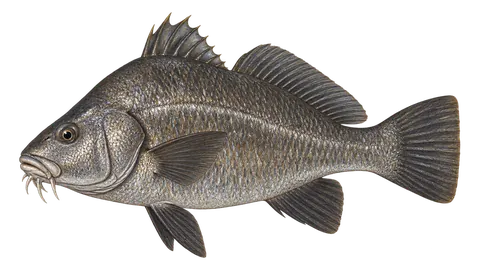
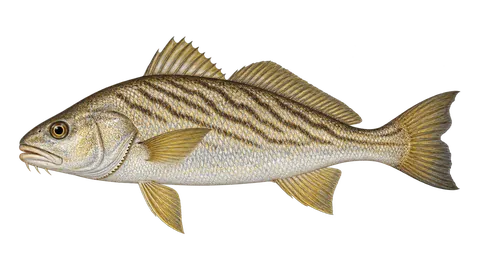
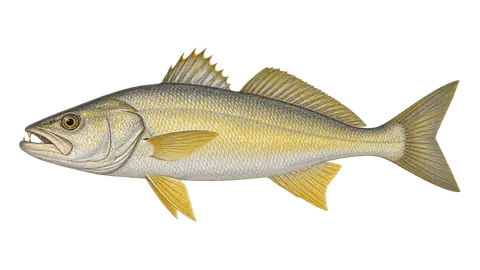

sources and references (4)
The season weights (months), the time of day and the sensitivities (cold, pressure, moon, wind, rain, tide, strong light, murky water and noise) are the app's editorial estimates, based on the literature below and on field experience from anglers and guides. They are not official data or measurements made for this species and may vary by region and year. Closed seasons and legal rules appear in the rules section, with the rule and link. The fishing depth range, the common size and the ideal water temperature range, when FishBase does not give a value, are editorial estimates based on the species' biology.
- scientific FishBase: Pogonias cromis (ficha da espécie)Size, length-weight, depth, habitat, distribution, biology, and IUCN status. Page checked on Oct 13, 2026.
- scientific FishBase: nomes populares de Pogonias cromisNames by country and language. The name miraguaia-negra was adopted on this page from the English (black drum) and Spanish (tambor negro), to separate the species from the Brazilian miraguaia (Pogonias courbina).
- official NOM-017-PESC-1994, Para regular las actividades de pesca deportivo-recreativa en las aguas de jurisdicción federal de los Estados Unidos Mexicanos (modificação de 2013)Daily limit of 10 marine fish and 5 per species (item 4.9.1), return of the excess (4.9.5), closed seasons (4.10) and sales ban (4.11). Text checked in the DOF on Oct 13, 2026.
- official Instrução Normativa MMA nº 53, de 22 de novembro de 2005: tamanhos mínimos de captura no Sudeste e SulAnnex I: miraguaia, cited as Pogonias cromis, 65 cm total length. The Brazilian species is today treated as Pogonias courbina.
how we calculatewhere each number comes from
The weather comes from three independent global models, cross-checked hour by hour: when they agree, confidence goes up; when they diverge, the band between them shows on the chart. Beyond 16 days, we use the GEFS ensemble of 31 simulations: if 20 of the 31 predict rain, the chance of rain is 65%. Sun and moon are calculated astronomically, with no uncertainty.
The index adds up, weighted for each species: time of day (species curve anchored to real sunrise and sunset), moon (transits, rise and set, phase), pressure (3 h trend and 24 h swing), water temperature (in rivers, estimated from air temperature; at sea, estimated by an ocean model), wind, rain, clouds, tide and the month in the species' cycle.
sources for this lookup
how accurate the forecast is
Accuracy measured in the reference project (4 regions, 93 days, forecast vs. observed): maximum temperature is off by 0.6 °C on average the next day and 1.7 °C at 7 days; rain of 5 mm or more is detected 76% of the time the next day and 57% at 7 days. Detection isn't everything: the false alarm rate isn't published here yet, and 93 days in 4 regions is still a small sample. We now also measure every day, at the app's destinations: