

white snook
Centropomus viridis · Centropomidae · predator
One of the largest snooks in the world, exceeding 1 m. It hunts at river mouths, coastal lagoons and beaches of the Pacific, from Mexico to Peru.
Also called: robalo-branco-do-pacífico, white snook, róbalo blanco

- common size
- 50–90 cm
- maximum
- 130 cm
- common weight
- 2–8 kg
- record/max.
- 21.5 kg
- depth
- 0.5–15 m
- ideal water
- 24–30 °C

the right time
to be on the water
Choose the place and the species. The index, from 0 to 100, combines weather, sun, moon and tide with each fish's habits. Up to 28 days, with each day's confidence.
Reading the weather across 3 global models and 31 simulations…
—
hour by hour
slide your finger or mouse over the chart to see each hoursee hour-by-hour table
why this index at —?
choose the day
Each card shows the day's index (0 to 100) and, below it, a strip with the index for each hour, from 0h to 23h. from poor to excellent.
the fishing month at a glance
what's the best window for the crew?
Choose how many fishing days. We compare each stretch by its average index, discount days with a warning or closed season, and show the 3 best.
trend for the coming weeks
Line: the middle value of 31 simulations of the American GEFS model. Band: where 8 out of 10 fall. Narrow, firm trend; wide, high uncertainty.
everything about the white snook
who is the white snook
Eastern Pacific snook, from Baja California and the Gulf of California to Peru, including the Galápagos. It reaches 1.3 m and over 20 kg, comparable in size to the common snook. It lives in coastal lagoons, mangroves, estuaries and the surf near river mouths, where it ambushes mullet, sardines and shrimp carried by the current. Like Brazilian snooks, it is most active on a running tide, at dawn, dusk and at night. It is fished from beaches, rocks and boats with mid-water lures, poppers and live bait. It is also being studied for farming in Mexico. It shares the same habitats as the black snook of the Pacific.
fun facts
- Snooks (Centropomus) live on both sides of the Americas; the white and black snooks of the Pacific are close relatives of the common snook.
- In Mexico the species is being studied for cage farming.
identification
Elongated, silvery body, greenish to olive back, dark, well-marked lateral line running to the tip of the tail. Head with a concave profile, large mouth and projecting lower jaw. The Pacific black snook has a dark blue-grey back and charcoal fins; the white snook is paler and silvery.
where found
Does not occur in Brazil. Eastern Pacific, from Baja California and the Gulf of California (Mexico) to Peru, including the Galápagos: coastal lagoons, estuaries and beaches of Mexico, Central America, Colombia and Ecuador.
Habitat: River and lagoon mouths, mangrove estuaries, surf near sandbars and rocky points.
famous destinations
when to fish
best season
Along the Pacific coast of Mexico and Central America, the rainy season (June to October) brings river water and bait to the sandbars and usually concentrates snook at the mouths. Lagoons are fished all year.
best time of day
Dawn and dusk. Hunts at dawn, dusk and night, especially on a running tide. By day it shelters in structure and deeper water.
what affects the white snook
sensitivity The little bars show how much each factor affects this species. Five full: it feels it a lot.
cold and cold fronts
Cold upwelling shuts down activity on the beaches.
atmospheric pressure
Stable pressure helps; a turning weather often gives a short peak.
moon
Full and new moons bring stronger tides and good nights for fishing at the mouths.
rain
Rain that opens the river mouth and brings bait helps; a very muddy flood gets in the way.
water level
An open river mouth running out to sea is the classic setup.
noise
Wary in the shallows: arrive quietly and cast from a distance.
wind
Moderate chop helps on the beach; strong wind muddies the surf.
tide
Essential: the ebb at the mouths and the first hours of the flood in the lagoons.
depth
Shallow at the mouths and beaches (0.5 to 3 m); deeper pools and channels by day.
how to fish
- rod
- 7' to 8', 15 to 30 lb; from the beach, 9' to 11'
- spinning / baitcasting reel
- spinning reel 4000 to 6000 or low-profile baitcasting reel
- line
- braid 30 to 50 lb
- leader
- fluorocarbon 40 to 60 lb, 1 to 1.5 m
- hook
- circle or wide gap 3/0 to 6/0 on live bait; reinforced treble hooks on artificials
lures
- mid-water minnow 11 to 14 cm
- jig head 1/2 to 1 oz with shad
- popper and zara at dawn
natural baits
- live mullet or sardine
- live shrimp
accessories
- boga-grip
- alicate
- headlamp with red light
tip from an angler
Cast along the line where river water meets sea water and let the bait drift down with the current. Snook wait at the edge of the muddy water.
rules for the white snook
Summary of the regulations we found, with the source for each. Rules change; before keeping or transporting fish, check with the state environmental agency.
We found no species-specific rule beyond the region's general rules.
catch and release
catch and release Releasing the fish alive, quickly and with a wet hand. During a closed season it isn't always allowed: what the regulation says applies.
Hold it by the mouth with a lip grip and support the belly. The gill cover edge is sharp: do not put your finger in the gills. Release it in the current.
in the kitchen
White, firm flesh, among the most prized on the Pacific coast; grilled, fried or as ceviche.
how much it weighs without taking it out of the water
Length-weight relationship W = a·Lb (a = 0.00776, b = 3.01; FishBase). It's an average: a fat or lean fish can vary by 10% to 20%.
estimated weight
—
sources and references
The season weights (months), the time of day and the sensitivities (cold, pressure, moon, wind, rain, tide, strong light, murky water and noise) are the app's editorial estimates, based on the literature below and on the field experience of anglers and guides. They are not official data nor a measurement made for this species, and they may vary by region and year. Closed seasons and legal rules appear in the rules section, with the norm and a link.
- scientific FishBase — Centropomus viridis (ficha da espécie)Names, distribution, biology, length-weight relationship, country list and references. Page checked on Oct 13, 2026.
- scientific IUCN Red List — Centropomus viridis (avaliação global: Pouco Preocupante, LC, 12/11/2018)Global assessment. Link given on the FishBase entry (Red List, version 2025-2).
- scientific Rivas, L. R. (1986). Systematic review of the perciform fishes of the genus Centropomus. Copeia 1986(3): 579-611.DOI checked in Crossref.
- scientific Fischer, W. et al. (eds.) (1995). Guía FAO para la identificación de especies para los fines de la pesca. Pacífico centro-oriental. Vol. II: Vertebrados, parte 1. Roma: FAO.Regional identification guide; volume II covers the families Centropomidae, Carangidae and Istiophoridae.
similar species
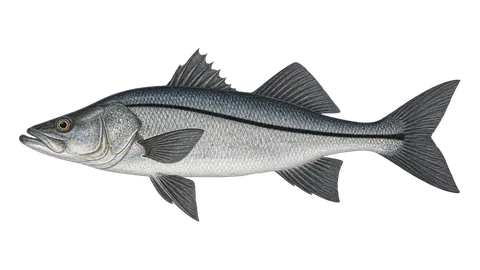
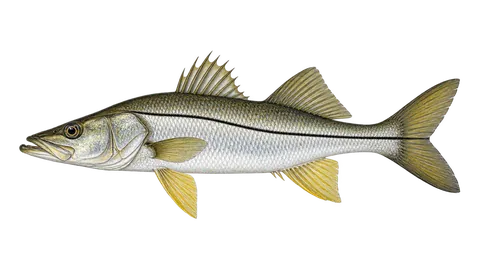
where each number comes from
The weather comes from three independent global models, cross-checked hour by hour: when they agree, confidence goes up; when they diverge, the band between them shows on the chart. Beyond 16 days, we use the GEFS ensemble of 31 simulations: if 20 of the 31 predict rain, the chance of rain is 65%. Sun and moon are calculated astronomically, with no uncertainty.
The index adds up, weighted for each species: time of day (species curve anchored to real sunrise and sunset), moon (transits, rise and set, phase), pressure (3 h trend and 24 h swing), water temperature (in rivers, estimated from air temperature; at sea, estimated by an ocean model), wind, rain, clouds, tide and the month in the species' cycle.
sources for this lookup
how accurate the forecast is
Accuracy measured in the reference project (4 regions, 93 days, forecast vs. observed): maximum temperature is off by 0.6 °C on average the next day and 1.7 °C at 7 days; rain of 5 mm or more is detected 76% of the time the next day and 57% at 7 days. Detection isn't everything: the false alarm rate isn't published here yet, and 93 days in 4 regions is still a small sample. We now also measure every day, at the app's destinations: