Skip to content
fishing forecast

atlantic salmon

Salmo salar · Salmonidae · predator

FreshwaterIUCN global: NT · near threatened

The Atlantic salmon of the North Atlantic, present in Patagonia as a landlocked fish in Argentine lakes and as an escapee from farms in southern Chile. In Argentina, release is mandatory.

Also called: salmão-do-atlântico, salmão, salmão encerrado, Atlantic salmon

Scientific illustration of Atlantic salmon
common size
40–75 cm
maximum
150 cm
common weight
0.7–5 kg
record/max.
46.8 kg
depth
0.5–20 m
ideal water
6–14 °C
location

Sample location: choose yours to see the forecast for where you fish.

period

Reading the weather across 3 global models and 31 simulations…

the species

everything about the atlantic salmon

overview

who is the atlantic salmon

Native to the North Atlantic, where it hatches in rivers, grows at sea and returns to spawn. It was released in Argentine Patagonia more than a century ago, along with trout, and in some lakes, such as Traful (Neuquén), it formed landlocked populations that spend their whole lives in fresh water and spawn in tributaries in autumn: this is the landlocked salmon (salmón encerrado). In southern Chile, one of the world's largest farmed-salmon producers, most of the fish that appear in rivers, lakes and fjords escaped from net-pen farms, and these fish rarely form populations that sustain themselves. In sport fishing it is a fly and spinning fish in cold lakes and rivers. In Argentina, the Patagonian regulation requires releasing all of them.

fun facts

  • In 2023 the IUCN reclassified Atlantic salmon as Near Threatened, due to a 23% decline in the global population between 2006 and 2020.
  • Escapes from farms in southern Chile are studied for their effects on native fauna and for conflicts with local fishing.
how to recognize it

identification

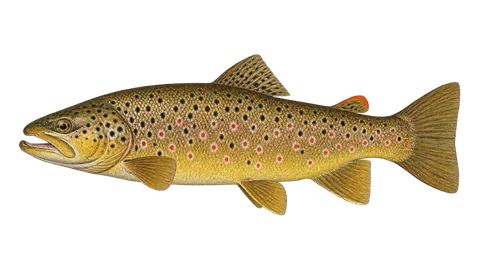
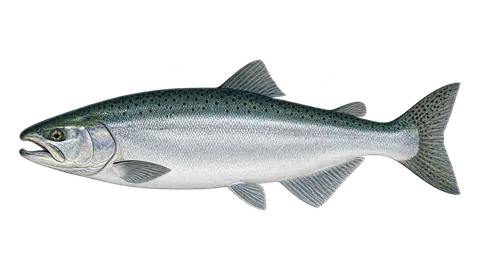
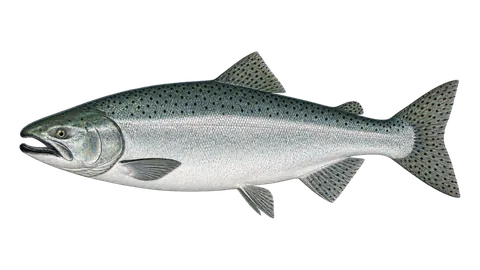
Slender body, thin caudal peduncle and slightly forked tail. Silvery, blue-green back and few black spots, none below the lateral line; tail almost without spots. The mouth reaches only to the back edge of the eye. The brown trout has a larger mouth, red spots with a pale halo, an orange adipose fin and a straight tail. Pacific salmon (coho and chinook) have a longer anal fin, with 12 rays or more.

distribution

where found

open on the large map

Not found in Brazil (FishBase records an introduction without establishment). Exotic, native to the North Atlantic. Landlocked populations in lakes of Argentine Patagonia, such as Traful (Neuquén), and fish escaped from farms in rivers, lakes and fjords of southern Chile.

Habitat: Cold, deep lakes, outflows of lakes and clean-water rivers with rapids and pools; in Chile, also estuaries and fjords near the farms.

calendar and clock

when to fish

best season

time of yearbest: Jan–Mar
JanFebSeaAprMayJunJulAugSepOctNovDec

Fishing follows the Patagonian seasons, from November to April or May, depending on the region. In autumn the landlocked fish run up the tributaries to spawn.

best time of day

0h6h12h18h sunrise ~6amsunset ~6pm

Daytime, with peaks at dawn and dusk. More active at dawn, dusk and on overcast days; in strong sun it goes deeper in the lakes.

weather, water and behavior

what affects the atlantic salmon
sensitivity The little bars show how much each factor affects this species. Five full: it feels it a lot.

cold and cold fronts

Cold-water fish; summer heat drives it to the bottom of the lakes.

atmospheric pressure

Little direct effect; overcast and stable weather is usually good.

moon

Little effect.

rain

Rain that raises the flow encourages the run up the tributaries in autumn.

water level

Rising flow in the tributaries attracts fish; very low river leaves them wary in the pools.

noise

Wary fish in clear water; approach carefully and without shade over the water.

wind

A light chop on the lakes helps; strong wind hinders fly casting.

depth

In lakes, from 2 to 15 m depending on temperature; in rivers, pools and currents from 1 to 3 m.

technique, gear and bait

how to fish

rod
fly #6 to #8; spinning 7' to 8', 6 to 15 lb
spinning / baitcasting reel
fly reel with a good drag; spinning reel 2500 to 3000
line
floating and sinking fly; monofilament 8 to 12 lb or braided line 15 to 20 lb
leader
fluorocarbon 8 to 14 lb
hook
barbless single hook in release areas

lures

  • streamers and salmon flies
  • spoon 7 to 15 g
  • spinner No. 2 to 4

natural baits

  • natural bait is usually banned for salmonids; check the regulations

accessories

  • rubber-mesh passaguá
  • waders with a belt
  • alicate

tip from an angler

In Argentina, a single barbless simple hook was already in use: every Atlantic salmon goes back into the water.

what the law says

rules for the atlantic salmon

Summary of the regulations we found, with the source for each. Rules change; before keeping or transporting fish, check with the state environmental agency.
Conservation: Exotic in southern South America. In its native range, the IUCN moved the species from Least Concern to Near Threatened in 2023.

Argentina (Patagonia): Atlantic salmon, release only

mandatory release in all environments

The Patagonian General Regulation of Continental Sport Fishing, adopted by Neuquén, Río Negro, Chubut and the National Parks Administration, requires mandatory release of Atlantic salmon in all environments. It requires a fishing permit, an artificial lure with a single hook and, in release areas, a barbless simple hook. The 2025/2026 season ran from Nov 1 to May 1.

Source: Resolución APN nº 417/2025 (Boletín Oficial, Dec 9, 2025), Annex I, items 7º, 11º and 13º

Chile: license and limit of 3 fish or 15 kg per day

3 fish or 15 kg per day (whichever comes first)confirm with the agency

In recreational salmonid fishing in Chile's inland waters, including Atlantic salmon, the general rule published by Sernapesca is a maximum of 3 fish or 15 kg per angler per day, with a valid recreational fishing license and one rod per person. The season is set by region (in Magallanes, 2025-2026: Oct 16 to Apr 14), and some rivers and lakes are release-only. In some regions it is prohibited to use live or organic bait for salmonids.

Source: Sernapesca — Ley de Pesca Recreativa nº 20.256 and regional season resolutions (official notices from 2023 and 2025)

catch and release
catch and release Releasing the fish alive, quickly and with a wet hand. During a closed season it isn't always allowed: what the regulation says applies.

Keep the fish in the water, remove the barbless hook with pliers and hold it by the tail base and belly, facing the current, until it swims off on its own.

in the kitchen

Pink, fatty flesh. In Chile, escaped fish may be kept within the quota; in Argentina, release is mandatory.

calculator

how much it weighs without taking it out of the water

Length-weight relationship W = a·Lb (a = 0.01023, b = 3.03; FishBase). It's an average: a fat or lean fish can vary by 10% to 20%.

estimated weight

—

sources and references

The season weights (months), the time of day and the sensitivities (cold, pressure, moon, wind, rain, tide, strong light, murky water and noise) are the app's editorial estimates, based on the literature below and on the field experience of anglers and guides. They are not official data nor a measurement made for this species, and they may vary by region and year. Closed seasons and legal rules appear in the rules section, with the norm and a link.

  1. scientific FishBase — Salmo salar (ficha da espécie)Names, distribution, biology, length-weight relationship, list of countries and references. Page checked 13/10/2026. FishBase records the species as introduced in Chile and southern Argentina.
  2. scientific IUCN Red List — Salmo salar (avaliação global: Quase Ameaçada, NT, 2023)Global assessment indicated on the FishBase entry (Red List, version 2025-2).
  3. official IUCN — Freshwater fish highlight escalating climate impacts on species: IUCN Red List (11/12/2023)Notice of the Red List update that moved Atlantic salmon to Near Threatened (global decline of 23% between 2006 and 2020).
  4. scientific Pascual, M. A.; Ciancio, J. E. (2007). Introduced anadromous salmonids in Patagonia: risks, uses, and a conservation paradox. In: Ecology of Fish Introductions. Dordrecht: Springer, p. 333-353.DOI checked in Crossref.
  5. scientific Soto, D.; Jara, F.; Moreno, C. (2001). Escaped salmon in the inner seas, southern Chile: facing ecological and social conflicts. Ecological Applications 11(6): 1750-1762.DOI checked in Crossref.
  6. official Argentina — Resolución APN nº 417/2025 (Administración de Parques Nacionales): aprova o Reglamento General de Pesca Deportiva Continental Patagónico, temporada 2025/2026Published in the Official Gazette on Dec 9, 2025. Annex I (general regulation) checked: items 8 to 11 (species), 13 (baits) and 17 and 18 (release and daily limit).
  7. official Sernapesca (Chile) — Comenzó la temporada de pesca recreativa en la región de Magallanes (16/10/2025)Official notice with the 2025-2026 season in Magallanes, mandatory license, a limit of 3 fish or 15 kg per day, and habitats with mandatory release.
don't confuse

similar species