

leatherjacket
Oligoplites saurus · Carangidae · predator
The small guaivira of beaches, bays and mangroves, which jumps and strikes surface lures in schools. Watch out for the loose dorsal and anal spines, which sting.
Also called: tibiro, tibiro-branco, guaivira, solteira, salteira, cavaco

- common size
- 20–27 cm
- maximum
- 35 cm
- common weight
- 0.1–0.2 kg
- record/max.
- 0.3 kg
- depth
- 0–10 m
- ideal water
- 23–29 °C

the right time
to be on the water
Choose the place and the species. The index, from 0 to 100, combines weather, sun, moon and tide with each fish's habits. Up to 28 days, with each day's confidence.
Reading the weather across 3 global models and 31 simulations…
—
hour by hour
tap or drag on the chart to read each hour · on a keyboard, arrow keyssee hour-by-hour table
why this index at —?
choose the day
Each card shows the day's index (0 to 100) and, below it, a strip with the index for each hour, from 0h to 23h. from poor to excellent.
the fishing month at a glance
what's the best window for the crew?
Choose how many fishing days. We compare each stretch by its average index, discount days with a warning or closed season, and show the 3 best.
trend for the coming weeks
Line: the middle value of 31 simulations of the American GEFS model. Band: where 8 out of 10 fall. Narrow, firm trend; wide, high uncertainty.
everything about the leatherjacket
who is the leatherjacket
The tibiro is a jack (family Carangidae), like the jacks and pompanos, found in the western Atlantic from New England to Argentina, and also in the eastern Pacific. It lives along the coast, on sandy beaches, in bays, channels and mangroves, and enters estuaries and even fresh water, preferably murky. It travels in large, fast schools that often leap out of the water. Juveniles have incisor-like teeth and act as cleaners for other fish; adults eat fish and crustaceans. It is smaller than the guaivira (Oligoplites saliens) and rarely exceeds 30 cm. It strikes spoons, surface lures and flies, which makes it fun on light tackle.
fun facts
- The dorsal and anal spines are connected to glands that make the sting painful; FishBase notes that the venom still needs to be confirmed.
- Juveniles may float motionless at the surface, with the tail bent and the head down.
identification
Elongated, very compressed body, blue-green back, silvery flanks sometimes with golden reflections, and yellowish pectoral fins and tail. Needle-shaped scales embedded in the skin. Five nearly separate spines in front of the dorsal fin and two or three loose spines on the anal fin. The maxilla reaches the back edge of the eye. The guaivira is much larger (over 40 cm) and has a deeper body; when in doubt, a reliable separation requires counting the gill rakers.
where found
All of the Brazilian coast, on beaches, bays, estuaries and mangroves. Outside Brazil, from New England to Argentina, including the Gulf of Mexico and the Caribbean, and in the eastern Pacific.
Habitat: Sandy beaches, bays, coves, mangrove channels and estuaries with murky water; enters fresh water.
coast
states
Amapá, Pará, Maranhão, Piauí, Ceará, Rio Grande do Norte, Paraíba, Pernambuco, Alagoas, Sergipe, Bahia, Espírito Santo, Rio de Janeiro, São Paulo, Paraná, Santa Catarina, Rio Grande do Sul
when to fish
best season
Present all year in the North and Northeast; in the Southeast and South it appears more in the warm months.
best time of day
Daytime. Hunts by day at the surface, with schools that burst after manjubas; early morning and late afternoon are usually the best times.
what affects the leatherjacket
sensitivity The little bars show how much each factor affects this species. Five full: it feels it a lot.
cold and cold fronts
Cold water drives the schools off the beaches of the South.
atmospheric pressure
Settled, warm weather is the best scenario.
moon
Little effect.
rain
It likes murky water, but excessive heavy rain scatters the schools.
water level
In estuaries it follows the tide and the manjuba schools.
noise
Moderate: shallow schools flee a noisy boat.
wind
Light swell helps; strong wind makes it hard to cast light lures.
tide
The flooding tide on beaches and at channel mouths often brings in the schools.
depth
At the surface and in midwater, 0 to 3 m.
how to fish
- rod
- 6'0" to 7'0", 6 to 14 lb, fast action
- spinning / baitcasting reel
- spinning reel 1000 to 3000
- line
- braid 8 to 15 lb
- leader
- fluorocarbon 0.30 to 0.40 mm
- hook
- fine hooks, sizes 1 to 2/0; small treble hooks on the lures
lures
- small spoon, 7 to 15 g
- small stickbait and prop bait
- streamer 5 to 8 cm (fly size 6 to 8)
natural baits
- manjuba or small sardine
- shrimp
accessories
- pliers
- cloth to hold the fish
tip from an angler
Reel in fast: the tibiro chases a lure that moves away and usually strikes at the end of the retrieve, close to the angler.
rules for the leatherjacket
Summary of the regulations we found, with the source for each. Rules change; before keeping or transporting fish, check with the state environmental agency.
Conservation: Not on the national list (Portaria GM/MMA 1.667/2026). We found no specific federal rule for this species.
We found no species-specific rule beyond the region's general rules.
catch and release
catch and release Releasing the fish alive, quickly and with a wet hand. During a closed season it isn't always allowed: what the regulation says applies.
Hold it with a cloth, smoothing the dorsal and anal spines backward: the sting hurts and swells. Remove the hook with pliers and release quickly.
in the kitchen
Little-valued flesh; sold fresh, salted or dried, and sometimes used as bait for larger fish.
how much it weighs without taking it out of the water
Length-weight relationship W = a·Lb (a = 0.00708, b = 2.88; FishBase (estimativa bayesiana, comprimento total)). It's an average: a fat or lean fish can vary by 10% to 20%.
estimated weight
—
sources and references
The season weights (months), the time of day and the sensitivities (cold, pressure, moon, wind, rain, tide, strong light, murky water and noise) are the app's editorial estimates, based on the literature below and on the field experience of anglers and guides. They are not official data nor a measurement made for this species, and they may vary by region and year. Closed seasons and legal rules appear in the rules section, with the norm and a link.
- scientific FishBase — Oligoplites saurus (ficha da espécie)Names, distribution, biology, length-weight relationship, country list and references. Page checked on 13/10/2026. The country list includes the eastern Pacific, where the form sometimes treated as a subspecies (O. saurus inornatus) lives.
- official Portaria GM/MMA nº 1.667, de 27 de abril de 2026 — Lista Nacional Oficial de Espécies da Fauna Ameaçadas de Extinção (peixes e invertebrados aquáticos)Most recent national list. The species is not on it (search by scientific name in the text published in the DOU, checked on October 13, 2026).
- official ICMBio/SALVE — Ficha de Oligoplites saurus (avaliação nacional do risco de extinção)National extinction risk assessment by ICMBio, published in 2023. DOI checked on Crossref.
- scientific IUCN Red List — Oligoplites saurus (avaliação global: Pouco Preocupante, LC, 07/09/2018)Global assessment. Link given on the FishBase entry (Red List, version 2025-2).
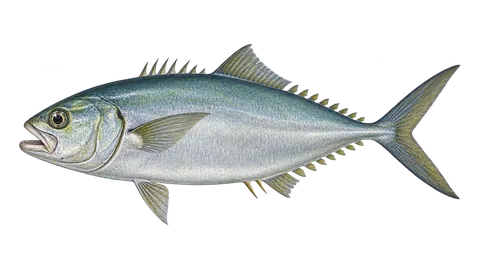
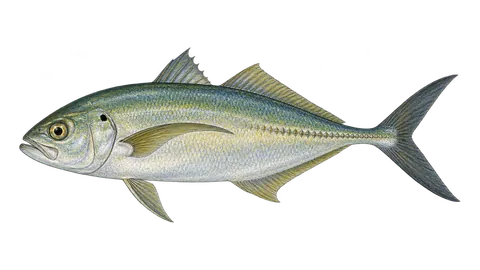
similar species
where each number comes from
The weather comes from three independent global models, cross-checked hour by hour: when they agree, confidence goes up; when they diverge, the band between them shows on the chart. Beyond 16 days, we use the GEFS ensemble of 31 simulations: if 20 of the 31 predict rain, the chance of rain is 65%. Sun and moon are calculated astronomically, with no uncertainty.
The index adds up, weighted for each species: time of day (species curve anchored to real sunrise and sunset), moon (transits, rise and set, phase), pressure (3 h trend and 24 h swing), water temperature (in rivers, estimated from air temperature; at sea, estimated by an ocean model), wind, rain, clouds, tide and the month in the species' cycle.
sources for this lookup
how accurate the forecast is
Accuracy measured in the reference project (4 regions, 93 days, forecast vs. observed): maximum temperature is off by 0.6 °C on average the next day and 1.7 °C at 7 days; rain of 5 mm or more is detected 76% of the time the next day and 57% at 7 days. Detection isn't everything: the false alarm rate isn't published here yet, and 93 days in 4 regions is still a small sample. We now also measure every day, at the app's destinations: