

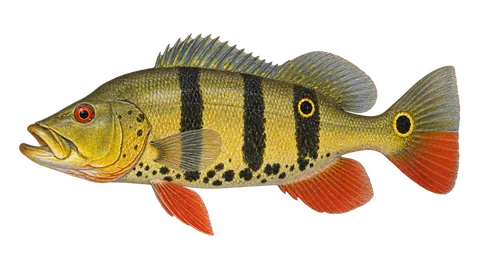

the right time
to be on the water
Choose the place and the species. The index, from 0 to 100, combines weather, sun, moon and tide with each fish's habits. Up to 28 days, with each day's confidence.
Loading the forecast…
—
hour by hour
slide your finger or mouse over the chart to see each hoursee hour-by-hour table
why this index at —?
choose the day
the fishing month at a glance
what's the best window for the crew?
Choose how many fishing days. We compare each stretch by its average index, discount days with a warning or closed season, and show the 3 best.
trend for the coming weeks
Line: the middle value of 31 simulations of the American GEFS model. Band: where 8 out of 10 fall. Narrow, firm trend; wide, high uncertainty.
everything about the peacock bass
how to recognize it
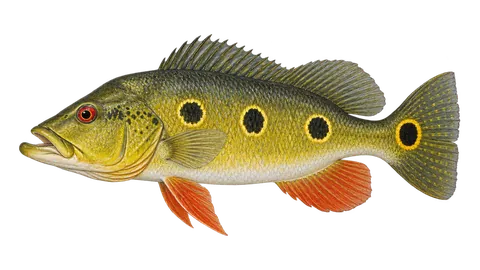
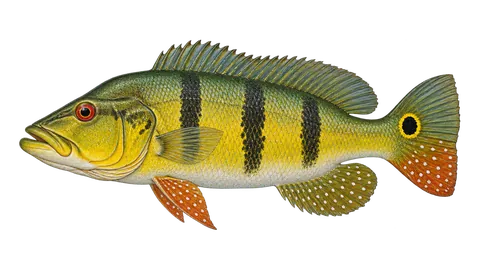
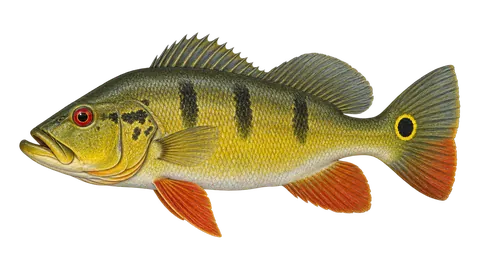
Three vertical dark bars of similar width on the flank, the rear one with an ocellus (dark spot with a pale ring) on the upper part, dark spots on the belly and a large ocellus at the base of the tail. No marked dark bar on the nape. The tucunaré-borboleta (C. orinocensis) has three large ocelli in the middle of the flank instead of bars; the tucunaré-amarelo and the popoca have a dark bar on the nape and bars that taper downward.
Also called: tucunaré-das-guianas, tucunaré, lukanani, butterfly peacock bass
don't confuse with:
where found
open on the large mapWhere to look: Rapids and mid-depth eddies with rocks, in clear- and black-water rivers; in the introduction areas, reservoirs and lakes.
No confirmed record in Brazil: FishBase considers the records in Brazil, Colombia and Venezuela doubtful. Native to the coastal rivers of Guyana, Suriname and French Guiana; introduced to Puerto Rico, the Dominican Republic, Panama and the United States.
when to fish
best season
In the Guiana rivers, low water concentrates fish on rocks and eddies. In Caribbean reservoirs fishing is year-round, with best days in clear water and stable weather.
best time of day
Daytime, with peaks at dawn and dusk. Feeds by day, with peaks early in the morning and late in the afternoon.
what affects the peacock bass
cold and cold fronts
Cold water drops activity.
atmospheric pressure
Stable weather helps; a storm shuts down fishing.
moon
Small effect.
rain
Rain that muddies the water scatters the fish.
water level
A falling river concentrates fish on the rocks.
noise
Wary in clear water: approach quietly.
wind
A light chop helps topwater lures.
depth
Along rocks and logs, 0.5 to 4 m.
how to fish
lures
- zara/stickbait 10 to 12 cm
- prop bait
- mid-water jerkbait 9 to 12 cm
- feather jig 1/4 to 1/2 oz
tip from an angler
Work the lure along the rocks and don't stop after the first strike: the peacock bass often comes back.
- rod
- 5'6" to 6'6", fast action, 14 to 25 lb
- spinning / baitcasting reel
- low-profile baitcasting reel 100 to 200 or spinning reel 3000
- line
- braid 30 to 50 lb
- leader
- fluorocarbon 40 to 60 lb, 60 to 80 cm
- hook
- reinforced treble hooks 1/0 to 3/0; prefer barbless
accessories
- long-nose pliers
- boga-grip
- polarized glasses
catch and release
Lip grip (boga) in the mouth, support under the belly and a quick photo. In areas where it was introduced, follow the local rule and never take it to another lake or river.
rules for the peacock bass
Rules change; before keeping or transporting fish, check with the state environmental agency.
We found no species-specific rule beyond the region's general rules.
how much it weighs without taking it out of the water
estimated weight
—
how we calculate
Length-weight relationship W = a·Lb (a = 0.01148, b = 3.07; FishBase). It's an average: a fat or lean fish can vary by 10% to 20%.
more about the peacock bass
For over a century, almost every South American peacock bass was called Cichla ocellaris. The 2006 revision of the genus restricted the name to the coastal rivers of the Guianas, from the Essequibo in Guyana to the Maroni (Marowijne), on the border between Suriname and French Guiana. Peacock bass stocked in reservoirs in southeastern and northeastern Brazil, once called C. ocellaris, are now identified as other species, such as the tucunaré-amarelo (C. kelberi) and the tucunaré-azul (C. piquiti). Outside the native range, FishBase records introductions in Puerto Rico, the Dominican Republic, Panama and the United States. It lives in rapids and mid-depth eddies with rocks, moves in shoals and eats fish. It can reach 74 cm and nearly 7 kg, according to sport fishing records.
Family: Cichlidae · predator
fun facts
- It was described in 1801 and is the type species of the genus Cichla.
- FishBase cites as prey freshwater sardines, livebearers, tilapias and bluegills, fish from the areas where it was introduced.
in the kitchen
White, firm flesh, like that of other peacock bass.
similar species
sources and references (3)
The season weights (months), the time of day and the sensitivities (cold, pressure, moon, wind, rain, tide, strong light, murky water and noise) are the app's editorial estimates, based on the literature below and on the field experience of anglers and guides. They are not official data nor a measurement made for this species, and they may vary by region and year. Closed seasons and legal rules appear in the rules section, with the norm and a link.
- scientific FishBase — Cichla ocellaris (ficha da espécie)Diagnosis after the 2006 revision, native distribution (Essequibo to Marowijne), introductions, biology, maximum size (IGFA record) and country list, which marks Brazil, Colombia and Venezuela as doubtful. Page checked on Oct 13, 2026.
- scientific IUCN Red List — Cichla ocellaris (avaliação global: Pouco Preocupante, LC, 05/11/2020)Global assessment. Link given on the FishBase entry (Red List, version 2025-2).
- scientific Kullander, S. O.; Ferreira, E. J. G. (2006). A review of the South American cichlid genus Cichla, with descriptions of nine new species (Teleostei: Cichlidae). Ichthyological Exploration of Freshwaters 17(4): 289-398.Revision of the genus with the species diagnosis; the URL is the bibliographic record on FishBase.
how we calculatewhere each number comes from
The weather comes from three independent global models, cross-checked hour by hour: when they agree, confidence goes up; when they diverge, the band between them shows on the chart. Beyond 16 days, we use the GEFS ensemble of 31 simulations: if 20 of the 31 predict rain, the chance of rain is 65%. Sun and moon are calculated astronomically, with no uncertainty.
The index adds up, weighted for each species: time of day (species curve anchored to real sunrise and sunset), moon (transits, rise and set, phase), pressure (3 h trend and 24 h swing), water temperature (in rivers, estimated from air temperature; at sea, estimated by an ocean model), wind, rain, clouds, tide and the month in the species' cycle.
sources for this lookup
how accurate the forecast is
Accuracy measured in the reference project (4 regions, 93 days, forecast vs. observed): maximum temperature is off by 0.6 °C on average the next day and 1.7 °C at 7 days; rain of 5 mm or more is detected 76% of the time the next day and 57% at 7 days. Detection isn't everything: the false alarm rate isn't published here yet, and 93 days in 4 regions is still a small sample. We now also measure every day, at the app's destinations: