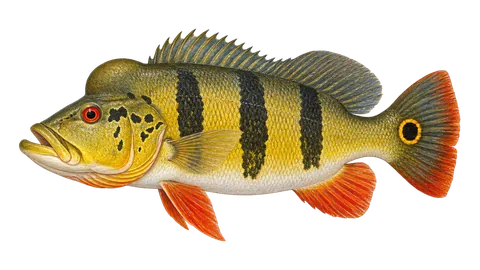
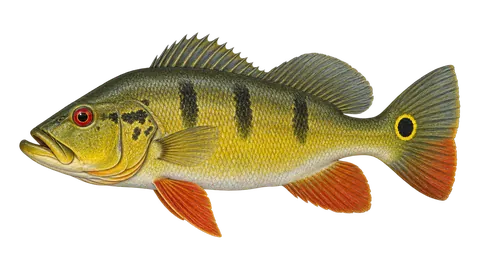
Shares the blackwater rivers of the upper and middle Rio Negro and of the Roraima tributaries with the speckled peacock bass. It is smaller and more numerous, and tends to move in groups that hit the same lure one after another. It prefers lakes, eddies and banks with timber and rock, always in clear or black water. In the dry season it forms large concentrations in isolated lakes and igarapé mouths, and keeps the action going until the açu shows up. It takes smaller lures and is a great target for light tackle and fly. It also breeds in pairs, with a nest and care of the young.
fun facts
The three flank ocelli gave it the name 'borboleta' (butterfly).
It's common to catch borboleta and açu on the same cast, along the same bank.
how to recognize it
identification
Three round black spots with a light ring in the middle of the flank, like butterfly eyes, in place of the vertical bars. Black ocellus also at the base of the tail. Golden to greenish body and reddish lower fins. The açu and the yellow have vertical bars. The popoca has faint bars, without round ocelli on the flank. It rarely exceeds 5 kg.
how butterfly pavon fishing looks
Loading the next 7 days…
Each card shows the day's index (0 to 100) and, below it, a strip with the index for each hour, from 0h to 23h. from poor to excellent.
Summary of the regulations we found, with the source for each. Rules change; before keeping or transporting fish, check with the state environmental agency. Conservation: Not on the national list (Portaria GM/MMA 1.667/2026).
Commercial peacock bass fishing banned on the Rio Negro (AM)
commercial fishing bannedAMAmazon
In the Rio Negro basin, from the Colombian border to the mouth of the Rio Branco, commercial peacock bass fishing is banned. Amateur and sport fishing remain allowed, but the fish may only be eaten by the angler himself.
Peacock bass catch and release only in rivers of southern Roraima
commercial and amateur fishing banned; sport fishing catch and release onlyRRAmazonconfirm with the agency
In the Água Boa do Univini, Itapará, Xeruini and Jufari rivers, commercial and amateur peacock bass fishing is banned; only riverside subsistence applies (up to 7 fish per boat), along with catch-and-release sport fishing by licensed operators. Original term of 5 years from November 2021; extension to 10 years approved by the ALE-RR in 2025, enactment not confirmed. Confirm with the state agency (Femarh).
Transport, storage and sale are fully prohibited for 5 years from Jan 1, 2024 for: cachara, caparari, dorado, jaú, matrinchã (Brycon spp.), pintado/surubim (Pseudoplatystoma spp.), piraíba, piraputanga, pirarara, arapaima (pirarucu), trairão and peacock bass (tucunaré, Cichla spp.). For recreational anglers: catch and release only. These 12 species may not even be eaten on site, since the 2 kg or 1 fish limit excludes the art. 19-B list. The law cites jaú as Zungaro zungaro; we also include the Pantanal jaú (Z. jahu) out of caution. The list may still change: § 2 (exotic and predatory species), § 3 (review through study) and the 3-year assessment planned for 2027. A TJMT news report of Jun 2, 2026 confirms the 12 prohibited species. The STF denied a preliminary injunction in the ADIs against the law in 2024; we found no merits ruling.
Roraima: peacock bass in rivers of the lower Rio Branco
RRAmazon
Commercial and recreational peacock bass fishing is prohibited in the Água Boa do Univini, Itapará, Xeruini, Jufari and Jauaperi rivers and their tributaries. Only sport fishing, by companies licensed by Femarh with a maximum of 2 barbless hooks per bait, and subsistence fishing by riverside residents, are allowed.
piracema closures in the basins where the species lives
Spawning closure (piracema) in Mato Grosso (all basins)
01/10 to 31/01MT
Allowed: All fishing modalities are prohibited in rivers, including catch and release (Law 9.096/2009, art. 19-A). Exceptions: subsistence fishing from shore (3 kg or 1 fish, no transport or sale) and scientific fishing. Law 13.159/2025 now allows licensed sport fishing in UHE/PCH hydropower reservoirs, natural lakes and border rivers, subject to a scientific study and a license from the environmental agency. We have not confirmed whether these licenses are already being issued.
Allowed: Recreational anglers with handline or rod, line and hook are outside the Annex II prohibitions, with a bag limit of 5 kg + 1 fish, unless a stricter state rule applies.
catch and release Releasing the fish alive, quickly and with a wet hand. During a closed season it isn't always allowed: what the regulation says applies.
Medium fish, easy to handle. Lip grip (boga) in the mouth, quick photo and back in the water.
in the kitchen
White, tasty flesh, like the other peacock bass. In the region it is eaten grilled over coals.
calculator
how much it weighs without taking it out of the water
Length-weight relationship W = a·Lb (a = 0.01175, b = 3.07; FishBase (bayesiano, espécie + gênero)). It's an average: a fat or lean fish can vary by 10% to 20%.
estimated weight
—
sources and references
The season weights (months), the time of day and the sensitivities (cold, pressure, moon, wind, rain, tide, strong light, murky water and noise) are the app's editorial estimates, based on the literature below and on the field experience of anglers and guides. They are not official data nor a measurement made for this species, and they may vary by region and year. Closed seasons and legal rules appear in the rules section, with the norm and a link.