

royal pavon
Cichla intermedia · Cichlidae · predator
Peacock bass of the Orinoco and Casiquiare in Venezuela, with a unique pattern: a row of dark blotches and thin bars, with no pale spots. It lives near rocks and logs in the channel, in moving water.
Also called: tucunaré-real, pavón real, royal peacock bass

- common size
- 30–45 cm
- maximum
- 55 cm
- common weight
- 0.5–2 kg
- record/max.
- 3.0 kg
- depth
- 0.5–5 m
- ideal water
- 27–31 °C

the right time
to be on the water
Choose the place and the species. The index, from 0 to 100, combines weather, sun, moon and tide with each fish's habits. Up to 28 days, with each day's confidence.
Reading the weather across 3 global models and 31 simulations…
—
hour by hour
tap or drag on the chart to read each hour · on a keyboard, arrow keyssee hour-by-hour table
why this index at —?
choose the day
Each card shows the day's index (0 to 100) and, below it, a strip with the index for each hour, from 0h to 23h. from poor to excellent.
the fishing month at a glance
what's the best window for the crew?
Choose how many fishing days. We compare each stretch by its average index, discount days with a warning or closed season, and show the 3 best.
trend for the coming weeks
Line: the middle value of 31 simulations of the American GEFS model. Band: where 8 out of 10 fall. Narrow, firm trend; wide, high uncertainty.
everything about the royal pavon
who is the royal pavon
A peacock bass species of the Orinoco and Casiquiare basins in Venezuela, and probably also in Colombian tributaries. Smaller than the açu peacock bass, it rarely exceeds 50 cm, but it fights hard because it lives in the main channel, near rocks and submerged wood, in or beside the current. It is a daytime predator of fish. For the angler who goes to the Orinoco in search of the speckled peacock bass (tucunaré-açu), this one is a much-wanted catch, because it completes the peacock bass species of the region. Fishing is best in the dry season, when the river falls and exposes rock beds and beaches. The baits are the same as for the other peacock bass, with a preference for mid-water lures worked close to the rocks.
fun facts
- It is the only peacock bass with a row of spots instead of broad bars and no pale spots on the body.
- The Casiquiare River naturally links the Orinoco with the Rio Negro, which helps explain fish species shared between the two basins.
identification
Instead of three broad bars, it has a row of irregular dark blotches along the flank and six or seven thin vertical bars below the dorsal fin. Adults with small black spots behind the eye and on the gill cover. No pale spots on the body, which separates it from the açu and the butterfly peacock bass. Black ocellus with a pale ring at the base of the tail, like the other peacock bass.
where found
Does not occur in Brazil. Orinoco basin (main channel and tributaries) and Casiquiare River, in Venezuela; probably also in Colombian tributaries of the Orinoco.
Habitat: Main channel of clear and blackwater rivers, along rock beds, logs and snags, in or beside the current; lagoon mouths in the dry season.
famous destinations
when to fish
best season
In Venezuela the Orinoco dry season (December to April) is the season: low river, rock beds exposed and fish concentrated. In flood it spreads into the flooded forest.
best time of day
Daytime, with peaks at dawn and dusk. Attacks by day, peaking early in the morning and late afternoon. At night it practically stops.
what affects the royal pavon
sensitivity The little bars show how much each factor affects this species. Five full: it feels it a lot.
cold and cold fronts
Temperature drops are rare on the Orinoco; prolonged cold rain reduces activity.
atmospheric pressure
Stable weather helps; a storm shuts fishing down for a few hours.
moon
Small effect.
rain
Rain at the start of the flood muddies clear-water rivers and scatters the fish.
water level
A falling, dry river is the best scenario. In flood the fish move into the forest.
noise
Wary in clear water: arrive by paddle or electric motor near the rock beds.
wind
Little effect in the channel; strong wind hampers accurate casting.
depth
Along rocks and sticks, 0.5 to 3 m; drops a little under midday sun.
how to fish
- rod
- 5'6" to 6'6", fast action, 14 to 25 lb
- spinning / baitcasting reel
- low-profile baitcasting reel 100 to 200 or spinning reel 3000
- line
- braid 30 to 50 lb
- leader
- fluorocarbon 40 to 60 lb, 60 to 80 cm
- hook
- reinforced treble hooks 1/0 to 3/0; prefer barbless
lures
- jerkbait and mid-water minnow 9 to 12 cm
- zara/stickbait 10 to 12 cm
- feather jig 1/4 to 1/2 oz
- large streamer for #8 fly
accessories
- long-nose pliers
- boga-grip
- polarized glasses
tip from an angler
Cast tight to the rock, upstream of the current, and bring the bait back in short twitches across the break in the water. It usually comes out from behind the rock.
rules for the royal pavon
Summary of the regulations we found, with the source for each. Rules change; before keeping or transporting fish, check with the state environmental agency.
We found no species-specific rule beyond the region's general rules.
catch and release
catch and release Releasing the fish alive, quickly and with a wet hand. During a closed season it isn't always allowed: what the regulation says applies.
Hold it by the mouth with a lip grip, support the belly and take a quick photo. Release it in water with some current, facing into it.
in the kitchen
White, firm flesh, like that of the other peacock bass. In sport fishing, the practice is to release.
how much it weighs without taking it out of the water
Length-weight relationship W = a·Lb (a = 0.01413, b = 3.03; FishBase). It's an average: a fat or lean fish can vary by 10% to 20%.
estimated weight
—
sources and references
The season weights (months), the time of day and the sensitivities (cold, pressure, moon, wind, rain, tide, strong light, murky water and noise) are the app's editorial estimates, based on the literature below and on the field experience of anglers and guides. They are not official data nor a measurement made for this species, and they may vary by region and year. Closed seasons and legal rules appear in the rules section, with the norm and a link.
- scientific FishBase — Cichla intermedia (ficha da espécie)Names, distribution, biology, length-weight relationship, country list and references. Page checked on Oct 13, 2026.
- scientific IUCN Red List — Cichla intermedia (avaliação global: Pouco Preocupante, LC, 28/10/2020)Global assessment. Link given on the FishBase entry (Red List, version 2025-2).
- scientific Winemiller, K. O.; Kelso Winemiller, L.; Montaña, C. G. (2021). Royal peacock bass, Cichla intermedia (Machado-Allison, 1971). In: Peacock Bass: Diversity, Ecology and Conservation. Academic Press, p. 91-103.DOI checked in Crossref.
- scientific Kullander, S. O.; Ferreira, E. J. G. (2006). A review of the South American cichlid genus Cichla, with descriptions of nine new species (Teleostei: Cichlidae). Ichthyological Exploration of Freshwaters 17(4): 289-398.Revision of the genus with the species diagnosis; the URL is the bibliographic record on FishBase.
similar species
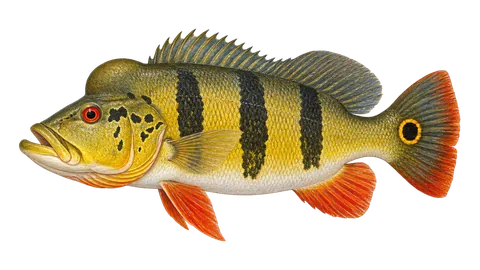
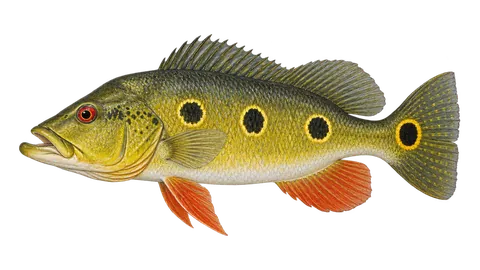
where each number comes from
The weather comes from three independent global models, cross-checked hour by hour: when they agree, confidence goes up; when they diverge, the band between them shows on the chart. Beyond 16 days, we use the GEFS ensemble of 31 simulations: if 20 of the 31 predict rain, the chance of rain is 65%. Sun and moon are calculated astronomically, with no uncertainty.
The index adds up, weighted for each species: time of day (species curve anchored to real sunrise and sunset), moon (transits, rise and set, phase), pressure (3 h trend and 24 h swing), water temperature (in rivers, estimated from air temperature; at sea, estimated by an ocean model), wind, rain, clouds, tide and the month in the species' cycle.
sources for this lookup
how accurate the forecast is
Accuracy measured in the reference project (4 regions, 93 days, forecast vs. observed): maximum temperature is off by 0.6 °C on average the next day and 1.7 °C at 7 days; rain of 5 mm or more is detected 76% of the time the next day and 57% at 7 days. Detection isn't everything: the false alarm rate isn't published here yet, and 93 days in 4 regions is still a small sample. We now also measure every day, at the app's destinations: