Skip to content
fishing forecast

mahogany snapper

Lutjanus mahogoni · Lutjanidae · predator

Sea

A small, big-eyed snapper, olive-gray with a reddish tint and a black spot on the lateral line, that forms daytime schools over shallow Caribbean reefs. It reaches Brazil's Northeast and is caught on light tackle, a good size for the pan.

Also called: vermelho-mogno, mahogany snapper, spot snapper

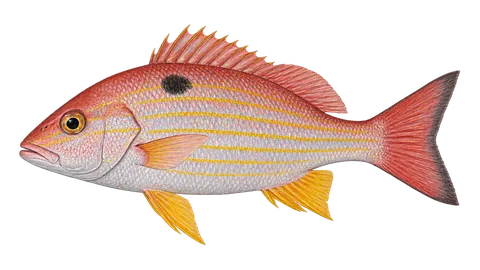
Scientific illustration of Mahogany snapper
common size
25–38 cm
maximum
48 cm
common weight
0.2–0.8 kg
record/max.
1.3 kg
depth
0–100 m
ideal water
24–29 °C
location

Sample location: choose yours to see the forecast for where you fish.

period

Reading the weather across 3 global models and 31 simulations…

the species

everything about the mahogany snapper

overview

who is the mahogany snapper

The vermelho-mogno (mahogany snapper, ojanco) is a small snapper of the western Atlantic, from North Carolina to northeastern Brazil, including the Gulf of Mexico, and is common in the Caribbean. Adults live in shallow, clear water over rocky bottoms near coral reefs, less often over sand or seagrass, and gather in large aggregations by day. At night they go out to feed on small fish, shrimp, crabs and cephalopods. It reaches 48 cm and 1.3 kg and can live 18 years. It has no established Brazilian name; we use "vermelho-mogno", a translation of the English name.

fun facts

  • The black spot on its side gave it the English name "spot snapper"; in Spanish, "pargo ojón" refers to the large eye.
  • By day it forms large aggregations near the reef and goes out to feed at night.
  • It lives up to 18 years, even though it is a small snapper.
how to recognize it

identification

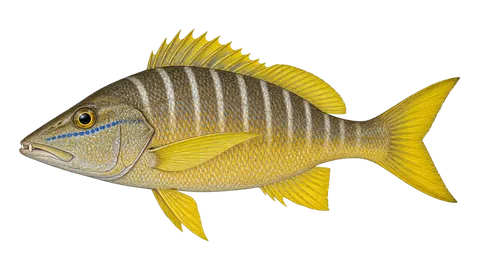
Fusiform body, back and flanks gray to olive-green, silvery on the belly, sometimes with a reddish tint. The mark is a black spot, about the size of the eye, on the lateral line, below the first soft dorsal rays. Large eye, pointed snout and a slightly protruding lower jaw. The ariacó (Lutjanus synagris) has yellow stripes and the caji (L. apodus) has pale bars on the flanks and yellowish fins.

distribution

where found

open on the large map

Western Atlantic, from North Carolina (USA) to northeastern Brazil, including the Gulf of Mexico, and common throughout the Caribbean (FishBase). In Brazil, the record is from the Northeast coast.

Habitat: Shallow, clear waters over rocky bottoms near coral reefs, less often over sand or seagrass, from 0 to 100 m. They form aggregations by day and disperse at night to feed.

coast

Northeast Coastcoastalshelf
calendar and clock

when to fish

best season

time of yearbest: May–Jul
JanFebSeaAprMayJunJulAugSepOctNovDec

Fishable all year. With warmer water in spring and summer, the fish is more active and closer to shallow reefs.

best time of day

0h6h12h18h sunrise ~6amsunset ~6pm

Night and twilight. Feeds at night; by day it stays grouped near the reef. Fishing is best at dusk, with bait on the bottom alongside the reef.

weather, water and behavior

what affects the mahogany snapper
sensitivity The little bars show how much each factor affects this species. Five full: it feels it a lot.

cold and cold fronts

Warm-water species (FishBase lists it as subtropical): a drop in temperature scatters the school.

atmospheric pressure

A cold front with rough seas shuts fishing down for a day or two.

moon

It feeds at night, so the full moon and the tidal current help at dusk and early night.

rain

Heavy rain muddies the water over shallow reefs and drives the school away.

water level

Doesn't apply at sea. The equivalent is the clean, clear water of the reef.

noise

Over a shallow reef in clear water, engine noise and hull knocks spook fish; anchor well away and cast from a distance.

wind

Light surf hides the line; strong wind stirs up sand and muddies the reef water.

tide

A moving tide draws the school out of its shelter and turns on the bite in the reef channel.

depth

Usually between 5 and 50 m, close to the reef; goes down to 100 m at edge spots.

technique, gear and bait

how to fish

rod
6' to 7', medium-heavy action, 15 to 30 lb
spinning / baitcasting reel
spinning reel 4000 to 6000 or a small baitcasting reel
line
braid 20 to 30 lb
leader
fluorocarbon 30 to 50 lb, 1 to 1.5 m (the reef cuts thin line)
hook
circle hook 1/0 to 3/0

lures

  • bottom jig, 30 to 80 g
  • silicone soft-plastic lure with lead head

natural baits

  • shrimp
  • squid strips
  • sardine pieces

accessories

  • sliding sinker, 30 to 100 g
  • long-nose pliers
  • luvas

tip from an angler

Fish the bait on the bottom alongside the reef in the late afternoon, and lift the fish quickly so it doesn't tangle in the rock.

what the law says

rules for the mahogany snapper

Summary of the regulations we found, with the source for each. Rules change; before keeping or transporting fish, check with the state environmental agency.
Conservation: Not on the Brazilian national list (Portaria GM/MMA nº 1.667/2026). The IUCN rates it Least Concern (2015 assessment). We found no specific Brazilian federal minimum size or quota for the species.

Mexico: up to 5 per species and 10 saltwater fish per day

5 specimens of the species per angler per day, within the limit of 10 saltwater fish

In recreational sport fishing in Mexican federal waters, each angler may keep up to 10 marine fish per day, with at most 5 of the same species. The vermelho-mogno (pargo ojón) is not among the species reserved for sport fishing (marlins, sailfish, swordfish, dorado, roosterfish and sábalo) and has no quota of its own. Fish over the limit are released alive, and sport-caught fish are for personal consumption, not for sale. Anyone fishing from a boat needs a Conapesca permit.
Source: Amendment to NOM-017-PESC-1994 (recreational sport fishing in federal waters of Mexico), published in the DOF on Nov 25, 2013, items 4.9.1 and 4.9.5 (Sagarpa/Conapesca)

Colombia: AUNAP license and catch and release as the main practice

personal AUNAP license; keep only fish that meets the minimum size, for personal useconfirm with the agency

Colombian sport fishing requires the personal, non-transferable AUNAP license (natural persons, nationals or foreigners). The resolution sets catch and release as the main practice and only allows keeping specimens that meet the minimum sizes, for personal use. We found no specific minimum size or marine quota for this species; confirm with AUNAP before taking any fish home.

Source: Resolución AUNAP nº 0549, of Mar 18, 2022 (sport fishing), arts. 6º and 8º

catch and release
catch and release Releasing the fish alive, quickly and with a wet hand. During a closed season it isn't always allowed: what the regulation says applies.

Small shallow-reef fish: it releases well if you let it go quickly, without lifting it out of the water, using pliers and a circle hook. In deeper spots barotrauma can appear; use a descender.

in the kitchen

Prized meat, sold mostly fresh; good whole-fried, grilled or in caldillo (fish stew). There are reports of ciguatera in Caribbean reef fish, so be wary of large specimens caught on reefs known for it.

calculator

how much it weighs without taking it out of the water

Length-weight relationship W = a·Lb (a = 0.01738, b = 2.95; FishBase (relação peso-comprimento bayesiana, estimativa da própria espécie)). It's an average: a fat or lean fish can vary by 10% to 20%.

estimated weight

—

sources and references

The season weights (months), the time of day and the sensitivities (cold, pressure, moon, wind, rain, tide, strong light, murky water and noise) are the app's editorial estimates, based on the literature below and on the field experience of anglers and guides. They are not official data nor a measurement made for this species, and they may vary by region and year. Closed seasons and legal rules appear in the rules section, with the norm and a link.

  1. scientific FishBase: Lutjanus mahogoni (ficha da espécie)Size, length-weight, depth, habitat, distribution, biology, and IUCN status. Page checked on Oct 13, 2026.
  2. scientific FishBase: nomes populares de Lutjanus mahogoniNames by country and language.
  3. official Portaria GM/MMA nº 1.667, de 27 de abril de 2026: Lista Nacional Oficial de Espécies da Fauna Ameaçadas de Extinção (peixes e invertebrados aquáticos)The species is not on the list. Checked in the DOU of April 28, 2026.
  4. scientific Florida Museum: Mahogany Snapper (Lutjanus mahogoni)Appearance, shallow habitat, nocturnal habits, fishing with line, traps and spear, and a warning about ciguatera. Page checked on Oct 13, 2026.
  5. scientific Allen, G. R. (1985). FAO species catalogue. Vol. 6. Snappers of the world. FAO Fisheries Synopsis 125(6). Roma: FAO.Reference catalogue of the snappers of the world (family Lutjanidae).
  6. official NOM-017-PESC-1994 e sua modificação: pesca deportivo-recreativa em águas de jurisdição federal do MéxicoItem 4.9.1: up to 10 marine fish per angler per day, no more than 5 per species. The original text (DOF May 9, 1995) was also read at https://platiica.economia.gob.mx/normalizacion/wp-content/uploads/sites/2/PDF_Normas_Publicas/017-pesc.pdf.
  7. official Resolução AUNAP nº 0549, de 18 de março de 2022: lineamentos para a pesca esportiva e recreativa na ColômbiaSummary of articles 6 (license) and 8 (catch and release, minimum sizes). We did not check the per-species quota and size values, which depend on the full text.
  8. official Instrução Normativa MMA nº 53, de 22 de novembro de 2005: tamanhos mínimos de captura no litoral do ES ao RSThe species is not in Annexes I and II (checked in the consolidated reproduction of the rule), so there is no federal minimum size under that rule. We found no other federal minimum-size rule or specific quota for the species.
don't confuse

similar species