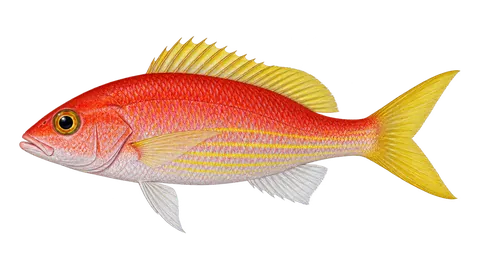
A scarlet snapper with a black spot at the base of the pectoral fin, which lives on bottoms of 80 to 150 m, along shelf edges and escarpments. It is very common in the Caribbean, reaches northern Brazil and is good eating.
Also called: saçupema, saçupema-boca-preta, vermelho-de-fundo, vermelho, blackfin snapper, black spot snapper
The saçupema is a shelf-edge snapper of the western Atlantic, from North Carolina and Bermuda to Trinidad and northern Brazil, including the Gulf of Mexico, and is very common in the Caribbean, especially the Antilles. Adults stay in deeper water over sand or rock bottoms and near escarpments and ledges, usually between 80 and 150 m; juveniles appear in shallower water, typically 35 to 50 m. It mainly eats fish. It reaches 75 cm and 14 kg and is good eating, sold fresh. Ciguatera has been reported, and the fish is sometimes sold as red snapper.
fun facts
Portaria MPA nº 532/2025 lists saçupema, saçupema-boca-preta and vermelho-de-fundo as names of the species.
Travels in groups and spawns almost year-round, with peaks in April and September in Jamaica (Florida Museum).
It is sometimes sold as red snapper, which mixes species on the plate and in landings.
how to recognize it
identification
Oval body, scarlet red, silvery on the lower flanks and belly, with yellowish to orange fins. The mark is a well-defined black, comma-shaped spot at the base and in the axil of the pectoral fin. The scale rows on the back run diagonally above the lateral line. The Gulf snapper (Lutjanus campechanus) has no such spot and a pointed anal fin, and the olhão (Etelis oculatus) has a bright red, forked tail.
how blackfin snapper fishing looks
Loading the next 7 days…
Each card shows the day's index (0 to 100) and, below it, a strip with the index for each hour, from 0h to 23h. from poor to excellent.
Western Atlantic, from North Carolina (USA) and Bermuda to Trinidad and northern Brazil, including the Gulf of Mexico (FishBase). In Brazil it occurs on the north coast and in the Northeast, on the outer shelf and along the edge of the slope.
Habitat: Outer shelf and slope edges, over sand or rock bottoms, near escarpments and ledges, from 80 to 150 m (FishBase gives the full range as 20 to 200 m). Juveniles are in shallower water, roughly 35 to 50 m.
coast
North CoastNortheast Coastshelf
calendar and clock
when to fish
best season
time of yearbest: Apr–May and Oct
JanFebSeaAprMayJunJulAugSepOctNovDec
It can be fished all year. In the literature the species spawns most of the year, with peaks in April and September (Jamaica); in practice, the best time is calm seas and moderate current.
best time of day
Daytime, with peaks at dawn and dusk. You can fish all day at 100 m, but dawn and late afternoon tend to be more productive, when the schools rise to hunt above the bottom.
weather, water and behavior
what affects the blackfin snapper
sensitivity The little bars show how much each factor affects this species. Five full: it feels it a lot.
cold and cold fronts
Stable bottom water; a cold front at the surface barely changes fishing at 100 m.
atmospheric pressure
Small effect; the problem with the front is rough seas.
moon
Big tides increase the current at shelf edges and can switch the bite on or off.
rain
Little effect on the fish at 100 m; what matters is the angler's comfort.
water level
Doesn't apply at sea. The equivalent is the bottom current, which determines whether the bait stays plumb.
noise
At 100 m the boat's noise barely reaches the fish.
wind
Strong wind pulls the line off plumb; choose calm seas for drifting or anchoring.
tide
The moving tide organizes the current along the shelf edge and gathers the school at the ledge.
depth
Usually between 80 and 150 m; juveniles occupy shallower bottoms, from 35 to 50 m.
deep-sea reel size 6/0 to 9/0 or electric, with 300 to 500 m of line
line
braided line 50 to 80 lb
leader
fluorocarbon or monofilament 60 to 100 lb, 2 to 3 m, with a two-hook leader
hook
circle hook 6/0 to 9/0
lures
bottom jig of 150 to 300 g
LED light above the leader
natural baits
whole or cut sardine
squid strips
cavalinha
accessories
sinker of 300 to 600 g depending on the current
descender
gloves and pliers
tip from an angler
Keep the bait one or two meters off the bottom and lift the sinker when the line touches: the saçupema strikes near the bottom, close to ledges.
what the law says
rules for the blackfin snapper
Summary of the regulations we found, with the source for each. Rules change; before keeping or transporting fish, check with the state environmental agency. Conservation: Not on the Brazilian national list (Portaria GM/MMA nº 1.667/2026). The IUCN rates it Data Deficient (2015 assessment). We found no specific Brazilian federal minimum size or bag limit for the species.
Puerto Rico (federal waters): up to 5 per person per day
5 per person per day; 15 per boat with 3 or more people
In federal waters around Puerto Rico, beyond 9 miles from shore, a recreational angler may keep at most 5 fish per day, combining groupers, snappers and parrotfish (up to 15 per boat when there are 3 or more people aboard). Saçupema (blackfin snapper) counts as a snapper toward this limit. The bag limit does not apply to anyone holding a commercial license from Puerto Rico or the Virgin Islands.
Puerto Rico (federal waters): closed Oct 1 to Dec 31
fishing and possession prohibited Oct 1 to Dec 3101/10 to 31/12
In federal waters around Puerto Rico, beyond 9 miles from shore, it is prohibited to fish for or have aboard saçupema (blackfin snapper) from Oct 1 to Dec 31 each year (the rule covers black, blackfin, silk and vermilion snappers together). The possession ban does not apply to fish caught and landed before the closure.
Puerto Rico (federal waters): descent device mandatory on board
1 descent device ready for use by anyone fishing for or carrying reef fish
Anyone fishing for or carrying reef fish (the saçupema (blackfin snapper) falls within the definition) in federal waters off Puerto Rico must have aboard, ready for use, at least one descending device: a tool able to return the fish to the depth where it was caught, with a minimum weight of 454 g (16 oz) and 18.3 m (60 ft) of line, which releases the fish on its own, by operator action or when it slips free at the bottom.
Mexico: up to 5 per species and 10 saltwater fish per day
5 specimens of the species per angler per day, within the limit of 10 saltwater fish
In recreational sport fishing in Mexican federal waters, each angler may keep up to 10 marine fish per day, with at most 5 of the same species. The saçupema (huachinango aleta negra) is not among the species reserved for sport fishing (marlins, sailfish, swordfish, dorado, roosterfish and tarpon) and has no quota of its own. Fish over the limit are released alive, and sport-caught fish are for personal consumption, not for sale. Anyone fishing from a boat needs a Conapesca permit.
Mexico (Gulf and Caribbean): up to 3 kg per day for domestic-consumption fishing
3 kg per angler per day, combining groupers and associated species
In federal waters of the Gulf of Mexico and the Mexican Caribbean, the grouper rule lists the species (pargo sesí or huachinango aleta negra) among the "associated species." For domestic-consumption fishing, each angler may take up to 3 kg per day of any grouper or associated species, only for personal and family consumption, not for sale, using gear that one person can operate alone. The Feb 1 to Mar 31 closed season in that rule applies to groupers, not to associated species.
Colombia: AUNAP license and catch and release as the main practice
personal AUNAP license; keep only fish that meets the minimum size, for personal useconfirm with the agency
Colombian sport fishing requires the personal, non-transferable AUNAP license (natural persons, nationals or foreigners). The resolution sets catch and release as the main practice and only allows keeping specimens that meet the minimum sizes, for personal use. We found no specific minimum size or marine quota for this species; confirm with AUNAP before taking any fish home.
catch and release Releasing the fish alive, quickly and with a wet hand. During a closed season it isn't always allowed: what the regulation says applies.
Coming up from 80 m or deeper, it arrives with barotrauma. If you are going to release it, use a descending device and return the fish to the bottom without delay; in Puerto Rico the device is mandatory aboard. If in doubt about local rules, don't keep the fish.
in the kitchen
Good meat, sold mostly fresh; does well grilled, whole-roasted or in moqueca (Brazilian fish stew). Ciguatera has been reported but is rare; very large reef fish call for more caution.
calculator
how much it weighs without taking it out of the water
Length-weight relationship W = a·Lb (a = 0.01479, b = 2.96; FishBase (relação peso-comprimento bayesiana, estimativa da própria espécie)). It's an average: a fat or lean fish can vary by 10% to 20%.
estimated weight
—
sources and references
The season weights (months), the time of day and the sensitivities (cold, pressure, moon, wind, rain, tide, strong light, murky water and noise) are the app's editorial estimates, based on the literature below and on the field experience of anglers and guides. They are not official data nor a measurement made for this species, and they may vary by region and year. Closed seasons and legal rules appear in the rules section, with the norm and a link.
scientificFlorida Museum: Blackfin Snapper (Lutjanus buccanella)Spot at the base of the pectoral fin, juveniles with a yellow spot on the tail, spawning almost year-round (peaks in April and September in Jamaica) and fishing methods. Page checked on Oct 13, 2026.