

silk snapper
Lutjanus vivanus
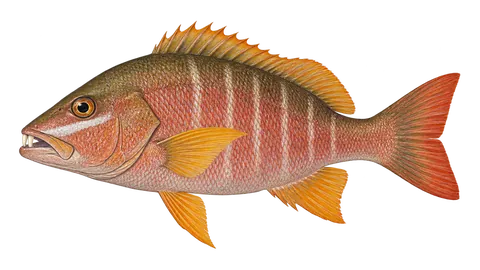
Pink to red snapper with yellow eyes and flanks with fine wavy yellow lines, living on the edge of the shelf, between 90 and 140 m. It rises to shallower water at night and is one of the targets of bottom fishing from the Caribbean to southeastern Brazil.
- common size
- 35–45 cm
- maximum
- 83 cm
- common weight
- 0.6–1 kg
- record/max.
- 8.3 kg
- depth
- 90–140 m
- ideal water
- 18–24 °C
how to recognize it
Small head, yellow eye and long pectoral fins that reach the level of the anus. Back and flanks pink to red, with a silvery sheen below and very fine wavy yellow lines on the sides; fins reddish or pale yellow. Juveniles (under 25 cm) have a dark spot on the back, under the first soft rays of the dorsal fin. It lacks the blotch at the base of the pectoral fin found in the saçupema, and the all-red, forked tail of the olhão.
Also called: carapitanga, vermelho-de-olho-amarelo, pargo-do-olho-amarelo, acarapitanga, acará-aia, vermelho, silk snapper, day snapper, yelloweye snapper
don't confuse with:
where found
open on the large mapWhere to look: Edge of the continental shelf and islands, over rock and gravel bottoms, from 90 to 242 m and more commonly 90 to 140 m. Adults may rise to shallower water at night.
Western Atlantic, from North Carolina (USA) and Bermuda to São Paulo (FishBase), most abundant around the Antilles and the Bahamas. In Brazil it occurs from the north coast to the Southeast, on the shelf edge and on the slope.
coast
when to fish
next 7 days
Loading the next 7 days…
best season
Fished all year. In the tropics spawning happens most of the year; near the edges of its range, in spring and summer, when schools gather. The window of calm sea matters more than the season.
best time of day
Night and twilight. It rises to shallower water at night; the most productive fishing is usually late afternoon and early evening, at 90 to 140 m.
what affects the silk snapper
cold and cold fronts
Lives in cold deep water; a cold front at the surface hardly changes fishing at 100 m.
atmospheric pressure
Small effect; the problem with the front is rough seas.
moon
Feeds more at night, when the moon influences the current on the shelf edge; moderate effect.
rain
Little effect on the fish at 100 m.
water level
Does not apply at sea. The equivalent is the bottom current, which sets the drift.
noise
At this depth the boat's noise barely reaches the fish.
wind
Strong wind pulls the line off vertical. Prefer calm seas.
tide
Tidal current on the shelf edge gathers bait and school.
depth
More by day at 90 to 140 m; at night it rises and can be fished on shallower bottoms.
how to fish
lures
- bottom jig of 150 to 300 g
- LED light above the leader
natural baits
- whole or cut sardine
- squid strips
- cavalinha
tip from an angler
Keep the bait one or two meters off the bottom and, at night, try raising it a few meters: the species rises to shallower water.
- rod
- 5'6" to 6'6", heavy action, 40 to 60 lb
- spinning / baitcasting reel
- deep-sea reel size 6/0 to 9/0 or electric, with 300 to 500 m of line
- line
- braided line 50 to 80 lb
- leader
- fluorocarbon or monofilament 60 to 100 lb, 2 to 3 m, with a two-hook leader
- hook
- circle hook 6/0 to 9/0
accessories
- sinker of 300 to 600 g depending on the current
- descender
- gloves and pliers
catch and release
Brought up from 90 m or deeper, it arrives with barotrauma. If you release it, use a descent device and return the fish to the bottom without delay; in Puerto Rico the device is mandatory on board.
rules for the silk snapper
Rules change; before keeping or transporting fish, check with the state environmental agency.
Puerto Rico (federal waters): up to 5 per person per day
5 per person per day; 15 per boat with 3 or more people details
In federal waters around Puerto Rico, beyond 9 miles from shore, recreational anglers may keep a maximum of 5 fish per day combined from groupers, snappers and parrotfish (up to 15 per boat when 3 or more people are aboard). The silk snapper counts as a snapper under this limit. The limit does not apply to anyone with a commercial license from Puerto Rico or the US Virgin Islands.
Source: 50 CFR 622.431 and 622.444(a)(1) (NOAA Fisheries, US)
Puerto Rico (federal waters): closed Oct 1 to Dec 31
fishing and possession prohibited Oct 1 to Dec 3101/10 to 31/12 details
In federal waters around Puerto Rico, beyond 9 miles from shore, it is prohibited to fish for or have on board silk snapper (carapitanga) from October 1 to December 31 of each year (the rule treats black, blackfin, silk and vermilion snappers together). The possession ban does not apply to fish caught and landed before the closure.
Puerto Rico (federal waters): descent device mandatory on board
1 descent device ready for use by anyone fishing for or carrying reef fish details
Anyone fishing for or carrying reef fish (silk snapper is included in the definition) in Puerto Rico's federal waters must have on board, ready for use, at least one descent device: an instrument able to return the fish to the depth where it was caught, with a minimum weight of 454 g (16 oz) and 18.3 m (60 ft) of line, that releases the fish on its own, by operator action or when it escapes at the bottom.
Mexico: up to 5 per species and 10 saltwater fish per day
5 specimens of the species per angler per day, within the limit of 10 saltwater fish details
In recreational sport fishing in Mexican federal waters, each angler may keep up to 10 marine fish per day, with a maximum of 5 of the same species. The silk snapper (huachinango ojo amarillo) is not among the species reserved for sport fishing (billfish, sailfish, swordfish, dorado, roosterfish and tarpon) and has no limit of its own. Anything over the limit goes back alive into the water, and sport-caught fish is for personal consumption, not for sale. Anglers fishing from a boat need a Conapesca permit.
Mexico (Gulf and Caribbean): up to 3 kg per day for domestic-consumption fishing
3 kg per angler per day, combining groupers and associated species details
In Mexico's federal waters of the Gulf of Mexico and the Mexican Caribbean, the grouper rule lists the species (pargo de lo alto or huachinango ojo amarillo) among the "associated species". For domestic-consumption fishing, each angler may take up to 3 kg per day of any grouper or associated species, for personal and family consumption only, with no sale, using gear that one person can operate alone. The closed season of Feb 1 to Mar 31 under that rule applies to groupers, not to the associated species.
Source: NOM-065-SAG/PESC-2014 (DOF Jul 3, 2015), items 4.1 and 4.13 (Sagarpa/Conapesca)
Colombia: AUNAP license and catch and release as the main practice
personal AUNAP license; keep only fish that meets the minimum size, for personal useconfirm with the agency details
Colombian sport fishing requires the personal, non-transferable AUNAP license (natural persons, nationals or foreigners). The resolution sets catch and release as the main practice and only allows keeping specimens that meet the minimum sizes, for personal use. We found no specific minimum size or marine quota for this species; confirm with AUNAP before taking any fish home.
Source: Resolución AUNAP nº 0549, of Mar 18, 2022 (sport fishing), arts. 6º and 8º
Conservation: Not on the Brazilian national list (Portaria GM/MMA nº 1.667/2026). The IUCN rates it Least Concern (2015 assessment). We found no specific Brazilian federal minimum size or quota for the species.
how much it weighs without taking it out of the water
estimated weight
—
how we calculate
Length-weight relationship W = a·Lb (a = 0.01479, b = 2.96; FishBase (relação peso-comprimento bayesiana, estimativa da própria espécie)). It's an average: a fat or lean fish can vary by 10% to 20%.
more about the silk snapper
The silk snapper (carapitanga) is a snapper of the outer shelf and islands of the western Atlantic, from North Carolina and Bermuda to São Paulo, and is most abundant around the Antilles and the Bahamas. Adults stay on the shelf edge, usually between 90 and 140 m, but reach 242 m, and often rise to shallower water at night. They eat fish, shrimp, crabs, gastropods, cephalopods and tunicates. It reaches 83 cm and 8.3 kg. In the tropics it spawns almost all year; near the edges of its range, only in spring and summer. It is sold fresh and has good flesh, but there are ciguatera reports. Portaria MPA nº 532/2025 also lists it as "dentão", a name that in the app belongs to Lutjanus jocu.
Family: Lutjanidae · predator
fun facts
- Portaria MPA nº 532/2025 lists five names: vermelho, dentão, carapitanga, vermelho-de-olho-amarelo and pargo-do-olho-amarelo.
- In English it is also called day snapper, or "pargo-do-dia".
- Juveniles have a dark spot on the back that disappears with growth, according to FishBase.
in the kitchen
Good flesh, sold fresh; it is good grilled, baked whole or in moqueca. There are ciguatera reports for reef fish; very large specimens call for more care.
similar species



sources and references (10)
The season weights (months), the time of day and the sensitivities (cold, pressure, moon, wind, rain, tide, strong light, murky water and noise) are the app's editorial estimates, based on the literature below and on the field experience of anglers and guides. They are not official data nor a measurement made for this species, and they may vary by region and year. Closed seasons and legal rules appear in the rules section, with the norm and a link.
- scientific FishBase: Lutjanus vivanus (ficha da espécie)Size, length-weight, depth, habitat, distribution, biology, and IUCN status. Page checked on Oct 13, 2026.
- scientific FishBase: nomes populares de Lutjanus vivanusNames by country and language.
- official Portaria GM/MMA nº 1.667, de 27 de abril de 2026: Lista Nacional Oficial de Espécies da Fauna Ameaçadas de Extinção (peixes e invertebrados aquáticos)The species is not on the list. Checked in the DOU of April 28, 2026.
- official Portaria MPA nº 532, de 23 de setembro de 2025: nomes científicos e nomes comuns das principais espécies de peixes de interesse comercialAnnex: Lutjanus vivanus, names "Vermelho", "Dentão", "Carapitanga", "Vermelho-de-Olho-Amarelo" and "Pargo-do-Olho-Amarelo" (checked in the Annex text).
- scientific Allen, G. R. (1985). FAO species catalogue. Vol. 6. Snappers of the world. FAO Fisheries Synopsis 125(6). Roma: FAO.Reference catalogue of the snappers of the world (family Lutjanidae).
- official 50 CFR Parte 622, Subparte S: plano de manejo da zona econômica exclusiva ao redor de Porto Rico (eCFR)Sections 622.431 (definition of reef fish), 622.437(a)(4) (descent device), 622.439(b) (closures by species) and 622.444(a) (daily limits). Consolidated eCFR text checked Oct 13, 2026.
- official NOM-017-PESC-1994 e sua modificação: pesca deportivo-recreativa em águas de jurisdição federal do MéxicoItem 4.9.1: up to 10 marine fish per angler per day, no more than 5 per species. The original text (DOF May 9, 1995) was also read at https://platiica.economia.gob.mx/normalizacion/wp-content/uploads/sites/2/PDF_Normas_Publicas/017-pesc.pdf.
- official NOM-065-SAG/PESC-2014: aproveitamento de meros e espécies associadas no Golfo do México e Mar Caribe (DOF 03/07/2015)Item 4.1 (list of associated species) and item 4.13 (domestic-consumption fishing: 3 kg per angler per day). We did not check whether there were changes after the 2015 text.
- official Resolução AUNAP nº 0549, de 18 de março de 2022: lineamentos para a pesca esportiva e recreativa na ColômbiaSummary of articles 6 (license) and 8 (catch and release, minimum sizes). We did not check the per-species quota and size values, which depend on the full text.
- official Instrução Normativa MMA nº 53, de 22 de novembro de 2005: tamanhos mínimos de captura no litoral do ES ao RSThe species is not in Annexes I and II (checked in the consolidated reproduction of the rule), so there is no federal minimum size under that rule. We found no other federal minimum-size rule or specific quota for the species.