

schoolmaster
Lutjanus apodus
A Caribbean reef snapper with pale bars and yellow fins. It lives in groups near corals and mangroves and takes natural bait and small jigs. It does not occur in Brazil.
- common size
- 25–45 cm
- maximum
- 79 cm
- common weight
- 0.4–2 kg
- record/max.
- 10.8 kg
- depth
- 2–63 m
- ideal water
- 25–29 °C
how to recognize it
Body gray-olive to brownish on the back, with about eight narrow pale vertical bars, which may disappear in large adults; yellow fins. Long snout and a pair of large upper canines, visible with the mouth closed. A blue line, continuous or broken, under the eye, which disappears with growth. The Brazilian baúna (Lutjanus alexandrei) has a reddish body, six vertical white lines and blue spots between the snout and the preopercle.
Also called: cají, cajisote, schoolmaster, schoolmaster snapper
don't confuse with:
where found
open on the large mapWhere to look: Shallow clear-water coral reefs, near corals and gorgonians; juveniles in seagrass, lagoons and mangroves.
Does not occur in Brazil's coastal waters: early records were misidentifications (Moura and Lindeman, 2007). Tropical western Atlantic, from the Bahamas and the Antilles to the Caribbean coasts of Central and South America, down to Trinidad.
when to fish
next 7 days
Loading the next 7 days…
best season
Found year-round in the Caribbean.
best time of day
Night and twilight. By day it stays still in groups in the shade of corals; it feeds more at dusk and at night.
what affects the schoolmaster
cold and cold fronts
A tropical reef fish; strong cold fronts reduce its activity.
atmospheric pressure
Little direct effect.
moon
Moonlit nights make night hunting more active.
rain
Murky water gets in the way.
water level
Not applicable at sea. In the mangrove, the ebbing tide carries juveniles into the channels.
noise
Still groups scatter at the noise of a motor or an anchor.
wind
Strong wind makes it hard to fish stationary over the reef.
tide
Current at the reef edge brings bait and activates the school.
depth
Shallow reefs, from 2 to 20 m for most catches.
how to fish
lures
- small jig head with artificial shrimp
- fly streamer
natural baits
- shrimp
- fish or squid strip
- small crab
tip from an angler
A small natural bait at the coral edge, late in the afternoon, works better than during the day, when the group stays still and wary.
- rod
- 6' to 7', 8 to 17 lb
- spinning / baitcasting reel
- spinning reel 2500 to 3000
- line
- braided line 10 to 20 lb
- leader
- fluorocarbon 15 to 25 lb, 1 m
- hook
- circle 1/0 to 2/0
accessories
- light sinker
- alicate
catch and release
Hold it by the mouth and belly, remove the hook with pliers and release it near the reef.
rules for the schoolmaster
Rules change; before keeping or transporting fish, check with the state environmental agency.
Puerto Rico (federal waters): up to 5 per person per day
5 per person per day; 15 per boat with 3 or more people details
In federal waters around Puerto Rico, beyond 9 miles from the coast, the recreational angler may keep a maximum of 5 fish per day from groupers, snappers and parrotfish combined (up to 15 per boat when there are 3 or more people aboard). The limit does not apply to anyone with a commercial license from Puerto Rico or the U.S. Virgin Islands.
Conservation: Species outside the Brazilian fauna. In Puerto Rico it counts toward the federal quota for groupers, snappers and parrotfish.
how much it weighs without taking it out of the water
estimated weight
—
how we calculate
Length-weight relationship W = a·Lb (a = 0.01514, b = 2.97; FishBase (estimativa bayesiana, comprimento total)). It's an average: a fat or lean fish can vary by 10% to 20%.
more about the schoolmaster
The cají, called schoolmaster in English, is a snapper of the tropical western Atlantic, common in the Bahamas, the Antilles and the Caribbean coasts of Central and South America, down to Trinidad. Adults live on shallow, clear-water coral reefs, often in still groups during the day in the shade of corals and gorgonians; juveniles stay on sandy bottoms with seagrass, in lagoons and mangroves, and sometimes enter brackish water. It eats fish, shrimp, crabs, worms, snails and octopus. It can live over 40 years. Brazilian records were confusion with the baúna (Lutjanus alexandrei), a Brazilian species described in 2007. It is good table fish and takes natural bait and small baits near reefs.
Family: Lutjanidae · predator
fun facts
- Can live over 40 years.
- Juveniles sometimes enter the brackish water of lagoons and mangroves.
in the kitchen
Good white flesh, fried or grilled. Ciguatera has been recorded in reef fish.
similar species
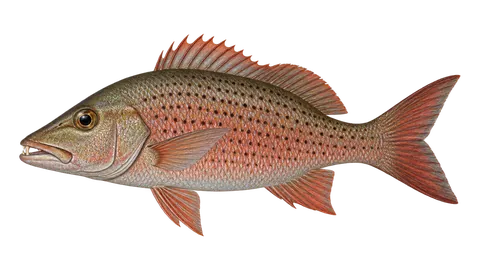
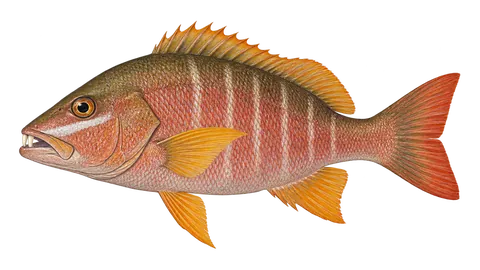
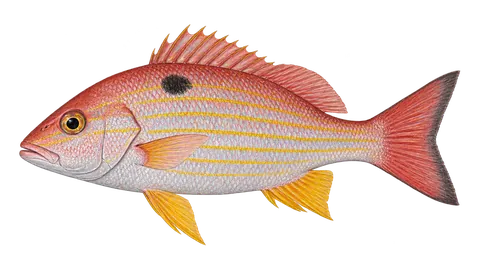
sources and references (7)
The season weights (months), the time of day and the sensitivities (cold, pressure, moon, wind, rain, tide, strong light, murky water and noise) are the app's editorial estimates, based on the literature below and on the field experience of anglers and guides. They are not official data nor a measurement made for this species, and they may vary by region and year. Closed seasons and legal rules appear in the rules section, with the norm and a link.
- scientific FishBase — Lutjanus apodus (ficha da espécie)Names, distribution, biology, length-weight relationship, country list and references. Page checked October 13, 2026. FishBase's country list still includes Brazil; we follow Moura and Lindeman (2007), who did not confirm the species in Brazilian waters.
- scientific Moura, R. L.; Lindeman, K. C. (2007). A new species of snapper (Perciformes: Lutjanidae) from Brazil, with comments on the distribution of Lutjanus griseus and L. apodus. Zootaxa 1422: 31-43.DOI verified in Crossref. Describes the baúna (Lutjanus alexandrei), previously confused with these species.
- scientific Moura, R. L.; Lindeman, K. C. A new inshore snapper species (Lutjanidae) from Brazil and the distributional status of gray snapper and schoolmaster, Lutjanus griseus and L. apodus. Proceedings of the Gulf and Caribbean Fisheries Institute 60.The abstract states that L. griseus and L. apodus do not occur in Brazil's inland waters.
- scientific IUCN Red List — Lutjanus apodus (avaliação global: Pouco Preocupante, LC, 10/10/2015)Global assessment. Link given on the FishBase entry (Red List, version 2025-2).
- official Code of Federal Regulations, 50 CFR Part 622, Subpart S — Regulations specific to the Puerto Rico Management Area (NOAA Fisheries, EUA)Consolidated text in the eCFR, checked October 13, 2026: §622.438 (prohibited species), §622.439 (area and time closures) and §622.444 (quotas). It applies in federal waters, beyond 9 miles from the coast.
- scientific Allen, G. R. (1985). FAO species catalogue. Vol. 6. Snappers of the world: an annotated and illustrated catalogue of lutjanid species known to date. FAO Fisheries Synopsis 125(6). Roma: FAO.
- scientific Carpenter, K. E. (org.) (2002). The living marine resources of the Western Central Atlantic. Vol. 3: Bony fishes part 2 (Opistognathidae to Molidae). FAO Species Identification Guide for Fishery Purposes. Roma: FAO.Chapter Lutjanidae (Anderson Jr., W. D.).