

- common size
- 25–40 cm
- maximum
- 60 cm
- common weight
- 0.2–0.7 kg
- record/max.
- — kg
- depth
- 0–100 m
- ideal water
- 24–29 °C

the right time
to be on the water
Choose the place and the species. The index, from 0 to 100, combines weather, sun, moon and tide with each fish's habits. Up to 28 days, with each day's confidence.
Loading the forecast…
—
Looking for alerts within 30 km…
Looking for what anglers have logged near here…
what you need to fish herelicense, certification and boat documents
fish likely at this spot
Tap a fish to see its forecast.
hour by hour
slide your finger or mouse over the chart to see each hoursee hour-by-hour table
why this index at —?
choose the day
the fishing month at a glance
what's the best window for the crew?
Choose how many fishing days. We compare each stretch by its average index, discount days with a warning or closed season, and show the 3 best.
trend for the coming weeks
Line: the middle value of 31 simulations of the American GEFS model. Band: where 8 out of 10 fall. Narrow, firm trend; wide, high uncertainty.
everything about the threadfin jack
how to recognize it
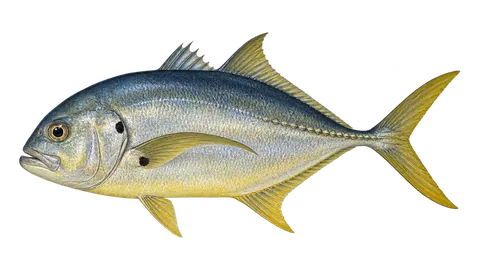
Tall, diamond-shaped body, flattened on the sides, with an angular head profile; silvery to gray-silver. It has an elongated black spot at the upper corner of the gill cover and small dark spots between the bases of the second dorsal fin rays, which is the mark that separates it from the other jacks. The lobes of the second dorsal and anal fins are long, like filaments, and the pectoral fins are longer than the head. The chest has no scales up to the base of the pectoral fins. It looks very much like the African pompano (Alectis ciliaris), with a blunter snout and a body without visible scales.
Also called: xaréu-de-fios, jurel chicuaca, jurel de hebra, Threadfin jack, Thread pompano
don't confuse with:
where found
open on the large mapWhere to look: Coastal and open-sea waters near the shore, over sand and rock bottoms, from the surface down to about 100 m; there is a report of a catch at the mouth of a river.
Not found in Brazil. Eastern Pacific, from southern Baja California and the Gulf of California (Mexico) to Ecuador, including Revillagigedo, Galápagos and Malpelo. FishBase lists Mexico, Guatemala, El Salvador, Honduras, Nicaragua, Costa Rica, Panama, Colombia and Ecuador.
when to fish
best season
Occurs all year and there is no seasonal study. The app gives more weight to the warmer months, May to November.
best time of day
Daytime, with peaks at dawn and dusk. Studies on the species are lacking. The app's estimate follows the pattern of coastal jacks, with more activity at dawn and dusk.
what affects the threadfin jack
cold and cold fronts
Cold water, as in winter upwellings, tends to keep jacks away from the shore.
atmospheric pressure
A front with strong wind stirs the sea and hinders; stable pressure helps.
moon
Small effect and no study for the species.
rain
Little effect; a thunderstorm with lightning: get out of the water.
water level
Not applicable at sea.
noise
A school passing along the shore spooks at a boat banging and a motor nearby.
wind
Strong wind hinders casting and controlling the drifting boat.
tide
Current at river mouths and points concentrates food and schools.
depth
From midwater down to about 100 m; the fishing records are from coastal waters.
how to fish
lures
- metal jig 20 to 60 g
- silicone shad on a jig head
- metal spoon
natural baits
- live or dead sardine or anchovy
- squid strips
- shrimp
tip from an angler
Like the coastal jacks, it strikes bait in motion: retrieve the jig with short pauses. If a thread-finned jack shows up, check the spot on the gill cover and the small spots at the base of the dorsal fin before deciding what to do.
- rod
- 6' to 7', medium-fast action, 10 to 20 lb
- spinning / baitcasting reel
- 3000 to 5000 spinning reel, with smooth drag
- line
- braid 20 to 30 lb
- leader
- fluorocarbon 20 to 40 lb, 1 to 1.5 m
- hook
- circle 1/0 to 3/0 on natural bait; assist hooks on the jigs
accessories
- alicate
- luvas
- decompression device (descender) if you fish the bottom
catch and release
Hold it firmly by the jaw and support the body; avoid touching the gills. If it comes from depth, release it without delay. Release it facing the current and only when it swims on its own.
rules for the threadfin jack
Rules change; before keeping or transporting fish, check with the state environmental agency.
Mexico: up to 5 per species and 10 saltwater fish per day
5 specimens of the species per angler per day, within the limit of 10 saltwater fish details
In recreational sport fishing in Mexican federal waters, each angler may keep up to 10 marine fish per day, no more than 5 of the same species. The threadfin jack is not among the species reserved for sport fishing (marlin, sailfish, swordfish, "sábalo o chiro," roosterfish and dorado, up to 50 nautical miles from shore, item 0.3 of the standard) and has no quota of its own. Fish over the limit go back alive (item 4.9.5), and sport-caught fish may not be sold. Anglers fishing from a boat need the permits of the Federal Duties Law; anglers fishing from shore do not (item 4.3).
Costa Rica: Incopesca sport fishing license
Personal Incopesca license, for people over 16confirm with the agency details
In the regulation of the Fisheries and Aquaculture Law (Decree 36782, of May 24, 2011), art. 69, sport fishing is authorized only for natural persons over 16, with a license issued by Incopesca; tourists, whether national or foreign, also need the license. Art. 68 limits the landing of large pelagics to 5 per trip, and art. 66 promotes catch and release, but the rule sets no quota for this species. The decree was later amended (Decree 39458), so confirm the current rule with Incopesca.
Panama: new sport fishing decree in force from Dec 10, 2026
Executive Decree No. 9 (Jun 10, 2026), in force from Dec 10, 2026confirm with the agency details
ARAP published Executive Decrees No. 9 and No. 10, of Jun 10, 2026, in the Official Gazette. The first regulates sport fishing throughout the territory; the second protects billfish (sailfish and marlins). Both take effect on Dec 10, 2026, after six months of adaptation. We did not verify the text: the press report gives no catch limits, sizes or license requirements. Before fishing in Panama, check with ARAP.
Colombia: AUNAP license and catch-and-release in sport fishing
Individual AUNAP license; catch-and-release guidanceconfirm with the agency details
AUNAP Resolution 0549 of 2022 sets the guidelines for sport fishing for recreational purposes in Colombia. Anyone fishing needs a permit: for a natural person, Colombian or foreign, it is a personal, non-transferable license (art. 6). The rule uses "capture and release" as guidance. We did not verify the daily limit or the minimum sizes by species: check with AUNAP before keeping any fish.
Conservation: Of little concern globally. Not listed in Mexico's NOM-059-SEMARNAT-2010.
how much it weighs without taking it out of the water
estimated weight
—
how we calculate
Length-weight relationship W = a·Lb (a = 0.01445, b = 2.93; FishBase (relação peso-comprimento bayesiana, estimativa da própria espécie)). It's an average: a fat or lean fish can vary by 10% to 20%.
more about the threadfin jack
Eastern Pacific jack, from southern Baja California and the Gulf of California to Ecuador, with records also at the Revillagigedo, Galápagos and Malpelo islands. It is a coastal, midwater fish: FishBase describes it as benthopelagic, and STRI's regional survey gives a depth of 0 to 100 m. Adults are opportunistic predators, eating bottom and midwater fish, squid and crustaceans. It reaches 60 cm, and there is a report of a 66 cm fish caught near San José del Cabo, Mexico. No directed fishery is known and catch reports are rare; the fish is sold fresh, salted or dried, and FishBase lists it among the sport fish.
Family: Carangidae · predator
fun facts
- In English it is threadfin jack or thread pompano, for the filaments on the dorsal and anal fins.
- According to the author of a Mexican fish guide, it is one of the rarest jacks in the Mexican Pacific: he has seen it for sale only once, in the markets of the Los Cabos region.
- Juvenile Alectis ciliaris also have very long filaments, which makes the two hard to tell apart.
in the kitchen
Sold fresh, salted or dried in the region, according to FishBase. The author of a Mexican fish guide considers it good eating and says he has rarely seen it for sale.
similar species


sources and references (9)
The season weights (months), time of day and sensitivities (cold, pressure, moon, wind, rain, tide, strong light, murky water and noise) are the app's editorial estimates, based on the literature below and on field experience of anglers and guides. They are not official data or measurements made for this species, and may vary by region and year. Closed seasons and legal rules appear in the rules section, with the standard and a link. The common size starts from FishBase's common length (30 cm), and the common weight is calculated from the length-weight relationship.
- scientific FishBase: Euprepocaranx dorsalis (ficha da espécie)Size, length-weight, depth, habitat, distribution, biology, and IUCN status. Page checked on Oct 13, 2026.
- scientific FishBase: nomes populares de Euprepocaranx dorsalisNames by country and language.
- scientific Robertson, D. R. & Allen, G. R. Shorefishes of the Eastern Pacific online information system. Smithsonian Tropical Research Institute: Euprepocaranx dorsalisDescription, colors, size, depth and distribution in the eastern Pacific. Page checked on 13/10/2026. It gives a depth of 0 to 100 m, against 60 to 100 m in FishBase; we adopted the wider range, which matches the reported coastal catches.
- technical Mexican Fish (mexican-fish.com): ficha do Threadfin Jack (Euprepocaranx dorsalis)Independent guide to Mexican Pacific fishes, with photos of catches and the author's observations; not an official source. Page checked on 13/10/2026. It cites specimens up to 66 to 67 cm from the Los Cabos region (FishBase and STRI give 60 cm; we kept 60 cm), and says the species is rare, eats fish, squid and crustaceans, and is confused with Alectis ciliaris.
- official DOF: Modificação da NOM-017-PESC-1994, para regular a pesca deportivo-recreativa em águas de jurisdição federal do México (publicada em 25/11/2013)Species reserved for sport fishing (item 0.3), permits by mode (4.3), daily quotas at sea (4.9.1), catch and release (4.9.5), closed areas and seasons (4.10), and the ban on selling the fish (4.11). Text checked Oct 13, 2026. The DOF text carries only the signature date of Oct 14, 2013; the publication date (Nov 25, 2013) comes from Secretaría de Economía rules that cite the amendment.
- official NOM-059-SEMARNAT-2010 (DOF 30/12/2010) e modificação do Anexo Normativo III (DOF 14/11/2019): lista de espécies em risco do MéxicoSearch by scientific name in the two texts published in the DOF (the 2019 amendment is at https://dof.gob.mx/nota_detalle.php?codigo=5578808&fecha=14/11/2019): the species is not on the list. Checked Oct 13, 2026.
- official Decreto Executivo nº 36782-MINAET-MAG-MOPT-TUR-SP-S-MTSS, de 24/05/2011: Regulamento da Lei de Pesca e Aquicultura da Costa RicaChapter XVIII (sport fishing), arts. 66 to 69, and the requirements for the sport fishing card. Text checked Oct 13, 2026; the decree was amended later (Decree 39458) and the amendments were not read.
- press La Estrella de Panamá: Panamá implementa nuevas reglas para la pesca deportiva en diciembre (15/06/2026)Reports Executive Decrees No. 9 and No. 10 of ARAP, dated 10/06/2026, and their entry into force on 10/12/2026. The matter contains no catch limits, sizes or licenses; the text of the decrees was not read.
- official AUNAP (Colômbia): Resolução 0549 de 2022, lineamientos de ordenación pesquera para la pesca deportiva con fines recreativosWe confirmed the existence of the rule, the dates and the requirement for a personal card (art. 6, cited in an AUNAP notice). We did not read the articles on the daily quota and minimum sizes, so those figures are left out.
how we calculatewhere each number comes from
The weather comes from three independent global models, cross-checked hour by hour: when they agree, confidence goes up; when they diverge, the band between them shows on the chart. Beyond 16 days, we use the GEFS ensemble of 31 simulations: if 20 of the 31 predict rain, the chance of rain is 65%. Sun and moon are calculated astronomically, with no uncertainty.
The index adds up, weighted for each species: time of day (species curve anchored to real sunrise and sunset), moon (transits, rise and set, phase), pressure (3 h trend and 24 h swing), water temperature (in rivers, estimated from air temperature; at sea, estimated by an ocean model), wind, rain, clouds, tide and the month in the species' cycle.
sources for this lookup
how accurate the forecast is
Accuracy measured in the reference project (4 regions, 93 days, forecast vs. observed): maximum temperature is off by 0.6 °C on average the next day and 1.7 °C at 7 days; rain of 5 mm or more is detected 76% of the time the next day and 57% at 7 days. Detection isn't everything: the false alarm rate isn't published here yet, and 93 days in 4 regions is still a small sample. We now also measure every day, at the app's destinations: