Skip to content
catalog Carangidae · predator

green jack

Caranx caballus

EstuarySea

Schooling jack of the eastern Pacific, slender, olive green on top and silver below. Fast and easy to find, it takes small jigs and natural bait. In some places it is already overfished.

Also called: xerelete-verde, green jack

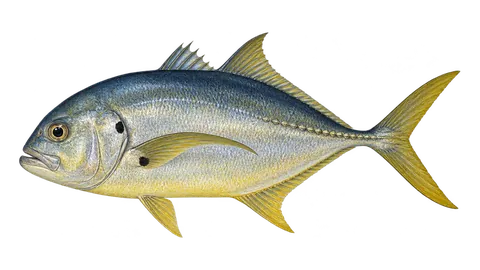
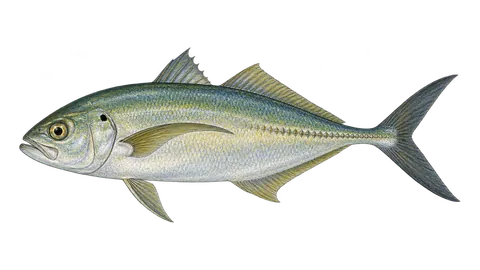
Scientific illustration of Green jack
common size
25–40 cm
maximum
55 cm
common weight
0.3–1.1 kg
record/max.
2.8 kg
depth
3–100 m
ideal water
22–28 °C
overview

who is the green jack

Small schooling carangid of the eastern Pacific, from southern California to Peru, including the Gulf of California and the oceanic islands. It moves in schools over soft bottoms, close to shore but also in deeper water down to about 100 m, and enters estuaries; juveniles are common in estuarine waters. It eats mainly silver fish, but also squid, shrimp and other invertebrates. It reaches about 55 cm and 2.8 kg and lives up to 8 years. It is sold fresh, salted, dried or smoked, and is also processed into meal and oil. In sport fishing it is a light-tackle and jig fish, fast and easy to find. A 2012 study in the Las Perlas archipelago, Panama, concluded that it is overfished there.

fun facts

  • It is called cocinero in Guatemala, Mexico, Nicaragua and Peru, and caballa in Colombia, Costa Rica, Ecuador and Guatemala.
  • It has been seen in large numbers in Hawaii, where it did not become established.
  • Lives up to 8 years, according to FishBase; in Panama it spawns two to three times a year.
how to recognize it

identification

Moderately compressed and relatively slender body, light olive to dark blue-green back, silvery-grey to golden flanks and pale fins. Black spot on the gill cover; juveniles have about seven dark bars. Well-developed transparent adipose eyelid, chest fully scaled and 45 to 56 strong scutes in the straight part of the lateral line, more than in other jacks. It is smaller and slimmer than the Pacific crevalle jack (Caranx caninus) and the bigeye trevally (Caranx sexfasciatus).

how green jack fishing looks

Loading the next 7 days…

Each card shows the day's index (0 to 100) and, below it, a strip with the index for each hour, from 0h to 23h. from poor to excellent.

distribution

where found

open on the large map

Does not occur in Brazil. Eastern Pacific: from southern California (United States) to Peru, including the Gulf of California and the Galápagos Islands. It has already been recorded in large numbers in Hawaii, without becoming established.

Habitat: Schools over soft bottoms near shore and in deeper water; juveniles in estuaries.

calendar and clock

when to fish

best season

time of yearbest: Mar–Oct
JanFebSeaAprMayJunJulAugSepOctNovDec

Fished all year. Bait schools near the beach and diving birds count for more than the month.

best time of day

0h6h12h18h sunrise ~6amsunset ~6pm

Daytime, with peaks at dawn and dusk. Feeds by day, in active schools at the surface and in midwater, with peaks at dawn and late afternoon.

weather, water and behavior

what affects the green jack
sensitivity The little bars show how much each factor affects this species. Five full: it feels it a lot.

cold and cold fronts

Cold upwelling water pushes the schools away from shore.

atmospheric pressure

Little direct effect.

moon

Small effect.

rain

Little effect; tolerates muddy water from river mouths.

water level

Not applicable at sea.

noise

Not very sensitive when the school is feeding.

wind

A light chop helps; strong wind makes casting light lures harder.

tide

Running tide at mouths and points concentrates the schools.

depth

Surface and midwater, down to about 30 m in sport fishing.

technique, gear and bait

how to fish

rod
6'6" to 7'6", 10 to 20 lb
spinning / baitcasting reel
3000 to 5000 spinning reel
line
braided line 15 to 30 lb
leader
fluorocarbon 20 to 40 lb, 1 m
hook
treble hooks 1/0 to 3/0 or circle 2/0 to 4/0 for live bait

lures

  • metal jig 20 to 60 g
  • small popper 8 to 12 cm
  • sabiki
  • heavy spoon

natural baits

  • live sardine or anchoveta, or cut pieces
  • shrimp
  • squid strips

accessories

  • alicate
  • ruler to check the size

tip from an angler

When the school boils at the surface, cast the jig past it and reel in fast. Release small fish: a study done in Panama recommended raising the minimum landing size to protect the larger spawners.

what the law says

rules for the green jack

Summary of the regulations we found, with the source for each. Rules change; before keeping or transporting fish, check with the state environmental agency.
Conservation: Of little concern globally, but a 2012 study (Mair et al.) concluded that the species is overfished in the Las Perlas archipelago, Panama.

Mexico: up to 5 per species and 10 saltwater fish per day

5 specimens of the species per angler per day, within the limit of 10 saltwater fish

In recreational sport fishing in Mexican federal waters, each angler may keep up to 10 marine fish per day, no more than 5 of the same species. The green jack is not among the species reserved for sport fishing (marlin, sailfish, swordfish, sábalo, roosterfish and dorado, up to 50 nautical miles from shore, item 0.3 of the regulation) and has no bag limit of its own. Fish over the limit go back alive to the water, and sport-caught fish may not be sold. Anglers fishing from a boat need an individual permit; from the shore, they do not.

Source: Amendment to NOM-017-PESC-1994 (recreational sport fishing in federal waters of Mexico), published in the DOF on Nov 25, 2013, items 0.3, 4.3, 4.9.1, 4.9.5, 4.11 and 4.14 (Sagarpa/Conapesca)

Colombia: AUNAP license and catch-and-release in sport fishing

Individual AUNAP license; catch-and-release guidanceconfirm with the agency

AUNAP Resolution 0549 of 2022 sets the guidelines for recreational sport fishing in Colombia. Anglers need a permit: for an individual, Colombian or foreign, it is a personal, non-transferable card. The rule makes "catch and release" the guidance and admits keeping only part of the catch for personal consumption, respecting the minimum sizes it sets. We did not confirm the daily limit or the minimum sizes by species: check with AUNAP before keeping fish.

Source: Resolución AUNAP 0549 of 2022 (fishing management guidelines for sport fishing for recreational purposes), arts. 6 and 8; Official Gazette of Mar 25, 2022

catch and release
catch and release Releasing the fish alive, quickly and with a wet hand. During a closed season it isn't always allowed: what the regulation says applies.

Tough fish: take the hook out quickly with pliers, keeping it in the water, and release it head down. Return the small ones.

in the kitchen

Sold fresh, salted, dried or smoked; goes well fried or roasted soon after catching.

calculator

how much it weighs without taking it out of the water

Length-weight relationship W = a·Lb (a = 0.01862, b = 2.98; FishBase (relação peso-comprimento bayesiana, estimativa da própria espécie)). It's an average: a fat or lean fish can vary by 10% to 20%.

estimated weight

—

sources and references

The season weights (months), the time of day and the sensitivities (cold, pressure, moon, wind, rain, tide, strong light, murky water and noise) are the app's editorial estimates, based on the literature below and on the field experience of anglers and guides. They are not official data nor a measurement made for this species, and they may vary by region and year. Closed seasons and legal rules appear in the rules section, with the norm and a link.

  1. scientific FishBase: Caranx caballus (ficha da espécie)Size, length-weight, depth, habitat, distribution, biology, and IUCN status. Page checked on Oct 13, 2026.
  2. scientific FishBase: nomes populares de Caranx caballusNames by country and language.
  3. scientific Robertson, D. R. & Allen, G. R. (2024). Shorefishes of the Eastern Pacific online information system, versão 3.0. Smithsonian Tropical Research Institute: Caranx caballusDescription, colors, size, depth and distribution in the eastern Pacific. Page checked Oct 13, 2026. Cites a length of at least 70 cm; we kept FishBase's 55 cm (FL).
  4. scientific Mair, J. M., Cipriani, R., Guzman, H. M. & Usan, D. (2012). Fishery of the Green Jack Caranx caballus (Osteichthyes: Carangidae) in Las Perlas Archipelago, Pacific Panama. Revista de Biología Tropical 60(3): 1271-1288.We read the abstract: 4,990 fish measured in landings between 2005 and 2006, mean length 36.1 cm, half the population mature at 38.8 cm (standard length), spawning two to three times a year, and a conclusion of overfishing in the archipelago. We have not checked the full article.
  5. official DOF: Modificação da NOM-017-PESC-1994, para regular a pesca deportivo-recreativa em águas de jurisdição federal do México (publicada em 25/11/2013)Reserves species for sport fishing (item 0.3), permits (4.3 and 4.14), rods and hooks (4.6), bait (4.7), daily limits at sea (4.9.1) and in fresh water (4.9.2), catch and release (4.9.5), closed zones and seasons (4.10), and a ban on selling the catch (4.11). Text checked on Oct 13, 2026; the publication date (Nov 25, 2013) comes from Secretaría de Economía rules that cite the amendment.
  6. official AUNAP (Colômbia): Resolução 0549 de 2022, lineamientos de ordenación pesquera para la pesca deportiva con fines recreativosWe reviewed, in a partial transcript of the text, what the rule says about the personal license (art. 6) and the catch-and-release guidance (arts. 8 to 10). We could not read the articles on the daily bag limit and minimum sizes; the draft rule provided for a personal-consumption limit that AUNAP said it would revise, so those figures are left out.
don't confuse

similar species