

tiger grouper
Mycteroperca tigris
Reef badejo of the Caribbean and the Gulf of Mexico, with about 11 thin, pale lines slanting across the back. It has a February-to-March closed season in Mexico and closes from February to April in Puerto Rico.
- common size
- 40–60 cm
- maximum
- 101 cm
- common weight
- 0.9–3.1 kg
- record/max.
- 10.0 kg
- depth
- 10–40 m
- ideal water
- 24–29 °C
how to recognize it
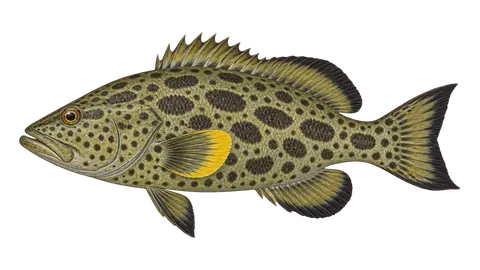
Elongated body, oval in cross-section, with about 11 thin, pale lines on the back, slanting downward and forward. No other Caribbean grouper has this pattern of diagonal lines. The corner of the preopercle is rounded, without a lobe, and the teeth are large, with well-developed canines. The badejo-ferro (Mycteroperca venenosa) has round dark spots and a yellow pectoral tip, without the diagonal lines.
Also called: badejo-tigre, serigado, tiger grouper
don't confuse with:
where found
open on the large mapWhere to look: Coral reefs and rock bottoms, from 10 to 40 m, hidden among corals and sponges.
In Brazil, FishBase gives the species for the tropical and subtropical coast, down to about 29°S; we found no survey stating which stretches are most common. Outside Brazil, it ranges from southern Florida and the Gulf of Mexico (where it became abundant at the Flower Garden Banks, Texas) to the Guianas and Venezuela.
coast
when to fish
next 7 days
Loading the next 7 days…
best season
No set season, as it is a tropical reef fish. In Puerto Rico's federal waters fishing closes from February to April, and in Mexico the grouper closed season runs from February to March. In Brazil there is no specific closed season.
best time of day
Daytime, with peaks at dawn and dusk. Ambush predator: it stays still beside its shelter and strikes when prey is close, by day and during the light changes at dawn and dusk.
what affects the tiger grouper
cold and cold fronts
A tropical reef fish; cold fronts reduce its activity.
atmospheric pressure
A churned sea after a cold front shuts down bottom fishing.
moon
Effect poorly known; spring tides move more bait on the reef.
rain
Little effect at depth.
water level
Not applicable at sea.
noise
Anchor and hull knocking on the reef scare fish.
wind
Strong wind makes it hard to hold position over the spot.
tide
Moderate current activates feeding at the reef edge.
depth
Usually 10 to 40 m.
how to fish
lures
- jig 80 to 200 g
- mid-water plug over the reef
natural baits
- small live fish
- lula
tip from an angler
Since the fish waits for prey to pass, keep the bait near the rock and lift the fish in the first few metres: once it has dived into a hole, it cuts the line on the coral.
- rod
- 6' to 7', 30 to 60 lb
- spinning / baitcasting reel
- baitcasting reel 300 to 400 or spinning reel 6000 to 8000, with strong drag
- line
- braided line 50 to 65 lb
- leader
- fluorocarbon 60 to 100 lb, 1.5 m
- hook
- circle 5/0 to 8/0
accessories
- descender (fish descender)
- long-nose pliers
- luvas
catch and release
If it comes from more than 15 to 20 m, use a descender. Support the belly and do not hold large fish by the mouth alone. In Puerto Rico (federal waters) and in Mexico, respect the closed seasons.
rules for the tiger grouper
Rules change; before keeping or transporting fish, check with the state environmental agency.
Mexico: grouper closed season from Feb 1 to Mar 31
catch prohibited from Feb 1 to Mar 3101/02 to 31/03 details
In Mexico, catching all grouper species, a group in which NOM-065 includes the badejo-tigre (cuna gata or mero vampiro), is banned from Feb 1 to Mar 31 in federal waters of the Gulf of Mexico off Tabasco, Campeche, Yucatán and Quintana Roo, up to the border with Belize. Bottom longlines are also banned in that period. The agreement does not mention sport fishing: confirm with Conapesca whether it applies to your type of fishing.
Mexico: up to 3 kg of grouper per angler per day (household consumption)
3 kg per angler per day details
In federal waters of the Gulf of Mexico and the Caribbean, NOM-065 allows, for household-consumption fishing, at most 3 kg per angler per day of any grouper species or associated species, such as the badejo-tigre. The fish is for the angler's and family's own consumption only, may not be sold, and only equipment that one person can operate alone is allowed. Sport fishing has its own rule (NOM-017-PESC-1994), which we did not check.
Source: NOM-065-SAG/PESC-2014 (DOF Jul 3, 2015), items 4.1 and 4.13 (Sagarpa/Conapesca)
Puerto Rico (federal waters): closed from Feb 1 to Apr 30
fishing and possession prohibited from Feb 1 to Apr 3001/02 to 30/04 details
In federal waters around Puerto Rico, beyond 9 miles from shore, it is prohibited to fish for or have on board black, red, tiger, yellowedge and yellowfin grouper from February 1 to April 30 each year. The badejo-tigre is the tiger grouper on the list. The possession ban does not apply to fish caught and landed before the closure.
Puerto Rico (federal waters): up to 5 per person per day
5 per person per day; 15 per boat with 3 or more people details
In federal waters around Puerto Rico, beyond 9 miles from the coast, the recreational angler may keep a maximum of 5 fish per day from groupers, snappers and parrotfish combined (up to 15 per boat when there are 3 or more people aboard). The limit does not apply to anyone with a commercial license from Puerto Rico or the U.S. Virgin Islands.
Conservation: Not on the Brazilian national list (Ministerial Ordinance GM/MMA No. 1.667/2026).
how much it weighs without taking it out of the water
estimated weight
—
how we calculate
Length-weight relationship W = a·Lb (a = 0.01122, b = 3.06; FishBase (relação peso-comprimento bayesiana, estimativa da própria espécie)). It's an average: a fat or lean fish can vary by 10% to 20%.
more about the tiger grouper
The badejo-tigre lives in the western Atlantic, from southern Florida and the Gulf of Mexico to Brazil. It is a fish of coral reefs and rock bottoms, from 10 to 40 m, that ambushes its prey, hidden among corals and sponges, and lets anglers get close. It frequents cleaning stations. Of the prey in 59 specimens studied, all were fish. It is born female and becomes male as it grows: in Bermuda, fish under 37 cm were all female and those over 45 cm were male. It reaches 101 cm and 10 kg, and FishBase gives 40 cm as the common length. It is a commercial and sport fish. The IUCN classifies it as Data Deficient, and FishBase records ciguatera cases with the species.
Family: Epinephelidae · predator
fun facts
- Ambush hunter: it stays still among corals and sponges and lets prey come to it.
- It visits cleaning stations, where smaller fish remove parasites from it.
- In Bermuda, fish under 37 cm were all female and those over 45 cm were male.
in the kitchen
It is sold fresh and is commercially caught, but FishBase records ciguatera cases with the species. On Caribbean reefs, follow local health advice on size and area before eating it.
similar species


sources and references (8)
The season weights (months), the time of day and the sensitivities (cold, pressure, moon, wind, rain, tide, strong light, murky water and noise) are the app's editorial estimates, based on the literature below and on field experience from anglers and guides. They are not official data or measurements made for this species and may vary by region and year. Closed seasons and legal rules appear in the rules section, with the rule and link. The common size and weight ranges, water temperature and typical depth are also editorial estimates, anchored in FishBase data.
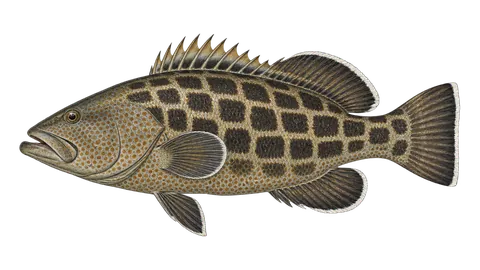
- scientific FishBase: Mycteroperca tigris (ficha da espécie)Size, length-weight, depth, habitat, distribution, biology and IUCN status. Page checked Oct 13, 2026. Common size and weight ranges, water temperature and typical depth: editorial estimates anchored in FishBase data. Name of this profile: 'serigado' is the only Brazilian Portuguese name FishBase lists for the species, but in Brazilian rules sirigado is the badejo-quadrado; so this profile uses 'badejo-tigre', a translation of 'tiger grouper'.
- scientific FishBase: nomes populares de Mycteroperca tigrisNames by country and language.
- official Portaria GM/MMA nº 1.667, de 27 de abril de 2026: Lista Nacional Oficial de Espécies da Fauna Ameaçadas de Extinção (peixes e invertebrados aquáticos)The species is not on the list. Checked in the DOU of April 28, 2026.
- official México: NOM-065-SAG/PESC-2014, para regular o aproveitamento das espécies de mero e espécies associadas no Golfo do México e no Mar do Caribe (DOF de 03/07/2015)Text published in the Diario Oficial de la Federación, in a copy from the Secretaría de Economía, read Oct 13, 2026: item 4.1 (list of grouper species), 4.8 (minimum size of the mero rojo) and 4.13 (household-consumption fishing: up to 3 kg per angler per day). Sport fishing has its own rule (NOM-017-PESC-1994, amended in 2013), whose limits were not checked.
- official México: acordo que modifica a veda de todas as espécies de mero no Golfo do México e no Caribe (DOF de 03/03/2017; acordo original de 14/02/2007)Sets the closed season from Feb 1 to Mar 31, starting in 2018, in federal waters off Tabasco, Campeche, Yucatán and Quintana Roo, and bans bottom longlines in that period. The text does not mention sport fishing. We found no later amendment; confirm each season with Conapesca.
- official 50 CFR § 622.439: fechamentos de área e de época nas águas federais de Porto Rico (NOAA Fisheries, EUA)Consolidated text of the Code of Federal Regulations, checked Oct 13, 2026: paragraph (b)(1), closure from February 1 to April 30 for black, red, tiger, yellowedge and yellowfin grouper. It applies in federal waters, beyond 9 miles from shore.
- official 50 CFR § 622.444: cotas de pesca recreativa nas águas federais de Porto Rico (NOAA Fisheries, EUA)Consolidated text of the Code of Federal Regulations, checked Oct 13, 2026: paragraph (a)(1), combined quota for groupers, snappers and wrasses.
- scientific Heemstra, P. C.; Randall, J. E. (1993). FAO species catalogue. Vol. 16. Groupers of the world (family Serranidae, subfamily Epinephelinae). FAO Fisheries Synopsis 125(16). Roma: FAO.General reference for identifying groupers worldwide.