

irish mojarra
Diapterus auratus
Silvery mojarra of mangroves, lagoons and estuaries of the western Atlantic, with yellowish pelvic and anal fins. It bites on light rod, with small bottom bait, and is eaten fresh.
- common size
- 15–25 cm
- maximum
- 43 cm
- common weight
- 0.1–0.2 kg
- record/max.
- 1.0 kg
- depth
- 0–10 m
- ideal water
- 24–30 °C
how to recognize it
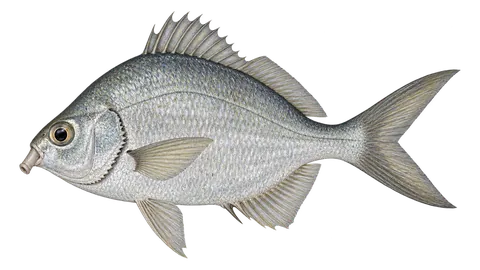
Deep-bodied, diamond-shaped gerreid, compressed and silvery to olive, darker on the back. Concave head profile and very protractile mouth, which projects downward like a tube. Spiny part of the dorsal fin with a thin black edge; pelvic and anal fins yellowish; tail deeply forked. Second anal spine longer and thicker than the third. Juveniles have three narrow dark bars. It is separated from the carapicu (Eucinostomus) by its deeper body and size; from the carapeba (Diapterus rhombeus) only by counts and examination of the preopercle, which is why the two are often confused in the field.
Also called: carapeba, carapicu, carapeba-dourada, Irish mojarra
don't confuse with:
where found
open on the large mapWhere to look: Shallow, brackish waters: mangrove creeks, coastal lagoons, sheltered bays and sand bottoms with submerged vegetation. Juveniles occupy more habitats than adults.
In Brazil, FishBase gives the species to the coast of São Paulo, and there are museum records from Pará to Santa Catarina; it lives in estuaries, coastal lagoons and mangroves. Outside Brazil, from the southern United States and the Greater Antilles to the continental Caribbean, the Guianas and Venezuela.
coast
states
Pará, Maranhão, Piauí, Ceará, Rio Grande do Norte, Paraíba, Pernambuco, Alagoas, Sergipe, Bahia, Espírito Santo, Rio de Janeiro, São Paulo, Paraná, Santa Catarina
when to fish
next 7 days
Loading the next 7 days…
best season
It bites all year on the tropical coast; late spring and summer, with warm water, tend to produce more. In the estuaries of the Southeast and South, cold winter reduces activity.
best time of day
Daytime, with peaks at dawn and dusk. It forages on the bottom all day; early morning and late afternoon tend to produce more on light tackle.
what affects the irish mojarra
cold and cold fronts
A cold front and falling water temperature push the school into deeper, sheltered stretches of mangrove.
atmospheric pressure
Little effect; the bite falls on rough sea and lagoon days right after the front.
moon
Small effect; full-moon and new-moon tides stir the bottom more and move the school.
rain
Heavy rain brings fresh water and mud into the lagoon and may drive the school away; light drizzle does not bother it.
water level
At low tide the school concentrates in channels and pools; on the rising tide it spreads through the mangrove.
noise
Moderate sensitivity: stamping hard on the pier and a nearby motor drive off the shallow school.
wind
Strong wind raises chop on open lagoons and muddies the water; in a sheltered channel it matters little.
tide
Moving tide, rising and falling, brings food and leaves the fish more active; slack tide produces less.
depth
Usually in less than 5 m, close to the bottom.
how to fish
natural baits
- shrimp pieces
- sea worm (polychaete)
- marisco
- fish paste
tip from an angler
Small bait, thin line and light sinker near the bottom; chum with crushed shrimp shell to hold the school in the channel.
- rod
- 2 to 3 m cane pole or ultralight rod of 5'0" to 6'6", 2 to 8 lb
- spinning / baitcasting reel
- spinning reel 1000 to 2000
- line
- monofilament 0.16 to 0.25 mm or braid 6 to 10 lb
- leader
- fluorocarbon 0.20 to 0.30 mm, 40 to 60 cm
- hook
- maruseigo or chinu, small, 10 to 14
accessories
- small float
- light sinker
- landing net
catch and release
Wet your hands, hold the fish firmly without squeezing, and remove the hook quickly. Watch out for the firm spines of the dorsal and anal fins.
rules for the irish mojarra
Rules change; before keeping or transporting fish, check with the state environmental agency.
Mexico: up to 10 marine fish per angler per day, no more than 5 of the same species
10 marine specimens per angler per day; no more than 5 of the same species details
In Mexico's federal waters, sport and recreational fishing for marine species has a limit of 10 specimens per angler per day, with no more than 5 of any one species. Fish over the limit may only be taken if released alive. Sport-caught fish belong to the permit holder and may not be sold; fish may not be landed as fillets (they may only be filleted on board for consumption during the trip). For spearfishing the limit is 5 fish per day. Fishing from a boat requires a permit.
Conservation: Not on the Brazilian national list (Portaria GM/MMA nº 1.667/2026). We found no specific Brazilian federal rule for the species.
how much it weighs without taking it out of the water
estimated weight
—
how we calculate
Length-weight relationship W = a·Lb (a = 0.01122, b = 3.07; FishBase (relação peso-comprimento bayesiana, estimativa da própria espécie)). It's an average: a fat or lean fish can vary by 10% to 20%.
more about the irish mojarra
The golden mojarra (carapeba-dourada) is a gerreid of shallow waters of the western Atlantic, from the southern United States and the Greater Antilles to the coast of São Paulo. It lives in lagoons, sheltered bays and mangrove creeks, over sand bottoms with vegetation, and juveniles spread into more habitats than adults. It eats bottom invertebrates, which it turns over with its protractile mouth. FishBase classifies it as minor commercial fishing and says it is eaten fresh. For the sport angler it is a light-tackle fish of mangroves and river mouths: the usual size is 20 cm, and the maximum recorded is 42.8 cm and 1 kg.
Family: Gerreidae · omnivore
fun facts
- The mouth projects downward like a tube and is used to root through the bottom for worms and crustaceans.
- A UFES study (2023) says the two Diapterus species of the Brazilian coast are known as carapicus or carapebas.
- FishBase records the species from 37°N to 24°S.
in the kitchen
Eaten fresh. Fried whole, scaled or grilled over embers; clean and chill it quickly, because small fish spoil fast in heat.
similar species


sources and references (9)
The season weights (months), the time of day and the sensitivities (cold, pressure, moon, wind, rain, tide, strong light, murky water and noise) are the app's editorial estimates, based on the literature below and on the field experience of anglers and guides. They are not official data nor a measurement made for this species, and they may vary by region and year. Closed seasons and legal rules appear in the rules section, with the norm and a link.
- scientific FishBase: Diapterus auratus (ficha da espécie)Size, length-weight, depth, habitat, distribution, biology and IUCN status. Page checked Oct 13, 2026. The depth in the profile (0 to 10 m) is an editorial estimate from the description of shallow coastal waters; FishBase gives no depth range. The common weight was calculated from the length-weight relationship.
- scientific FishBase: nomes populares de Diapterus auratusNames by country and language. FishBase gives no Portuguese name for the species: 'carapeba' and 'carapicu' are the common names of the genus in Brazil (Oliveira, 2023), and 'carapeba-dourada' is an editorial designation based on the epithet auratus (golden), used here to separate the profile from the carapeba (Diapterus rhombeus).
- official Portaria GM/MMA nº 1.667, de 27 de abril de 2026: Lista Nacional Oficial de Espécies da Fauna Ameaçadas de Extinção (peixes e invertebrados aquáticos)The species is not on the list. Checked in the DOU of April 28, 2026.
- scientific IUCN Red List: Diapterus auratus (avaliação global: Pouco Preocupante, LC, 01/03/2010)Global assessment. Link given on the FishBase entry (Red List, version 2025-2).
- official ICMBio/SALVE: Ficha de Diapterus auratus (avaliação nacional do risco de extinção)Record from the ICMBio national assessment in the SALVE system; the DOI was checked on Crossref. The national category should be confirmed on the record itself: the species is not in Portaria GM/MMA nº 1.667/2026.
- scientific GBIF: registros de Diapterus auratus no BrasilChecked Oct 13, 2026 in the open GBIF database (country = Brazil). Records come from collections and observations and show where the species has been seen, not how abundant it is. There are collection records from Pará to Santa Catarina; FishBase limits the species to São Paulo.
- scientific Oliveira, J. M. (2023). Distribuição populacional de Diapterus rhombeus (Cuvier, 1829) e Diapterus auratus Ranzani, 1842 (Perciformes, Gerreidae) em estuários na costa leste do Brasil. Trabalho de conclusão de curso, Ciências Biológicas, UFES (São Mateus).Treats the two Diapterus species as carapicus or carapebas, and cites the range from the southern Gulf of Mexico to southern Brazil.
- scientific Carpenter, K. E. (org.) (2002). The living marine resources of the Western Central Atlantic. Vol. 3: Bony fishes part 2 (Opistognathidae to Molidae). FAO Species Identification Guide for Fishery Purposes. Roma: FAO.Reference identification guide for the western Atlantic (Gerreidae chapter).
- official Modificação da NOM-017-PESC-1994, para regular a pesca deportivo-recreativa nas águas de jurisdição federal do México (DOF, 25/11/2013)Text read in the DOF: items 4.2 to 4.12 (quotas, underwater fishing, sales and fillets).