


the right time
to be on the water
Choose the place and the species. The index, from 0 to 100, combines weather, sun, moon and tide with each fish's habits. Up to 28 days, with each day's confidence.
Loading the forecast…
—
hour by hour
slide your finger or mouse over the chart to see each hoursee hour-by-hour table
why this index at —?
choose the day
the fishing month at a glance
what's the best window for the crew?
Choose how many fishing days. We compare each stretch by its average index, discount days with a warning or closed season, and show the 3 best.
trend for the coming weeks
Line: the middle value of 31 simulations of the American GEFS model. Band: where 8 out of 10 fall. Narrow, firm trend; wide, high uncertainty.
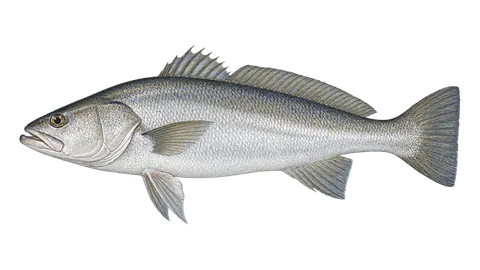
everything about the white seabass
how to recognize it
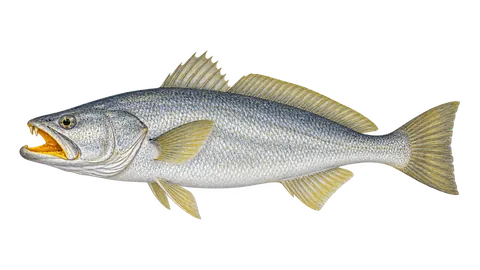
Elongated, slightly compressed body, blue-gray to bronze back, silvery flank and pale belly; juveniles have dark vertical bars. Large mouth, no chin barbel, and a fleshy fold at the base of the pelvic fins. Do not confuse it with the totoaba, which lives only in the Gulf of California and is protected, with fishing prohibited in Mexico: if in doubt, release. The orangemouth corvina has canine teeth at the tip of the upper jaw and an orange mouth inside.
Also called: corvina-branca-do-pacífico, white seabass
don't confuse with:
where found
open on the large mapWhere to look: Rocky bottoms, kelp forests and reef edges; also in the surf. Juveniles in bays and sandy beaches.
Not found in Brazil. Northeastern Pacific, from Alaska (rare) to southern Baja California and the Gulf of California; in Mexico, the Pacific coast of Baja California and the northern gulf.
when to fish
best season
The best period usually runs from spring to early summer, when squid spawn and the schools move closer to shore.
best time of day
Night and twilight. Feeds most from dusk to before dawn and on overcast days; by day it stays deeper, near the kelp and rocks.
what affects the white seabass
cold and cold fronts
Very cold upwelling pushes the schools away from shore.
atmospheric pressure
Fronts with a turning sea hinder night fishing.
moon
New moon and waxing moon nights often coincide with concentrations of squid.
rain
Little effect at sea.
water level
Not applicable at sea.
noise
Very wary: anchor far from the school and avoid excess light and noise.
wind
Rough seas hinder beach fishing and fishing from an anchored boat.
tide
A moving tide and current along the edge of the kelp are best.
depth
From 5 to 30 m near the kelp and rocks; in the surf, a few meters.
how to fish
lures
- metal jig, 60 to 150 g
- 15 to 20 cm swimbait
- heavy spoon
natural baits
- live or fresh squid
- live sardine and mackerel
tip from an angler
Let the live squid work near the kelp without extra weight and be patient: white seabass bite slowly; wait for the line to tighten before reeling in.
- rod
- 7' to 8', 20 to 40 lb; 10' to 12' surf rod in the surf
- spinning / baitcasting reel
- medium conventional baitcasting reel or spinning reel 5000 to 8000
- line
- braid 30 to 50 lb
- leader
- fluorocarbon 30 to 50 lb, 1.5 m
- hook
- circle 4/0 to 7/0
accessories
- large passaguá or gaff
- red light lantern
catch and release
Large fish with a long fight: revive it in the water before releasing, holding it facing the current until it swims off on its own.
rules for the white seabass
Rules change; before keeping or transporting fish, check with the state environmental agency.
Mexico: up to 5 per species and 10 saltwater fish per day
5 specimens of the species per angler per day, within the limit of 10 saltwater fish details
In recreational sport fishing in Mexican federal waters, each angler may keep up to 10 saltwater fish per day, no more than 5 of the same species. The white seabass (corvina blanca) is not among the species reserved for sport fishing under art. 68 of the General Law of Sustainable Fishing and Aquaculture, and has no quota of its own. Fish over the limit must be returned alive to the water, and sport-caught fish may not be sold. Anglers fishing from a boat need a Conapesca permit.
Conservation: Not listed in the NOM-059-SEMARNAT-2010 list of species at risk (2010 text).
how much it weighs without taking it out of the water
estimated weight
—
how we calculate
Length-weight relationship W = a·Lb (a = 0.00813, b = 3.06; FishBase). It's an average: a fat or lean fish can vary by 10% to 20%.
more about the white seabass
The largest croaker on the North American Pacific coast, reaching 1.66 m and 41 kg and living about 20 years. It occurs from Alaska to southern Baja California and in the Gulf of California, but is rare north of California. Adults travel in schools over rocky bottoms and in kelp forests, and sometimes enter the surf; juveniles live in bays and sandy beaches. It eats fish, squid and crustaceans. It is a difficult trophy: it appears and disappears, feeds heavily at night and during squid spawning, and fights with long runs. In Mexico it is fished from boats and from beaches along the Pacific coast of Baja California and the northern gulf.
Family: Sciaenidae · predator
fun facts
- Despite the name, it is not in the genus Cynoscion, of the best-known croakers and seatrouts, but in Atractoscion.
- In California, hatchery-reared juvenile release programs try to restore the species.
in the kitchen
White, firm and very tasty flesh; grilled, roasted or in ceviche.
similar species
sources and references (5)
The season weights (months), the time of day and the sensitivities (cold, pressure, moon, wind, rain, tide, strong light, murky water and noise) are the app's editorial estimates, based on the literature below and on the field experience of anglers and guides. They are not official data nor a measurement made for this species, and they may vary by region and year. Closed seasons and legal rules appear in the rules section, with the norm and a link.
- scientific FishBase — Atractoscion nobilis (ficha da espécie)Names, distribution, biology, length-weight relationship, list of countries and references. Page checked 13/10/2026. The FishBase country list includes Nicaragua as a doubtful record.
- scientific IUCN Red List — Atractoscion nobilis (avaliação global: Pouco Preocupante, LC, 03/09/2019)Global assessment. Link given on the FishBase entry (Red List, version 2025-2).
- scientific Eschmeyer, W. N.; Herald, E. S.; Hammann, H. (1983). A field guide to Pacific coast fishes of North America. Boston: Houghton Mifflin. 336 p.Printed work; the URL is the bibliographic record in FishBase, which cites this work for habitat and distribution.
- official Semarnat — NOM-059-SEMARNAT-2010, espécies nativas da flora e fauna silvestres do México em risco (texto de 2010)The totoaba (Totoaba macdonaldi) is on the list; the white seabass is not. The 2019 revision of the list was not checked.
- official DOF — Modificação da NOM-017-PESC-1994, para regular a pesca deportivo-recreativa em águas de jurisdição federal do México (publicada em 25/11/2013)Daily limits at sea (item 4.9.1) and in fresh water (4.9.2), one rod in inland waters (4.6 b), ban on live fish as bait in inland waters (4.7 c) and on fishing in closed areas and seasons (4.10).
how we calculatewhere each number comes from
The weather comes from three independent global models, cross-checked hour by hour: when they agree, confidence goes up; when they diverge, the band between them shows on the chart. Beyond 16 days, we use the GEFS ensemble of 31 simulations: if 20 of the 31 predict rain, the chance of rain is 65%. Sun and moon are calculated astronomically, with no uncertainty.
The index adds up, weighted for each species: time of day (species curve anchored to real sunrise and sunset), moon (transits, rise and set, phase), pressure (3 h trend and 24 h swing), water temperature (in rivers, estimated from air temperature; at sea, estimated by an ocean model), wind, rain, clouds, tide and the month in the species' cycle.
sources for this lookup
how accurate the forecast is
Accuracy measured in the reference project (4 regions, 93 days, forecast vs. observed): maximum temperature is off by 0.6 °C on average the next day and 1.7 °C at 7 days; rain of 5 mm or more is detected 76% of the time the next day and 57% at 7 days. Detection isn't everything: the false alarm rate isn't published here yet, and 93 days in 4 regions is still a small sample. We now also measure every day, at the app's destinations: