Skip to content
catalog Sciaenidae · predator

atlantic croaker

Micropogonias undulatus

EstuarySea

A coastal croaker of the western North Atlantic that lives on mud bottoms, breeds in estuaries and makes drumming sounds with its swim bladder. In Latin America it is a fish of the northern Gulf of Mexico; Caribbean records are uncertain.

Also called: corvina-do-atlântico, roncadina, Atlantic croaker, hardhead, croaker

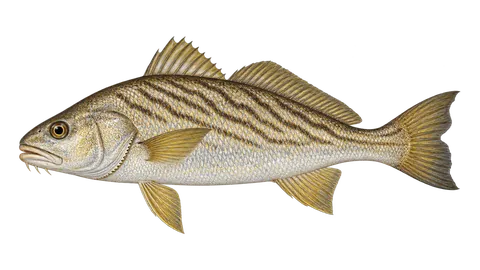
Scientific illustration of Atlantic croaker
common size
20–35 cm
maximum
55 cm
common weight
0.1–0.5 kg
record/max.
2.6 kg
depth
0–100 m
ideal water
16–26 °C
overview

who is the atlantic croaker

The Atlantic croaker, which US anglers call croaker, lives in coastal waters over mud and muddy-sand bottoms, down to about 100 m, and uses estuaries as nursery and feeding grounds. It eats worms, crustaceans and fish. It reaches 55 cm and 2.6 kg, although its common length is 30 cm, and it lives about 5 years. Its range runs from Massachusetts to the northern Gulf of Mexico and northern Mexico. FishBase notes a possible occurrence from southern Brazil to Argentina and treats records from the southern Gulf, the Lesser Antilles and the southern Caribbean as uncertain. In Brazil and Argentina, the fish caught as corvina is Micropogonias furnieri, described in the corvina entry.

fun facts

  • The English name, croaker, and the Spanish name roncadina come from the drumming sound the fish makes with its swim bladder.
  • It lives about 5 years, according to FishBase, and matures at 18 cm or more.
  • Estuaries serve as nursery grounds: juveniles grow up there and adults leave to spawn at sea.
how to recognize it

identification

Slender, slightly compressed croaker, silvery with coppery reflections and a darker back. Its mouth is underslung, with several small barbels on the chin, not the single large barbel of the papa-terra. It usually has dark spots that form slanting lines on the back and upper flanks. It looks very much like the corvina (Micropogonias furnieri) of the South American Atlantic: the fishing location helps, since the Atlantic croaker lives from the Gulf of Mexico northward.

how atlantic croaker fishing looks

Loading the next 7 days…

Each card shows the day's index (0 to 100) and, below it, a strip with the index for each hour, from 0h to 23h. from poor to excellent.

distribution

where found

open on the large map

Western Atlantic: from Massachusetts (USA, except Florida) and the northern Gulf of Mexico to northern Mexico. FishBase mentions a possible occurrence from southern Brazil to Argentina, unconfirmed, and treats records from the southern Gulf, the Lesser Antilles and the southern Caribbean as uncertain. Outside Brazil, the main interest for Latin America is the Gulf of Mexico coast.

Habitat: Mud and muddy-sand bottoms in coastal waters and estuaries, which serve as nursery and feeding grounds; adults reach about 100 m.

calendar and clock

when to fish

best season

time of yearbest: Jun–Oct
JanFebSeaAprMayJunJulAugSepOctNovDec

In the Gulf of Mexico and the North Atlantic it is most productive from late summer into autumn. Adults spawn at sea and juveniles return to estuaries, where they spend their first year.

best time of day

0h6h12h18h sunrise ~6amsunset ~6pm

Night and twilight. Bites best at dusk and at night, in channels and bar mouths. Scientific sources do not detail the timing; the indication comes from bottom-fishing practice in estuaries.

weather, water and behavior

what affects the atlantic croaker
sensitivity The little bars show how much each factor affects this species. Five full: it feels it a lot.

cold and cold fronts

A sharp drop in temperature pushes the school out of shallow channels and into steadier bottoms.

atmospheric pressure

A cold front with strong wind shuts fishing down for a day or two; once the front passes, it picks up again.

moon

Small effect; spring tide currents stir the mud bottom and bring food.

rain

Light rain does not bother it; runoff that drops the salinity at the bar mouth drives the fish away.

water level

Not applicable at sea; in an estuary, the tide determines where the fish feed.

noise

Not very sensitive, but motor noise near the channel scares the school away.

wind

Strong wind kicks up chop and muddies the water; moderate wind on a rising tide helps.

tide

Fish the rising and falling tide in channels and bar mouths; slack tide produces little.

depth

2 to 20 m for most catches, over mud.

technique, gear and bait

how to fish

rod
7' to 9', 15 to 30 lb, medium action
spinning / baitcasting reel
spinning reel 3000 to 4000
line
monofilament 12 to 20 lb or braided line 15 to 30 lb
leader
monofilament 20 to 30 lb, 40 cm
hook
circle or long-shank hook no. 1 to 2/0, in a two-hook rig

lures

  • small jig of 1/4 to 1/2 oz with a soft tail

natural baits

  • shrimp
  • sea worm
  • fish pieces
  • lula

accessories

  • sinker of 30 to 90 g
  • two-hook dropper rig
  • alicate

tip from an angler

Leave the bait on the mud bottom, in the channel current, with a sinker that does not drag; the strike is sharp.

what the law says

rules for the atlantic croaker

Summary of the regulations we found, with the source for each. Rules change; before keeping or transporting fish, check with the state environmental agency.

Mexico: up to 5 per species and 10 saltwater fish per day

5 specimens of the species per angler per day, within the limit of 10 saltwater fish

In recreational fishing in Mexican federal waters, each angler may keep up to 10 marine fish per day, no more than 5 of the same species. The Atlantic croaker (gurrubata) is not among the species with their own limit (billfish, sharks, giant seatrout, tarpon, dorado, roosterfish and baya). Fish over the limit go back into the water alive, and fish caught in recreational fishing may not be sold. Fishing from a boat requires a permit, and recreational fishing is banned in closed zones and seasons.

Source: Amendment to NOM-017-PESC-1994 (recreational sport fishing in federal waters of Mexico), signed Oct 14, 2013, items 4.3, 4.9.1, 4.9.5, 4.10 and 4.11 (Sagarpa/Conapesca)

Cuba: minimum size for croaker of 22 cm (fork length)

22 cm (fork length)confirm with the agency

The Cuban minimum-size regulation for shelf fish lists croaker of the genus Micropogonias (Micropogonias sp.) at 22 cm fork length. Taking, landing, transporting and selling fish below that size is prohibited, and the ban also covers recreational fishing. The table names the genus, not the species M. undulatus in particular. The rule dates from 2009: check with the Ministry of Food Industry whether it has been updated.

Source: Resolución No. 126/09 of the Ministry of the Food Industry of Cuba (signed May 20, 2009; Official Gazette of Jun 10, 2009), art. 1º and Annex

catch and release
catch and release Releasing the fish alive, quickly and with a wet hand. During a closed season it isn't always allowed: what the regulation says applies.

Wet your hands, watch out for the spines of the dorsal and anal fins, remove the hook with pliers and release it quickly.

in the kitchen

FishBase considers it an excellent table fish, sold fresh and frozen; it is eaten fried, grilled or baked.

calculator

how much it weighs without taking it out of the water

Length-weight relationship W = a·Lb (a = 0.00871, b = 3.08; FishBase (relação peso-comprimento bayesiana, estimativa da própria espécie)). It's an average: a fat or lean fish can vary by 10% to 20%.

estimated weight

—

sources and references

The season weights (months), the time of day and the sensitivities (cold, pressure, moon, wind, rain, tide, strong light, murky water and noise) are the app's editorial estimates, based on the literature below and on field experience from anglers and guides. They are not official data or measurements made for this species and may vary by region and year. Closed seasons and legal rules appear in the rules section, with the rule and link. The fishing depth range, the common size and the ideal water temperature range, when FishBase does not give a value, are editorial estimates based on the species' biology.

  1. scientific FishBase: Micropogonias undulatus (ficha da espécie)Size, length-weight, depth, habitat, distribution, biology, and IUCN status. Page checked on Oct 13, 2026.
  2. scientific FishBase: nomes populares de Micropogonias undulatusNames by country and language. The Portuguese name corvina-do-atlântico was adopted for this entry from the English Atlantic croaker, to separate the species from the Brazilian corvina (Micropogonias furnieri).
  3. official NOM-017-PESC-1994, Para regular las actividades de pesca deportivo-recreativa en las aguas de jurisdicción federal de los Estados Unidos Mexicanos (modificação de 2013)Daily limit of 10 marine fish and 5 per species (item 4.9.1), return of the excess (4.9.5), closed seasons (4.10) and sales ban (4.11). Text checked in the DOF on Oct 13, 2026.
  4. official Resolución No. 126/09 (Cuba): tallas mínimas para especies marinas de la plataformaAnnex: croaker (Bairdiella sp., 18 cm; Micropogonias sp., 22 cm), fork length. Repeals Resolution 561/96 and extends the ban to recreational sport fishing. Copy from FAOLEX; we found no later rule.
don't confuse

similar species