

- common size
- 20–35 cm
- maximum
- 55 cm
- common weight
- 0.1–0.5 kg
- record/max.
- 2.6 kg
- depth
- 0–100 m
- ideal water
- 16–26 °C

the right time
to be on the water
Choose the place and the species. The index, from 0 to 100, combines weather, sun, moon and tide with each fish's habits. Up to 28 days, with each day's confidence.
Loading the forecast…
—
Looking for alerts within 30 km…
Looking for what anglers have logged near here…
what you need to fish herelicense, certification and boat documents
fish likely at this spot
Tap a fish to see its forecast.
hour by hour
slide your finger or mouse over the chart to see each hoursee hour-by-hour table
why this index at —?
choose the day
the fishing month at a glance
what's the best window for the crew?
Choose how many fishing days. We compare each stretch by its average index, discount days with a warning or closed season, and show the 3 best.
trend for the coming weeks
Line: the middle value of 31 simulations of the American GEFS model. Band: where 8 out of 10 fall. Narrow, firm trend; wide, high uncertainty.
everything about the atlantic croaker
how to recognize it
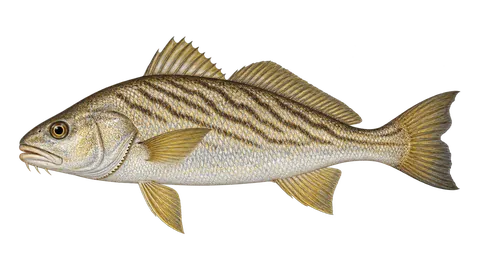
Slender, slightly compressed croaker, silvery with coppery reflections and a darker back. Its mouth is underslung, with several small barbels on the chin, not the single large barbel of the papa-terra. It usually has dark spots that form slanting lines on the back and upper flanks. It looks very much like the corvina (Micropogonias furnieri) of the South American Atlantic: the fishing location helps, since the Atlantic croaker lives from the Gulf of Mexico northward.
Also called: corvina-do-atlântico, roncadina, Atlantic croaker, hardhead, croaker
don't confuse with:
where found
open on the large mapWhere to look: Mud and muddy-sand bottoms in coastal waters and estuaries, which serve as nursery and feeding grounds; adults reach about 100 m.
Western Atlantic: from Massachusetts (USA, except Florida) and the northern Gulf of Mexico to northern Mexico. FishBase mentions a possible occurrence from southern Brazil to Argentina, unconfirmed, and treats records from the southern Gulf, the Lesser Antilles and the southern Caribbean as uncertain. Outside Brazil, the main interest for Latin America is the Gulf of Mexico coast.
when to fish
best season
In the Gulf of Mexico and the North Atlantic it is most productive from late summer into autumn. Adults spawn at sea and juveniles return to estuaries, where they spend their first year.
best time of day
Night and twilight. Bites best at dusk and at night, in channels and bar mouths. Scientific sources do not detail the timing; the indication comes from bottom-fishing practice in estuaries.
what affects the atlantic croaker
cold and cold fronts
A sharp drop in temperature pushes the school out of shallow channels and into steadier bottoms.
atmospheric pressure
A cold front with strong wind shuts fishing down for a day or two; once the front passes, it picks up again.
moon
Small effect; spring tide currents stir the mud bottom and bring food.
rain
Light rain does not bother it; runoff that drops the salinity at the bar mouth drives the fish away.
water level
Not applicable at sea; in an estuary, the tide determines where the fish feed.
noise
Not very sensitive, but motor noise near the channel scares the school away.
wind
Strong wind kicks up chop and muddies the water; moderate wind on a rising tide helps.
tide
Fish the rising and falling tide in channels and bar mouths; slack tide produces little.
depth
2 to 20 m for most catches, over mud.
how to fish
lures
- small jig of 1/4 to 1/2 oz with a soft tail
natural baits
- shrimp
- sea worm
- fish pieces
- lula
tip from an angler
Leave the bait on the mud bottom, in the channel current, with a sinker that does not drag; the strike is sharp.
- rod
- 7' to 9', 15 to 30 lb, medium action
- spinning / baitcasting reel
- spinning reel 3000 to 4000
- line
- monofilament 12 to 20 lb or braided line 15 to 30 lb
- leader
- monofilament 20 to 30 lb, 40 cm
- hook
- circle or long-shank hook no. 1 to 2/0, in a two-hook rig
accessories
- sinker of 30 to 90 g
- two-hook dropper rig
- alicate
catch and release
Wet your hands, watch out for the spines of the dorsal and anal fins, remove the hook with pliers and release it quickly.
rules for the atlantic croaker
Rules change; before keeping or transporting fish, check with the state environmental agency.
Mexico: up to 5 per species and 10 saltwater fish per day
5 specimens of the species per angler per day, within the limit of 10 saltwater fish details
In recreational fishing in Mexican federal waters, each angler may keep up to 10 marine fish per day, no more than 5 of the same species. The Atlantic croaker (gurrubata) is not among the species with their own limit (billfish, sharks, giant seatrout, tarpon, dorado, roosterfish and baya). Fish over the limit go back into the water alive, and fish caught in recreational fishing may not be sold. Fishing from a boat requires a permit, and recreational fishing is banned in closed zones and seasons.
Cuba: minimum size for croaker of 22 cm (fork length)
22 cm (fork length)confirm with the agency details
The Cuban minimum-size regulation for shelf fish lists croaker of the genus Micropogonias (Micropogonias sp.) at 22 cm fork length. Taking, landing, transporting and selling fish below that size is prohibited, and the ban also covers recreational fishing. The table names the genus, not the species M. undulatus in particular. The rule dates from 2009: check with the Ministry of Food Industry whether it has been updated.
how much it weighs without taking it out of the water
estimated weight
—
how we calculate
Length-weight relationship W = a·Lb (a = 0.00871, b = 3.08; FishBase (relação peso-comprimento bayesiana, estimativa da própria espécie)). It's an average: a fat or lean fish can vary by 10% to 20%.
more about the atlantic croaker
The Atlantic croaker, which US anglers call croaker, lives in coastal waters over mud and muddy-sand bottoms, down to about 100 m, and uses estuaries as nursery and feeding grounds. It eats worms, crustaceans and fish. It reaches 55 cm and 2.6 kg, although its common length is 30 cm, and it lives about 5 years. Its range runs from Massachusetts to the northern Gulf of Mexico and northern Mexico. FishBase notes a possible occurrence from southern Brazil to Argentina and treats records from the southern Gulf, the Lesser Antilles and the southern Caribbean as uncertain. In Brazil and Argentina, the fish caught as corvina is Micropogonias furnieri, described in the corvina entry.
Family: Sciaenidae · predator
fun facts
- The English name, croaker, and the Spanish name roncadina come from the drumming sound the fish makes with its swim bladder.
- It lives about 5 years, according to FishBase, and matures at 18 cm or more.
- Estuaries serve as nursery grounds: juveniles grow up there and adults leave to spawn at sea.
in the kitchen
FishBase considers it an excellent table fish, sold fresh and frozen; it is eaten fried, grilled or baked.
similar species


sources and references (4)
The season weights (months), the time of day and the sensitivities (cold, pressure, moon, wind, rain, tide, strong light, murky water and noise) are the app's editorial estimates, based on the literature below and on field experience from anglers and guides. They are not official data or measurements made for this species and may vary by region and year. Closed seasons and legal rules appear in the rules section, with the rule and link. The fishing depth range, the common size and the ideal water temperature range, when FishBase does not give a value, are editorial estimates based on the species' biology.
- scientific FishBase: Micropogonias undulatus (ficha da espécie)Size, length-weight, depth, habitat, distribution, biology, and IUCN status. Page checked on Oct 13, 2026.
- scientific FishBase: nomes populares de Micropogonias undulatusNames by country and language. The Portuguese name corvina-do-atlântico was adopted for this entry from the English Atlantic croaker, to separate the species from the Brazilian corvina (Micropogonias furnieri).
- official NOM-017-PESC-1994, Para regular las actividades de pesca deportivo-recreativa en las aguas de jurisdicción federal de los Estados Unidos Mexicanos (modificação de 2013)Daily limit of 10 marine fish and 5 per species (item 4.9.1), return of the excess (4.9.5), closed seasons (4.10) and sales ban (4.11). Text checked in the DOF on Oct 13, 2026.
- official Resolución No. 126/09 (Cuba): tallas mínimas para especies marinas de la plataformaAnnex: croaker (Bairdiella sp., 18 cm; Micropogonias sp., 22 cm), fork length. Repeals Resolution 561/96 and extends the ban to recreational sport fishing. Copy from FAOLEX; we found no later rule.
how we calculatewhere each number comes from
The weather comes from three independent global models, cross-checked hour by hour: when they agree, confidence goes up; when they diverge, the band between them shows on the chart. Beyond 16 days, we use the GEFS ensemble of 31 simulations: if 20 of the 31 predict rain, the chance of rain is 65%. Sun and moon are calculated astronomically, with no uncertainty.
The index adds up, weighted for each species: time of day (species curve anchored to real sunrise and sunset), moon (transits, rise and set, phase), pressure (3 h trend and 24 h swing), water temperature (in rivers, estimated from air temperature; at sea, estimated by an ocean model), wind, rain, clouds, tide and the month in the species' cycle.
sources for this lookup
how accurate the forecast is
Accuracy measured in the reference project (4 regions, 93 days, forecast vs. observed): maximum temperature is off by 0.6 °C on average the next day and 1.7 °C at 7 days; rain of 5 mm or more is detected 76% of the time the next day and 57% at 7 days. Detection isn't everything: the false alarm rate isn't published here yet, and 93 days in 4 regions is still a small sample. We now also measure every day, at the app's destinations: