Skip to content
catalog Coryphaenidae · predator

pompano dolphinfish

Coryphaena equiselis

Sea

A smaller relative of the common dolphinfish, with a deeper body. It travels in schools under floating objects, takes surface lures and is often mistaken for young dolphinfish.

Also called: dourado-pampo, dourado, pompano dolphinfish, pompano dolphin, small dolphin

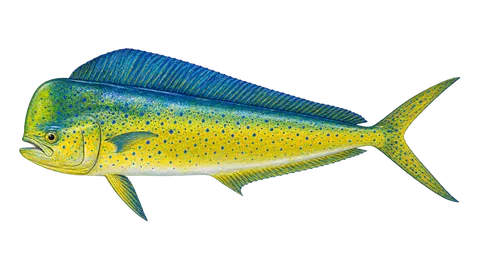
Scientific illustration of Pompano dolphinfish
common size
40–60 cm
maximum
146 cm
common weight
0.7–2.4 kg
record/max.
— kg
depth
0–400 m
ideal water
24–29 °C
overview

who is the pompano dolphinfish

The dourado-pampo (pompano dolphinfish) is the other dolphinfish of the sea: from the same family as the common dolphinfish (Coryphaena hippurus), but smaller and deeper-bodied. It lives in open ocean, in tropical and subtropical waters worldwide, from the surface down to about 400 m, and sometimes enters coastal waters. It travels in schools, follows boats and gathers under floating objects. It eats small fish and squid, its eggs and larvae float, and it lives about 4 years. FishBase gives a common length of 50 cm and a maximum of 146 cm. It is often mistaken for juvenile dolphinfish or for females of the common dolphinfish. It is taken in small-scale commercial fishing and is an important sport fish in northern South America. The flesh is excellent.

fun facts

  • FishBase warns that it is often mistaken for juvenile dolphinfish or for females of the common dolphinfish.
  • It lives only about 4 years, according to FishBase, and grows fast.
  • After death, the bright blue-green gives way to gray with green tints.
how to recognize it

identification

Elongated body, flattened at the sides, with a single long dorsal fin that starts at the nape. Blue-green and metallic in life, gray with green tints after death, with golden flanks and diffuse dark spots. The body is deeper than that of the common dolphinfish (more than 25% of standard length), the anal fin margin is convex, the dorsal fin has 52 to 59 rays, and the pectoral fin is about half the length of the head. In the mouth, the tongue tooth plate is broad and square. Juveniles have a white tail edge. To tell it apart from the common dolphinfish, look at the tongue tooth plate and the anal fin margin.

how pompano dolphinfish fishing looks

Loading the next 7 days…

Each card shows the day's index (0 to 100) and, below it, a strip with the index for each hour, from 0h to 23h. from poor to excellent.

distribution

where found

open on the large map

Open ocean along the whole Brazilian coast, near floating objects and current edges, in blue, warm water. FishBase lists it as cosmopolitan in tropical and subtropical seas and highly migratory.

Habitat: Blue, warm open-ocean water at the surface and down to about 400 m, near floating objects, sargassum, buoys and current edges; occasionally in coastal waters.

coast

North CoastNortheast CoastSoutheast CoastSouth Coastshelfoceanic
calendar and clock

when to fish

best season

time of yearbest: Dec–Mar
JanFebSeaAprMayJunJulAugSepOctNovDec

No well-studied season for Brazil. Like the common dolphinfish, it should show up better in the warm months, when the blue water comes close to the shelf; the timing is an editorial estimate.

best time of day

0h6h12h18h sunrise ~6amsunset ~6pm

Daytime. Feeds during the day, most actively in the morning. Recreational fishing at night produces little.

weather, water and behavior

what affects the pompano dolphinfish
sensitivity The little bars show how much each factor affects this species. Five full: it feels it a lot.

cold and cold fronts

Below about 21 °C it disappears from the surface; follow the warm water and the temperature breaks.

atmospheric pressure

After a cold front the sea is choppy and the water cools; fishing improves when the weather settles.

moon

Small effect.

rain

Light rain does not bother it; thunderstorm with lightning: head back to port.

water level

Not applicable at sea. The equivalent is the water color: look for clear blue water and current lines.

noise

Tolerates the boat well and often follows the hull.

wind

Chop helps hide the line; strong wind makes it hard to find floating objects.

tide

Little effect in open sea.

depth

Almost always at the surface and in the top 40 m; it lives down to about 400 m according to FishBase.

technique, gear and bait

how to fish

rod
6'6" to 7'0", 12 to 25 lb for casting; 20 to 30 lb for trolling
spinning / baitcasting reel
4000 to 6000 spinning reel or 20 to 30 lb trolling baitcaster
line
braided line 20 to 40 lb
leader
fluorocarbon 40 to 60 lb, 1.5 m
hook
simple 4/0 to 6/0 or circle 5/0 on natural bait; reinforced treble hooks on plugs

lures

  • poppers and stickbaits 10 to 14 cm
  • short-lip trolling plugs
  • silicone squid and small skirts
  • metal jigs 40 to 80 g
  • medium streamers for fly fishing

natural baits

  • whole or cut sardine
  • small flying fish
  • lula

accessories

  • alicate
  • large passaguá
  • insulated cooler with ice

tip from an angler

Find the floating object and keep the first fish hooked in the water: the school stays with it, and you cast to the others.

what the law says

rules for the pompano dolphinfish

Summary of the regulations we found, with the source for each. Rules change; before keeping or transporting fish, check with the state environmental agency.
Conservation: Not on the Brazilian national list (Portaria GM/MMA nº 1.667/2026). We found no specific federal minimum size or closed season for this species in Brazil.

Mexico: dorado reserved for recreational fishing; up to 2 per angler per day

2 dorado per angler per day (each one counts as 5 of the other marine fish)confirm with the agency

In recreational fishing in Mexican federal waters, dorado has a limit of 2 fish per angler per day, and each one counts as five fish within the general limit of 10 marine fish. The rule uses only the name 'dorado', without the scientific name. Since the pompano dolphinfish is often mistaken for juvenile dorado, treat it under the same limit. Fish over the limit go back into the water alive, and a retained fish may not be sold.

Source: Amendment to NOM-017-PESC-1994 (recreational sport fishing in federal waters of Mexico), DOF Nov 25, 2013, items 4.9.1, 4.9.5 and 4.11 (Sagarpa/Conapesca)

Mexico: dorado reserved for recreational fishing up to 50 miles

commercial fishing banned up to 50 nautical miles from the baselineconfirm with the agency

NOM-017 states that dorado, along with marlin, sailfish, swordfish, tarpon and roosterfish, is reserved exclusively for recreational fishing within 50 nautical miles of the baseline of the Mexican coast. The rule does not name the scientific species; the pompano dolphinfish is confused with the common dolphinfish.

Source: NOM-017-PESC-1994 (amendment published in the DOF on Nov 25, 2013), item 0.3 (Sagarpa/Conapesca)

catch and release
catch and release Releasing the fish alive, quickly and with a wet hand. During a closed season it isn't always allowed: what the regulation says applies.

It handles release well if done quickly. Don't use a gaff on a fish you plan to release, and avoid lifting it out of the water. Release the small ones and keep only what you'll eat.

in the kitchen

White, tender, tasty flesh, rated excellent by FishBase and sold fresh. Grilled, in moqueca or as ceviche. Bleed and chill it quickly: it spoils fast in the heat.

calculator

how much it weighs without taking it out of the water

Length-weight relationship W = a·Lb (a = 0.0123, b = 2.98; FishBase (relação peso-comprimento bayesiana, estimativa)). It's an average: a fat or lean fish can vary by 10% to 20%.

estimated weight

—

sources and references

The seasonal weights (months), timing and sensitivities (cold, pressure, moon, wind, rain, tide, strong light, murky water and noise) are the app's editorial estimates, drawn from the literature below and from the field experience of anglers and guides. They are not official data nor a measurement made for this species, and they may vary by region and year. Closed seasons and legal rules appear in the rules section, with the norm and a link. Common sizes and weights are ranges around the common length reported by FishBase, with weight calculated from the length-weight relationship. FishBase publishes no maximum weight for the species, and the maximum length of 146 cm is probably an extreme; use the common length of 50 cm as the reference.

  1. scientific FishBase: Coryphaena equiselis (ficha da espécie)Size, length-weight, depth, habitat, distribution, biology, and IUCN status. Page checked on Oct 13, 2026.
  2. scientific FishBase: nomes populares de Coryphaena equiselisNames by country and language. No Brazilian Portuguese popular name is recorded: in Brazil the species is usually just called dorado. The app uses "dourado-pampo", a translation of the English name (pompano dolphinfish), to tell it apart from the common dolphinfish.
  3. official Portaria GM/MMA nº 1.667, de 27 de abril de 2026: Lista Nacional Oficial de Espécies da Fauna Ameaçadas de Extinção (peixes e invertebrados aquáticos)The species is not on the list. Checked in the DOU of April 28, 2026.
  4. official DOF: Modificação da NOM-017-PESC-1994, para regular a pesca deportivo-recreativa em águas de jurisdição federal do México (DOF de 25/11/2013)Daily catch limits at sea (item 4.9.1), return of excess fish (4.9.5), ban on selling the fish (4.11) and ban on fishing in closed zones and seasons (4.10 a). Text checked on 13/10/2026. Item 4.9.1 c) sets 2 dorado per day; item 0.3 reserves dorado for recreational fishing.
don't confuse

similar species