

- common size
- 40–60 cm
- maximum
- 146 cm
- common weight
- 0.7–2.4 kg
- record/max.
- — kg
- depth
- 0–400 m
- ideal water
- 24–29 °C

the right time
to be on the water
Choose the place and the species. The index, from 0 to 100, combines weather, sun, moon and tide with each fish's habits. Up to 28 days, with each day's confidence.
Loading the forecast…
—
Looking for alerts within 30 km…
Looking for what anglers have logged near here…
what you need to fish herelicense, certification and boat documents
fish likely at this spot
Tap a fish to see its forecast.
hour by hour
slide your finger or mouse over the chart to see each hoursee hour-by-hour table
why this index at —?
choose the day
the fishing month at a glance
what's the best window for the crew?
Choose how many fishing days. We compare each stretch by its average index, discount days with a warning or closed season, and show the 3 best.
trend for the coming weeks
Line: the middle value of 31 simulations of the American GEFS model. Band: where 8 out of 10 fall. Narrow, firm trend; wide, high uncertainty.
everything about the pompano dolphinfish
how to recognize it
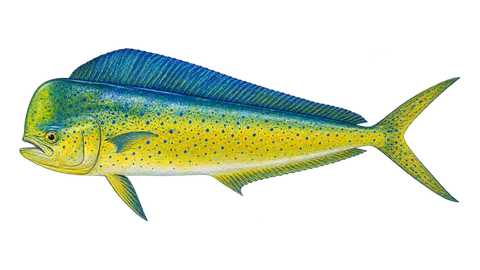
Elongated body, flattened at the sides, with a single long dorsal fin that starts at the nape. Blue-green and metallic in life, gray with green tints after death, with golden flanks and diffuse dark spots. The body is deeper than that of the common dolphinfish (more than 25% of standard length), the anal fin margin is convex, the dorsal fin has 52 to 59 rays, and the pectoral fin is about half the length of the head. In the mouth, the tongue tooth plate is broad and square. Juveniles have a white tail edge. To tell it apart from the common dolphinfish, look at the tongue tooth plate and the anal fin margin.
Also called: dourado-pampo, dourado, pompano dolphinfish, pompano dolphin, small dolphin
don't confuse with:
where found
open on the large mapWhere to look: Blue, warm open-ocean water at the surface and down to about 400 m, near floating objects, sargassum, buoys and current edges; occasionally in coastal waters.
Open ocean along the whole Brazilian coast, near floating objects and current edges, in blue, warm water. FishBase lists it as cosmopolitan in tropical and subtropical seas and highly migratory.
coast
when to fish
best season
No well-studied season for Brazil. Like the common dolphinfish, it should show up better in the warm months, when the blue water comes close to the shelf; the timing is an editorial estimate.
best time of day
Daytime. Feeds during the day, most actively in the morning. Recreational fishing at night produces little.
what affects the pompano dolphinfish
cold and cold fronts
Below about 21 °C it disappears from the surface; follow the warm water and the temperature breaks.
atmospheric pressure
After a cold front the sea is choppy and the water cools; fishing improves when the weather settles.
moon
Small effect.
rain
Light rain does not bother it; thunderstorm with lightning: head back to port.
water level
Not applicable at sea. The equivalent is the water color: look for clear blue water and current lines.
noise
Tolerates the boat well and often follows the hull.
wind
Chop helps hide the line; strong wind makes it hard to find floating objects.
tide
Little effect in open sea.
depth
Almost always at the surface and in the top 40 m; it lives down to about 400 m according to FishBase.
how to fish
lures
- poppers and stickbaits 10 to 14 cm
- short-lip trolling plugs
- silicone squid and small skirts
- metal jigs 40 to 80 g
- medium streamers for fly fishing
natural baits
- whole or cut sardine
- small flying fish
- lula
tip from an angler
Find the floating object and keep the first fish hooked in the water: the school stays with it, and you cast to the others.
- rod
- 6'6" to 7'0", 12 to 25 lb for casting; 20 to 30 lb for trolling
- spinning / baitcasting reel
- 4000 to 6000 spinning reel or 20 to 30 lb trolling baitcaster
- line
- braided line 20 to 40 lb
- leader
- fluorocarbon 40 to 60 lb, 1.5 m
- hook
- simple 4/0 to 6/0 or circle 5/0 on natural bait; reinforced treble hooks on plugs
accessories
- alicate
- large passaguá
- insulated cooler with ice
catch and release
It handles release well if done quickly. Don't use a gaff on a fish you plan to release, and avoid lifting it out of the water. Release the small ones and keep only what you'll eat.
rules for the pompano dolphinfish
Rules change; before keeping or transporting fish, check with the state environmental agency.
Mexico: dorado reserved for recreational fishing; up to 2 per angler per day
2 dorado per angler per day (each one counts as 5 of the other marine fish)confirm with the agency details
In recreational fishing in Mexican federal waters, dorado has a limit of 2 fish per angler per day, and each one counts as five fish within the general limit of 10 marine fish. The rule uses only the name 'dorado', without the scientific name. Since the pompano dolphinfish is often mistaken for juvenile dorado, treat it under the same limit. Fish over the limit go back into the water alive, and a retained fish may not be sold.
Mexico: dorado reserved for recreational fishing up to 50 miles
commercial fishing banned up to 50 nautical miles from the baselineconfirm with the agency details
NOM-017 states that dorado, along with marlin, sailfish, swordfish, tarpon and roosterfish, is reserved exclusively for recreational fishing within 50 nautical miles of the baseline of the Mexican coast. The rule does not name the scientific species; the pompano dolphinfish is confused with the common dolphinfish.
Source: NOM-017-PESC-1994 (amendment published in the DOF on Nov 25, 2013), item 0.3 (Sagarpa/Conapesca)
Conservation: Not on the Brazilian national list (Portaria GM/MMA nº 1.667/2026). We found no specific federal minimum size or closed season for this species in Brazil.
how much it weighs without taking it out of the water
estimated weight
—
how we calculate
Length-weight relationship W = a·Lb (a = 0.0123, b = 2.98; FishBase (relação peso-comprimento bayesiana, estimativa)). It's an average: a fat or lean fish can vary by 10% to 20%.
more about the pompano dolphinfish
The dourado-pampo (pompano dolphinfish) is the other dolphinfish of the sea: from the same family as the common dolphinfish (Coryphaena hippurus), but smaller and deeper-bodied. It lives in open ocean, in tropical and subtropical waters worldwide, from the surface down to about 400 m, and sometimes enters coastal waters. It travels in schools, follows boats and gathers under floating objects. It eats small fish and squid, its eggs and larvae float, and it lives about 4 years. FishBase gives a common length of 50 cm and a maximum of 146 cm. It is often mistaken for juvenile dolphinfish or for females of the common dolphinfish. It is taken in small-scale commercial fishing and is an important sport fish in northern South America. The flesh is excellent.
Family: Coryphaenidae · predator
fun facts
- FishBase warns that it is often mistaken for juvenile dolphinfish or for females of the common dolphinfish.
- It lives only about 4 years, according to FishBase, and grows fast.
- After death, the bright blue-green gives way to gray with green tints.
in the kitchen
White, tender, tasty flesh, rated excellent by FishBase and sold fresh. Grilled, in moqueca or as ceviche. Bleed and chill it quickly: it spoils fast in the heat.
similar species
sources and references (4)
The seasonal weights (months), timing and sensitivities (cold, pressure, moon, wind, rain, tide, strong light, murky water and noise) are the app's editorial estimates, drawn from the literature below and from the field experience of anglers and guides. They are not official data nor a measurement made for this species, and they may vary by region and year. Closed seasons and legal rules appear in the rules section, with the norm and a link. Common sizes and weights are ranges around the common length reported by FishBase, with weight calculated from the length-weight relationship. FishBase publishes no maximum weight for the species, and the maximum length of 146 cm is probably an extreme; use the common length of 50 cm as the reference.
- scientific FishBase: Coryphaena equiselis (ficha da espécie)Size, length-weight, depth, habitat, distribution, biology, and IUCN status. Page checked on Oct 13, 2026.
- scientific FishBase: nomes populares de Coryphaena equiselisNames by country and language. No Brazilian Portuguese popular name is recorded: in Brazil the species is usually just called dorado. The app uses "dourado-pampo", a translation of the English name (pompano dolphinfish), to tell it apart from the common dolphinfish.
- official Portaria GM/MMA nº 1.667, de 27 de abril de 2026: Lista Nacional Oficial de Espécies da Fauna Ameaçadas de Extinção (peixes e invertebrados aquáticos)The species is not on the list. Checked in the DOU of April 28, 2026.
- official DOF: Modificação da NOM-017-PESC-1994, para regular a pesca deportivo-recreativa em águas de jurisdição federal do México (DOF de 25/11/2013)Daily catch limits at sea (item 4.9.1), return of excess fish (4.9.5), ban on selling the fish (4.11) and ban on fishing in closed zones and seasons (4.10 a). Text checked on 13/10/2026. Item 4.9.1 c) sets 2 dorado per day; item 0.3 reserves dorado for recreational fishing.
how we calculatewhere each number comes from
The weather comes from three independent global models, cross-checked hour by hour: when they agree, confidence goes up; when they diverge, the band between them shows on the chart. Beyond 16 days, we use the GEFS ensemble of 31 simulations: if 20 of the 31 predict rain, the chance of rain is 65%. Sun and moon are calculated astronomically, with no uncertainty.
The index adds up, weighted for each species: time of day (species curve anchored to real sunrise and sunset), moon (transits, rise and set, phase), pressure (3 h trend and 24 h swing), water temperature (in rivers, estimated from air temperature; at sea, estimated by an ocean model), wind, rain, clouds, tide and the month in the species' cycle.
sources for this lookup
how accurate the forecast is
Accuracy measured in the reference project (4 regions, 93 days, forecast vs. observed): maximum temperature is off by 0.6 °C on average the next day and 1.7 °C at 7 days; rain of 5 mm or more is detected 76% of the time the next day and 57% at 7 days. Detection isn't everything: the false alarm rate isn't published here yet, and 93 days in 4 regions is still a small sample. We now also measure every day, at the app's destinations: