

black marlin
Istiompax indica
The giant of the billfishes, with fish over 700 kg. In the American Pacific it is the great trophy of Panama, Costa Rica, Colombia, Ecuador and northern Peru.
- common size
- 250–380 cm
- maximum
- 465 cm
- common weight
- 60–250 kg
- record/max.
- 750.0 kg
- depth
- 0–200 m
- ideal water
- 24–29 °C
how to recognize it
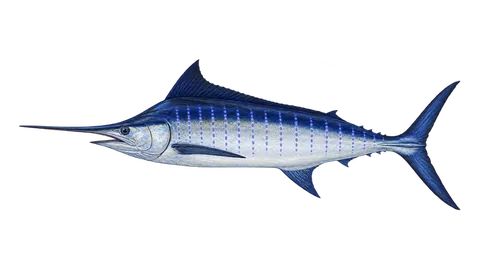
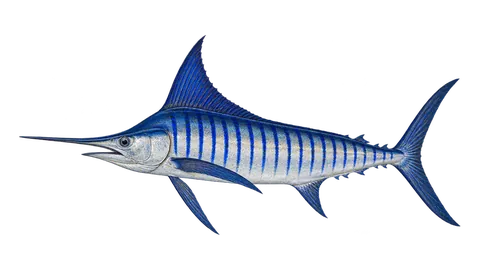
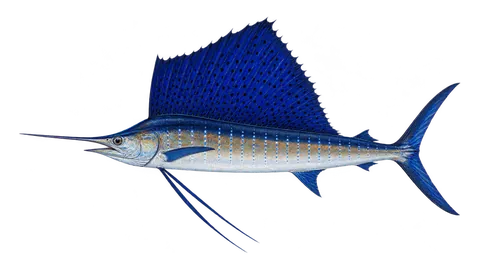
Thick, slightly compressed body, short sturdy bill. The first dorsal fin is low, lower than the body depth. The pectoral fins are rigid and stay open, not folding against the body, even on a dead fish. Dark blue back, silver-white belly, sometimes with light blue stripes. The blue marlin has pectoral fins that fold; the striped marlin has a first dorsal fin taller than the body and well-marked stripes.
Also called: marlim-negro, black marlin
don't confuse with:
where found
open on the large mapWhere to look: Surface layer above the thermocline, near the coast, islands, seamounts, shelf edges and banks with schools of bonito and tuna.
Does not occur regularly in Brazil; in the Atlantic there are only records of stray fish. Tropical and subtropical Indo-Pacific; in the Americas, the Pacific from Mexico to Peru. Classic destinations: Piñas Bay and Hannibal Bank (Panama), Costa Rica, the Pacific coast of Colombia, Ecuador and Cabo Blanco in northern Peru.
when to fish
next 7 days
Loading the next 7 days…
best season
In the Pacific off Panama and Costa Rica it is fished all year; many operators point to the dry season, December to April, as the best window. The presence of bonito schools over the banks matters more than the month.
best time of day
Daytime. Strikes all day; tide and current changes over the banks often concentrate the bites.
what affects the black marlin
cold and cold fronts
Water below 22 °C often drives the fish away; look for thermal fronts and warmer blue water.
atmospheric pressure
Little direct effect; a front with rough seas makes fishing hard.
moon
At the dock they say a full moon makes fish feed at night; the effect counts for less than bait and water.
rain
Light rain is no problem; a thunderstorm with lightning at sea: head in.
water level
Does not apply at sea. The equivalent is clear blue water with bait over the bank.
noise
Engine and wake attract; noisy teasers help bring the fish up.
wind
Moderate swell helps the baits; strong wind makes leaving dangerous.
tide
Tide and current changes over banks and seamounts concentrate the strikes.
depth
Hunts from the surface down to about 200 m; fish the edges of banks and seamounts.
how to fish
lures
- resin heads with 12 to 16 inch skirts
- chain teasers and dredges
natural baits
- live bonito, slow-trolled
- dead bait rigged for trolling
tip from an angler
Find the bonito school over the bank, put a live bait in front of it and pull very slowly. With a circle hook, don't strike: let the line tighten and let the drag do the work.
- rod
- stand-up or chair rod, 80 to 130 lb, with roller guides
- spinning / baitcasting reel
- two-speed trolling reel 80 to 130 lb
- line
- monofilament 80 to 130 lb, 600 m or more; or braided backing with topshot
- leader
- monofilament 300 to 500 lb, 4.5 to 7 m
- hook
- circle 14/0 to 18/0 on live bait; single 10/0 to 12/0 on artificials
accessories
- fighting chair or stand-up harness
- leather gloves for the leader
- cutting pliers
- scientific tagging tags
catch and release
Release with the fish in the water, cutting the leader near the hook when it cannot be removed safely. Revive it with the boat moving slowly forward. Never haul a large marlin aboard for a photo.
rules for the black marlin
Rules change; before keeping or transporting fish, check with the state environmental agency.
Mexico: billfish reserved for sport fishing; 1 per angler per day
1 billfish per angler per day details
Within the 50 nautical mile strip off the Mexican coast, marlins, sailfish and swordfish (the billfish) are reserved for recreational sport fishing. The limit is 1 billfish per angler per day, which counts as 5 toward the total limit of 10 marine fish. Filleting billfish on board is prohibited, fish above the quota must be released alive, and fish caught in sport fishing may not be sold.
Conservation: Highly migratory; stocks are assessed by regional tuna commissions in the Pacific.
how much it weighs without taking it out of the water
estimated weight
—
how we calculate
Length-weight relationship W = a·Lb (a = 0.00447, b = 3.13; FishBase (estimativa bayesiana)). It's an average: a fat or lean fish can vary by 10% to 20%.
more about the black marlin
Indo-Pacific tropical and subtropical marlin, which on the American continent appears along the Pacific coast from Mexico to Peru. Unlike other marlins, it tends to stay close to the coast, islands, seamounts and shelf edges, in the layer above the thermocline. It eats small tunas, squid, octopus and other fish. It is the largest marlin, with records over 4.5 m and 750 kg. Its pectoral fins are rigid and do not fold against the body, the surest mark of the species. It is caught trolling live bait (mainly bonito) pulled slowly, from lodges and boats in Panama, Costa Rica, Colombia and Ecuador. Nearly all sport fishing is catch and release.
Family: Istiophoridae · predator
fun facts
- The IGFA all-tackle world record for marlin is a black marlin of about 707 kg, caught at Cabo Blanco, Peru, in 1953.
- The rigid pectoral fins stay open like wings, even on a dead fish.
in the kitchen
Good-quality meat, eaten in some countries, but in sport fishing in the Americas the practice is release.
similar species
sources and references (5)
The season weights (months), the time of day and the sensitivities (cold, pressure, moon, wind, rain, tide, strong light, murky water and noise) are the app's editorial estimates, based on the literature below and on the field experience of anglers and guides. They are not official data nor a measurement made for this species, and they may vary by region and year. Closed seasons and legal rules appear in the rules section, with the norm and a link.
- scientific FishBase — Istiompax indica (ficha da espécie)Names, distribution, biology, length-weight relationship, country list and references. Page checked on Oct 13, 2026.
- scientific IUCN Red List — Istiompax indica (avaliação global: Dados Insuficientes, DD, 01/05/2021)Global assessment. Link given on the FishBase entry (Red List, version 2025-2).
- scientific Nakamura, I. (1985). FAO species catalogue. Vol. 5. Billfishes of the world. FAO Fisheries Synopsis 125(5). Roma: FAO.
- scientific Domeier, M. L.; Speare, P. (2012). Dispersal of adult black marlin (Istiompax indica) from a Great Barrier Reef spawning aggregation. PLoS ONE 7(2): e31629.DOI checked in Crossref.
- official México — Modificación a la Norma Oficial Mexicana NOM-017-PESC-1994, para regular las actividades de pesca deportivo-recreativa (DOF)Official text in the Diario Oficial de la Federación. Items 0.3 (species reserved for sport fishing) and 4.9 (catch limits) checked on Oct 13, 2026.