


the right time
to be on the water
Choose the place and the species. The index, from 0 to 100, combines weather, sun, moon and tide with each fish's habits. Up to 28 days, with each day's confidence.
Loading the forecast…
—
hour by hour
slide your finger or mouse over the chart to see each hoursee hour-by-hour table
why this index at —?
choose the day
the fishing month at a glance
what's the best window for the crew?
Choose how many fishing days. We compare each stretch by its average index, discount days with a warning or closed season, and show the 3 best.
trend for the coming weeks
Line: the middle value of 31 simulations of the American GEFS model. Band: where 8 out of 10 fall. Narrow, firm trend; wide, high uncertainty.
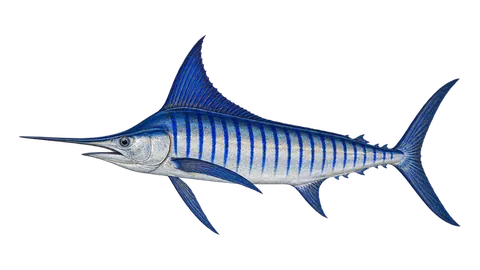
everything about the striped marlin
how to recognize it
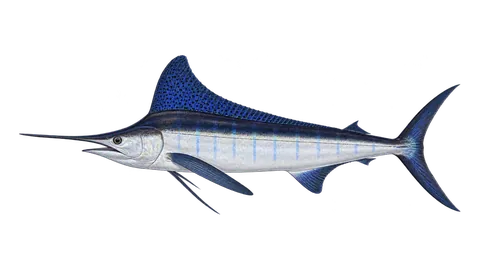
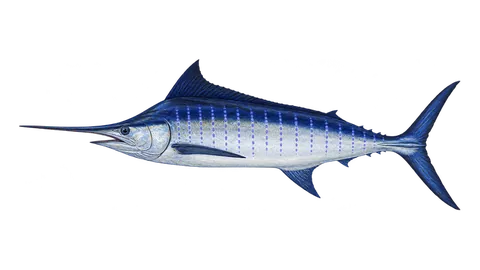
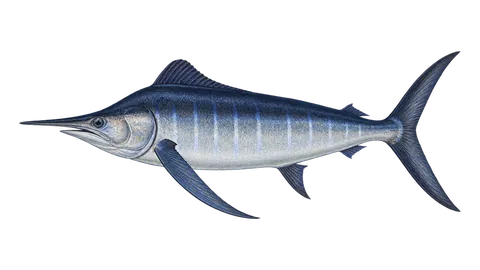
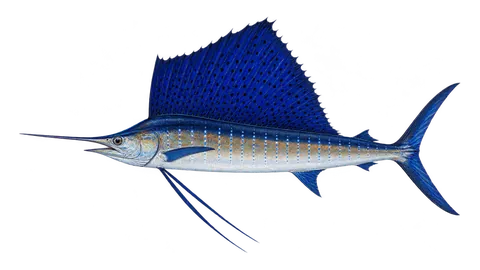
Long, compressed body, medium sturdy bill. The first dorsal fin is tall and pointed, taller than the body depth. Flanks with about 15 to 20 vertical cobalt-blue bars, clearly visible. Flexible pectoral fins that fold against the body. The black marlin has rigid pectoral fins and a low dorsal fin; the blue marlin has a lower dorsal fin and faint stripes.
Also called: marlim-listrado, striped marlin
don't confuse with:
where found
open on the large mapWhere to look: Open sea over the shelf and slope, above the thermocline; near shore where the bottom drops quickly, at thermal fronts and banks with bait schools.
Does not occur in Brazil. Indo-Pacific; in the Americas, the Pacific from California to Chile. Classic destinations: Cabo San Lucas and Magdalena Bay (Baja California Sur, Mexico), the Pacific coast of Central America, Ecuador and Peru.
when to fish
best season
At Cabo San Lucas it appears all year. In Magdalena Bay the peak usually runs October to December, when marlins chase sardine schools near the surface.
best time of day
Daytime. Strikes all day, often at the surface, with the dorsal fin and tail out of the water when herding schools.
what affects the striped marlin
cold and cold fronts
Likes water between 20 and 25 °C; water that is too warm or too cold scatters the fish.
atmospheric pressure
Little direct effect.
moon
Small effect; bait and temperature matter more.
rain
Little effect.
water level
Does not apply at sea. The equivalent is the presence of bait schools and birds working.
noise
The engine and teasers attract; near a school, approach slowly so as not to sink the bait.
wind
Light swell helps you see fish at the surface; strong wind hampers casting.
tide
Little effect in open sea; currents and thermal fronts matter more.
depth
Surface down to about 100 m; many strikes happen in sight.
how to fish
lures
- resin heads with 7 to 10 inch skirts
- teasers without hooks
- large popper-style flies for fly fishing
natural baits
- live mackerel or sardine cast to the fish seen
- lula
tip from an angler
When the marlin rises to the teaser, pull the teaser and put the live bait in front of it. With a circle hook, count to three and only then let the line tighten.
- rod
- stand-up 20 to 50 lb; #12 to #14 fly in the teaser-and-switch technique
- spinning / baitcasting reel
- 20 to 50 lb trolling reel or large reel with strong drag
- line
- monofilament 30 to 50 lb or braided line with topshot
- leader
- monofilament 80 to 130 lb, 3 to 5 m
- hook
- circle 7/0 to 10/0 on live bait
accessories
- fighting belt
- luvas
- cutting pliers
- scientific tagging tags
catch and release
Release with the fish in the water; don't haul it aboard. Revive it with the boat moving slowly forward, and cut the leader near the hook if needed.
rules for the striped marlin
Rules change; before keeping or transporting fish, check with the state environmental agency.
Mexico: billfish reserved for sport fishing; 1 per angler per day
1 billfish per angler per day details
Within the 50 nautical mile strip off the Mexican coast, marlins, sailfish and swordfish (the billfish) are reserved for recreational sport fishing. The limit is 1 billfish per angler per day, which counts as 5 toward the total limit of 10 marine fish. Filleting billfish on board is prohibited, fish above the quota must be released alive, and fish caught in sport fishing may not be sold.
Conservation: Highly migratory; Pacific stocks are assessed by regional tuna commissions.
how much it weighs without taking it out of the water
estimated weight
—
how we calculate
Length-weight relationship W = a·Lb (a = 0.0055, b = 3.15; FishBase (estimativa bayesiana)). It's an average: a fat or lean fish can vary by 10% to 20%.
more about the striped marlin
Indo-Pacific marlin, the most abundant of the billfish. In the Pacific it forms a horseshoe-shaped distribution, from the northwest Pacific to the eastern and southwest Pacific, and in the Americas it ranges from California to Chile. It prefers slightly cooler water than the blue and black marlin, generally 20 to 25 °C, and stays farther from shore, coming close only where the shelf drops off quickly. It eats sardines, mackerel, squid and crustaceans, and in some areas herds bait schools at the surface. In Baja California (Cabo San Lucas and Magdalena Bay) it is caught trolling, with live bait cast to fish seen, and also on fly. It is a jumper and fast, and sport fishing is nearly all catch and release.
Family: Istiophoridae · predator
fun facts
- Its horseshoe distribution in the Pacific is unique among marlins and tunas.
- In Magdalena Bay the marlin herds sardine schools at the surface, and boats cast baits and flies to fish seen.
in the kitchen
Considered the best meat among billfish for sashimi in Japan, but in sport fishing in the Americas the practice is release.
similar species
sources and references (5)
The season weights (months), the time of day and the sensitivities (cold, pressure, moon, wind, rain, tide, strong light, murky water and noise) are the app's editorial estimates, based on the literature below and on the field experience of anglers and guides. They are not official data nor a measurement made for this species, and they may vary by region and year. Closed seasons and legal rules appear in the rules section, with the norm and a link.
- scientific FishBase — Kajikia audax (ficha da espécie)Names, distribution, biology, length-weight relationship, country list and references. Page checked on Oct 13, 2026.
- scientific IUCN Red List — Kajikia audax (avaliação global: Pouco Preocupante, LC, 10/05/2021)Global assessment. Link given on the FishBase entry (Red List, version 2025-2).
- scientific Nakamura, I. (1985). FAO species catalogue. Vol. 5. Billfishes of the world. FAO Fisheries Synopsis 125(5). Roma: FAO.
- scientific Acosta-Pachón, T. A.; Martínez-Rincón, R. O.; Hinton, M. G. (2017). Habitat preferences of striped marlin (Kajikia audax) in the eastern Pacific Ocean. Fisheries Oceanography 26(6): 615-624.DOI checked in Crossref.
- official México — Modificación a la Norma Oficial Mexicana NOM-017-PESC-1994, para regular las actividades de pesca deportivo-recreativa (DOF)Official text in the Diario Oficial de la Federación. Items 0.3 (species reserved for sport fishing) and 4.9 (catch limits) checked on Oct 13, 2026.
how we calculatewhere each number comes from
The weather comes from three independent global models, cross-checked hour by hour: when they agree, confidence goes up; when they diverge, the band between them shows on the chart. Beyond 16 days, we use the GEFS ensemble of 31 simulations: if 20 of the 31 predict rain, the chance of rain is 65%. Sun and moon are calculated astronomically, with no uncertainty.
The index adds up, weighted for each species: time of day (species curve anchored to real sunrise and sunset), moon (transits, rise and set, phase), pressure (3 h trend and 24 h swing), water temperature (in rivers, estimated from air temperature; at sea, estimated by an ocean model), wind, rain, clouds, tide and the month in the species' cycle.
sources for this lookup
how accurate the forecast is
Accuracy measured in the reference project (4 regions, 93 days, forecast vs. observed): maximum temperature is off by 0.6 °C on average the next day and 1.7 °C at 7 days; rain of 5 mm or more is detected 76% of the time the next day and 57% at 7 days. Detection isn't everything: the false alarm rate isn't published here yet, and 93 days in 4 regions is still a small sample. We now also measure every day, at the app's destinations: