

gafftopsail pompano
Trachinotus rhodopus
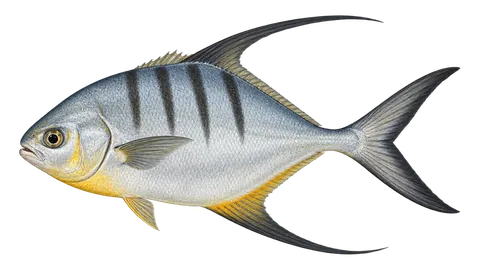
Diamond-shaped pompano, with long dorsal and anal lobes and yellowish bars on the flanks. Appears near the surface around islets and rocks; takes natural bait and light jigs.
- common size
- 20–40 cm
- maximum
- 61 cm
- common weight
- 0.1–0.7 kg
- record/max.
- 1.3 kg
- depth
- 0–30 m
- ideal water
- 22–29 °C
how to recognize it
Diamond-shaped, very compressed body with a blunt, pointed snout. Silvery, with 4 to 6 yellowish to brown bars on the flanks (which darken after death) and yellowish to reddish fins. The second dorsal and anal fins have long, pointed lobes at the front, which give it its English name, gafftopsail. Six short, sturdy spines free in front of the main dorsal and no scutes on the lateral line. The blackblotch pompano (Trachinotus kennedyi) has short lobes and a black blotch at the base of the pectoral.
Also called: pampo-fino, gafftopsail pompano
don't confuse with:
where found
open on the large mapWhere to look: Sandy bottoms near the coast and clear water around reefs, rocks and islets, from 0 to 30 m.
Does not occur in Brazil. Eastern Pacific: from southern California and the Gulf of California to Peru, including Cocos, Galápagos and Malpelo.
when to fish
next 7 days
Loading the next 7 days…
best season
Fished all year. Clear, clean water matters more than the month.
best time of day
Daytime. Feeds by day, near the surface and the surf; disappears at night.
what affects the gafftopsail pompano
cold and cold fronts
Cold upwelling water drives the fish away from the coast.
atmospheric pressure
Little direct effect.
moon
Small effect.
rain
Heavy rain muddies the water near river mouths and drives the fish away.
water level
Not applicable at sea.
noise
Not very sensitive in the surf; sensitive in calm, clear water.
wind
A light swell helps; a heavy sea makes casting hard.
tide
Tidal movement in channels and around rocks concentrates the fish.
depth
From the surface to about 15 m, near islets and the surf.
how to fish
lures
- metal jig 15 to 40 g
- clear streamer (fly)
- jig head with silicone shrimp
natural baits
- shrimp
- caranguejinho-de-areia
- clam or mussel
tip from an angler
Small natural bait and a fine hook: the pompano nibbles before it swallows. Once hooked, it runs in short, strong bursts, so adjust the drag carefully.
- rod
- 9' to 12' for beach (20 to 40 lb); 6'6" to 7', 10 to 20 lb for boat
- spinning / baitcasting reel
- 3000 to 5000 spinning reel
- line
- monofilament 0.28 to 0.35 mm or braid 15 to 25 lb
- leader
- fluorocarbon 20 to 30 lb, 60 cm to 1 m
- hook
- circle 1/0 to 2/0, or short hook no. 1 to 2/0
accessories
- rod holder (beach)
- sinker 40 to 100 g
- alicate
catch and release
Wet your hands, remove the hook with pliers and release it quickly; avoid leaving the fish on the hot sand.
rules for the gafftopsail pompano
Rules change; before keeping or transporting fish, check with the state environmental agency.
Mexico: up to 5 per species and 10 saltwater fish per day
5 specimens of the species per angler per day, within the limit of 10 saltwater fish details
In federal waters of Mexico, recreational sport fishing allows each angler to keep up to 10 marine fish per day, no more than 5 of the same species. The fine pompano is not among the species reserved for sport fishing (marlins, sailfish, swordfish, tarpon (sábalo), roosterfish and dorado, up to 50 nautical miles from shore, item 0.3 of the standard) and has no quota of its own. Fish over the quota must go back alive, and sport-caught fish may not be sold. Anyone fishing from a boat needs an individual permit; from shore, no.
Colombia: AUNAP license and catch-and-release in sport fishing
Individual AUNAP license; catch-and-release guidanceconfirm with the agency details
AUNAP Resolution 0549 of 2022 sets the guidelines for recreational sport fishing in Colombia. Anglers need a permit: for an individual, Colombian or foreign, it is a personal, non-transferable card. The rule makes "catch and release" the guidance and admits keeping only part of the catch for personal consumption, respecting the minimum sizes it sets. We did not confirm the daily limit or the minimum sizes by species: check with AUNAP before keeping fish.
how much it weighs without taking it out of the water
estimated weight
—
how we calculate
Length-weight relationship W = a·Lb (a = 0.01288, b = 2.94; FishBase (relação peso-comprimento bayesiana, estimativa)). It's an average: a fat or lean fish can vary by 10% to 20%.
more about the gafftopsail pompano
Pompano of the eastern Pacific, from southern California and the Gulf of California to Peru, with the Cocos, Galápagos and Malpelo islands. Lives over sandy bottoms near the coast and in clear water around reefs and rocks; it often appears near the surface around offshore rocky islets. Eats small invertebrates and fish. Reaches about 61 cm total length and 1.3 kg. Sold fresh, salted or dried, and FishBase classifies it as a sport fish. For beach, rocky-shore and boat anglers it is a small-to-medium pompano, caught with natural bait (shrimp, sand crab, shellfish), light jigs and fly.
Family: Carangidae · predator
fun facts
- The English name, gafftopsail, refers to the shape of the long lobes of the dorsal and anal fins.
- The yellowish bars on the flanks darken after the fish dies.
in the kitchen
Sold fresh, salted or dried. Like the other pompanos, it has white, firm flesh; good fried whole or grilled.
similar species

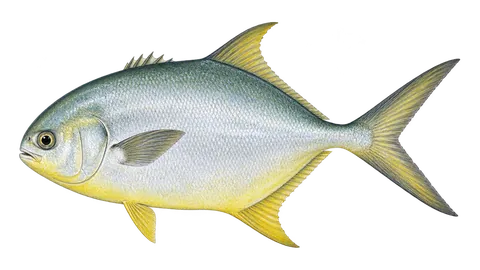
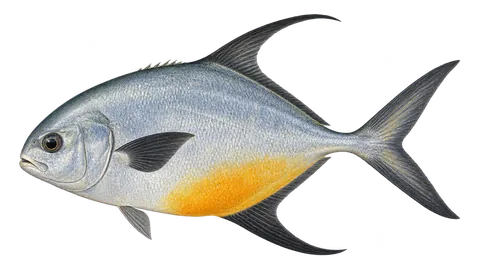
sources and references (5)
The season weights (months), the time of day and the sensitivities (cold, pressure, moon, wind, rain, tide, strong light, murky water and noise) are the app's editorial estimates, based on the literature below and on the field experience of anglers and guides. They are not official data nor a measurement made for this species, and they may vary by region and year. Closed seasons and legal rules appear in the rules section, with the norm and a link.
- scientific FishBase: Trachinotus rhodopus (ficha da espécie)Size, length-weight, depth, habitat, distribution, biology, and IUCN status. Page checked on Oct 13, 2026.
- scientific FishBase: nomes populares de Trachinotus rhodopusNames by country and language.
- scientific Robertson, D. R. & Allen, G. R. (2024). Shorefishes of the Eastern Pacific online information system, versão 3.0. Smithsonian Tropical Research Institute: Trachinotus rhodopusDescription, colors, size, depth and distribution in the eastern Pacific. Page checked Oct 13, 2026. Description, colors, size (at least 61 cm), depth of 0 to 30 m, and a habit of staying near the surface around rocky islets.
- official DOF: Modificação da NOM-017-PESC-1994, para regular a pesca deportivo-recreativa em águas de jurisdição federal do México (publicada em 25/11/2013)Reserves species for sport fishing (item 0.3), permits (4.3 and 4.14), rods and hooks (4.6), bait (4.7), daily limits at sea (4.9.1) and in fresh water (4.9.2), catch and release (4.9.5), closed zones and seasons (4.10), and a ban on selling the catch (4.11). Text checked on Oct 13, 2026; the publication date (Nov 25, 2013) comes from Secretaría de Economía rules that cite the amendment.
- official AUNAP (Colômbia): Resolução 0549 de 2022, lineamientos de ordenación pesquera para la pesca deportiva con fines recreativosWe reviewed, in a partial transcript of the text, what the rule says about the personal license (art. 6) and the catch-and-release guidance (arts. 8 to 10). We could not read the articles on the daily bag limit and minimum sizes; the draft rule provided for a personal-consumption limit that AUNAP said it would revise, so those figures are left out.