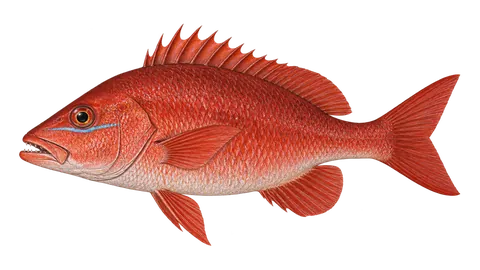
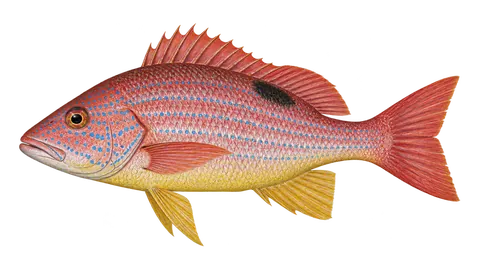
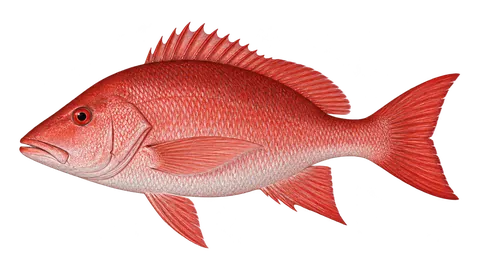
The Pacific red snapper (huachinango) of Mexico, one of the most prized table fish from Mexico to Peru. It lives on deeper rocks and is caught with jigs and natural bait.
Also called: huachinango-do-pacífico, huachinango, pargo-seda, Pacific red snapper
Eastern Pacific red snapper, from Mexico to Peru. It lives over hard bottoms and coastal reefs, down to at least 80 m, often in schools. It eats large invertebrates, such as squid and crabs, and fish. The flesh is excellent, and huachinango is one of the most expensive and sought-after fish on the Mexican Pacific coast, supporting artisanal fishing throughout the area. In sport fishing it is targeted from boats over shoals and deeper rocks, with metal jigs, slow jigs and natural bait, and sometimes it rises behind the jig in a school.
fun facts
In Mexico, huachinango is a prestige name on the menu and also applies to other red snappers.
Large specimens develop a groove between the eye and the nostrils, a useful sign for recognizing the species.
how to recognize it
identification
Red to pink with a silvery sheen on the flank and reddish fins, no black spot on the back. In adults, the bone below the eye (preorbital) is very wide, and large ones have a groove from the front of the eye to the nostrils. The scale rows on the back rise diagonally above the lateral line. The colorado snapper (pargo colorado) looks similar, but is a more uniform red without the silvery sheen; the spotted rose snapper (pargo lunarejo) has the dark spot on its back.
how pacific red snapper fishing looks
Loading the next 7 days…
Each card shows the day's index (0 to 100) and, below it, a strip with the index for each hour, from 0h to 23h. from poor to excellent.
baitcasting reel 300 to 400 or spinning reel 5000 to 6000
line
braid 30 to 50 lb
leader
fluorocarbon 40 to 60 lb, 1.5 m
hook
circle 3/0 to 6/0; assist hooks on the jig
lures
metal jig 80 to 200 g
slow jig
artificial squid (octopus)
natural baits
whole or strip squid
sardinha
caranguejo
accessories
sinker 100 to 250 g
descender (fish descender)
alicate
tip from an angler
When you find the school on the sonar, drop the jig to the bottom and lift it with short jerks in the first 10 m: the snappers rise behind the lure.
what the law says
rules for the pacific red snapper
Summary of the regulations we found, with the source for each. Rules change; before keeping or transporting fish, check with the state environmental agency. Conservation: Old global assessment; heavily exploited by artisanal fishing.
Mexico: up to 5 per species and 10 saltwater fish per day
5 specimens of the species per angler per day, within the limit of 10 saltwater fish
In recreational sport fishing in Mexican federal waters, each angler may keep up to 10 saltwater fish per day, no more than 5 of the same species. The Pacific red snapper (huachinango) is not among the species reserved for sport fishing under art. 68 of the General Law of Sustainable Fishing and Aquaculture, and has no quota of its own. Fish over the limit must be returned alive to the water, and sport-caught fish may not be sold. Anglers fishing from a boat need a Conapesca permit.
Incopesca set, in AJDIP/026-2018 (which repealed AJDIP/102-2017), 28 cm total length for the Pacific red snapper (pargo seda) during the first two years (until February 2020). Transitional provision 2, as worded in AJDIP/098-2018, raises the minimum to 34 cm after that and provides for a review to see whether the first-maturity size of 43 cm will apply. 34 cm applies until a new decision. The rule covers all fishing activity, prohibits selling and transporting fish below the size, and allows a 10% tolerance in number and weight, only from catch to landing. We did not find the result of the review; check with Incopesca.
El Salvador: minimum size of 30 cm (rule not confirmed in full)
30 cm (total length)confirm with the agency
Document from El Salvador's Ministry of Agriculture and Livestock (MAG) that prohibits, in snapper fishing, catching Pacific red snapper (boca colorada) under 30 cm total length. We did not confirm the number, date or validity of the rule: check with Cendepesca before keeping small fish.
catch and release Releasing the fish alive, quickly and with a wet hand. During a closed season it isn't always allowed: what the regulation says applies.
Deep-rock fish rises with an inflated swim bladder: use a descender to return it to depth. Do not puncture the bladder.
in the kitchen
Excellent-quality white flesh; in Mexico, huachinango a la veracruzana, fried whole or roasted.
calculator
how much it weighs without taking it out of the water
Length-weight relationship W = a·Lb (a = 0.01479, b = 2.96; FishBase (estimativa bayesiana para o gênero e o formato do corpo)). It's an average: a fat or lean fish can vary by 10% to 20%.
estimated weight
—
sources and references
The season weights (months), the time of day and the sensitivities (cold, pressure, moon, wind, rain, tide, strong light, murky water and noise) are the app's editorial estimates, based on the literature below and on the field experience of anglers and guides. They are not official data nor a measurement made for this species, and they may vary by region and year. Closed seasons and legal rules appear in the rules section, with the norm and a link.