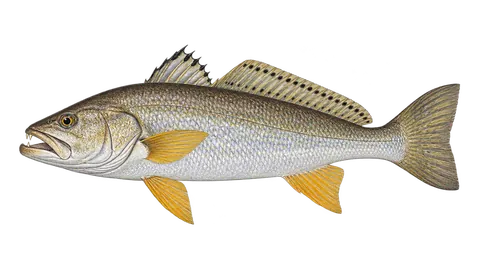
smooth weakfish
Cynoscion leiarchus
Silver weakfish of estuaries and beaches, from North to South. Fights well on light tackle and has highly prized meat.
Also called: pescada-branca, pescada-perna-de-moça, perna-de-moça, pescada-do-reino, curvitinga

- common size
- 30–50 cm
- maximum
- 90 cm
- common weight
- 0.3–1.5 kg
- record/max.
- 2.0 kg
- depth
- 1–40 m
- ideal water
- 23–29 °C
who is the smooth weakfish
The smooth weakfish (pescada-branca) is a medium-sized weakfish, silver with bluish and greenish reflections, living on mud and sand bottoms in estuaries, bays and the shallow shelf, almost always at less than 25 m. It occurs from Panama to southern Brazil and is common from the North and Northeast to São Paulo and Paraná. It hunts shrimp and small fish, moving toward inlets and channels with the tide. It is important for artisanal fishing, sold fresh and salted, and sought by recreational anglers from estuary boats and beach fishing with live shrimp and small artificial lures. It has white, tender meat with a delicate flavor.
fun facts
- The name perna-de-moça comes from its white, tender flesh.
- Like other weakfish, it makes sounds with muscles linked to the swim bladder.
identification
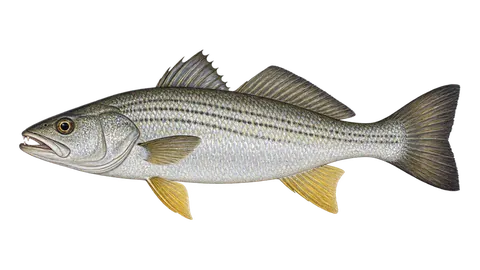
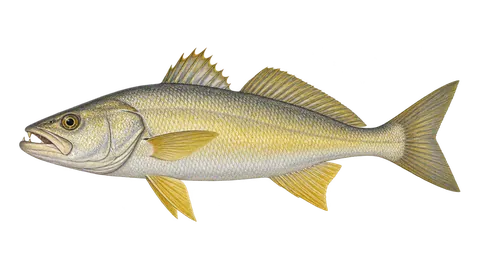
Elongated, silver body with a bluish or greenish back and sometimes faint small dark dots above the lateral line. Soft part of the dorsal and caudal fins with a black edge; ventral and anal fins yellowish; inside of the gill cover dark, visible from outside. Large mouth, protruding lower jaw, a pair of canines at the tip of the upper jaw. Small smooth scales. Differs from the green weakfish by its shorter soft dorsal fin (20 to 24 rays, versus 27 to 31) and from the vermilion seatrout by its smaller scales.
Loading the next 7 days…
Each card shows the day's index (0 to 100) and, below it, a strip with the index for each hour, from 0h to 23h. from poor to excellent.
where found
From Amapá to Santa Catarina, most common from the North to São Paulo, in estuaries, bays and beaches.
Habitat: Estuaries, bays, channels and beaches with mud and sand bottoms; adults on the shallow shelf, usually at less than 25 m.
coast
states
Amapá, Pará, Maranhão, Piauí, Ceará, Rio Grande do Norte, Paraíba, Pernambuco, Alagoas, Sergipe, Bahia, Espírito Santo, Rio de Janeiro, São Paulo, Paraná, Santa Catarina
when to fish
best season
In the North and Northeast it lasts all year; in the Southeast, best from spring to autumn.
best time of day
Night and twilight. Hunts at dawn, dusk and night; by day it bites best in murky water with a running tide.
what affects the smooth weakfish
sensitivity The little bars show how much each factor affects this species. Five full: it feels it a lot.
cold and cold fronts
A cold front shuts down activity in the Southeast.
atmospheric pressure
Stable pressure helps; a sharp drop before a front can give a short peak.
moon
Spring tides (new and full moon) move the estuary more and usually produce.
rain
Light rain doesn't hurt; a strong flood pushes the weakfish out to sea.
water level
With the river high, it moves down to the inlet; in drought, it moves up the channels.
noise
Moderately sensitive; avoid running the motor over the spot.
wind
Wind against the tide keeps the water stirred and sometimes helps.
tide
Best times are the start of the flood and the start of the ebb, at channel corners.
depth
From 2 to 15 m in estuaries and bays.
how to fish
- rod
- 6'0" to 7'0", 10 to 20 lb
- spinning / baitcasting reel
- spinning reel 2500 to 4000
- line
- braided 15 to 20 lb
- leader
- fluorocarbon 20 to 30 lb, 60 to 100 cm
- hook
- circle 1/0 to 3/0 or wide gap 1/0 to 2/0
lures
- 7 to 10 cm shads on 7 to 15 g jig heads
- 10 to 30 g jigs
- small mid-water plugs
natural baits
- live shrimp
- sardinha
- manjuba
accessories
- landing net
tip from an angler
Work the shad slowly, bumping the bottom, at the turn of the tide; the weakfish bites lightly and drops it if it feels resistance.
rules for the smooth weakfish
Summary of the regulations we found, with the source for each. Rules change; before keeping or transporting fish, check with the state environmental agency.
Conservation: Not on the national list (Portaria GM/MMA 1.667/2026). We found no specific federal rule for this species.
We found no species-specific rule beyond the region's general rules.
catch and release
catch and release Releasing the fish alive, quickly and with a wet hand. During a closed season it isn't always allowed: what the regulation says applies.
Weakfish lose scales and die easily: use a rubber passaguá, don't rest it on dry surfaces, and release it quickly, holding it from below.
in the kitchen
White, tender meat with a delicate flavor; excellent as fried fillets, baked and in moqueca.
how much it weighs without taking it out of the water
Length-weight relationship W = a·Lb (a = 0.00912, b = 3.02; FishBase (estimativa bayesiana, comprimento total)). It's an average: a fat or lean fish can vary by 10% to 20%.
estimated weight
—
sources and references
The season weights (months), the time of day and the sensitivities (cold, pressure, moon, wind, rain, tide, strong light, murky water and noise) are the app's editorial estimates, based on the literature below and on the field experience of anglers and guides. They are not official data nor a measurement made for this species, and they may vary by region and year. Closed seasons and legal rules appear in the rules section, with the norm and a link.
- scientific FishBase — Cynoscion leiarchus (ficha da espécie)Names, distribution, biology, length-weight relationship and references. Page checked on Oct 13, 2026. The maximum length (90.8 cm) and the published maximum weight (2.0 kg) come from different references cited by FishBase.
- official Portaria GM/MMA nº 1.667, de 27 de abril de 2026 — Lista Nacional Oficial de Espécies da Fauna Ameaçadas de Extinção (peixes e invertebrados aquáticos)Most recent national list. The species is not on it (search by scientific name in the text published in the DOU, checked on October 13, 2026).
- official ICMBio/SALVE — Ficha de Cynoscion leiarchus (avaliação nacional do risco de extinção)ICMBio national assessment, published in 2025. DOI checked on Crossref.
- scientific IUCN Red List — Cynoscion leiarchus (avaliação global: Pouco Preocupante, LC, 11/10/2019)Global assessment. Link given on the FishBase entry (Red List, version 2025-2).
- scientific Carpenter, K. E. (org.) (2002). The living marine resources of the Western Central Atlantic. Vol. 3: Bony fishes part 2 (Opistognathidae to Molidae). FAO Species Identification Guide for Fishery Purposes. Roma: FAO.Sciaenidae chapter (Chao, N. L.), cited by FishBase for the species.
- scientific Cervigón, F. (1993). Los peces marinos de Venezuela. Vol. 2. Caracas: Fundación Científica Los Roques. 497 p.Printed work; the URL is the bibliographic record on FishBase, which cites this work for the species.