Skip to content
catalog Nematistiidae · predator

roosterfish

Nematistius pectoralis

Sea

The emblematic fish of Pacific beaches, from Baja California to Peru. Its crest of seven long spines breaks the surface when it chases the bait in the surf.

Also called: pez-gallo, galo-do-pacífico, papagallo, roosterfish

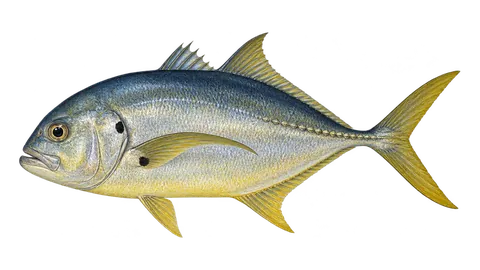
Scientific illustration of Roosterfish
common size
60–110 cm
maximum
163 cm
common weight
3–20 kg
record/max.
51.7 kg
depth
0–20 m
ideal water
24–29 °C
overview

who is the roosterfish

The only living species of its family, found only in the eastern Pacific from southern California to Peru, including the Galápagos. It lives in shallow water: sandy beaches, surf, rocky points and river mouths, where it hunts mullet, sardines and other schooling fish. Juveniles stay in tide pools. The first dorsal fin has seven very long spines, which it raises like a rooster's comb when attacking. It is one of the most sought-after trophies in beach and boat fishing in Mexico, Costa Rica and Panama, fished with slowly dragged live bait, poppers and even flies. It fights with long, low runs. The flesh is little valued, and almost all sport-caught roosterfish are released. In Mexico it is reserved for sport fishing within 50 miles of the coast.

fun facts

  • It is the only living species of the family Nematistiidae.
  • Studies with electronic tags follow released fish along the Central American coast to measure survival after release.
how to recognize it

identification

Tall, compressed body, grey-silver to bluish, with two dark curved bands across the flank. The first dorsal fin has seven very long, flexible spines, like a comb, which lie in a groove when the fish swims. Jacks have no crest and have bony scutes along the lateral line.

how roosterfish fishing looks

Loading the next 7 days…

Each card shows the day's index (0 to 100) and, below it, a strip with the index for each hour, from 0h to 23h. from poor to excellent.

distribution

where found

open on the large map

Does not occur in Brazil. Eastern Pacific, from southern California to Peru, including the Galápagos; rare north of Baja California. Classic destinations: the east coast and La Paz, Baja California Sur (Mexico); Guanacaste and the Osa Peninsula (Costa Rica); the Gulf of Chiriquí and islands of the Gulf of Panama.

Habitat: Sandy beaches and surf, rocky points, shallow bays and river mouths; juveniles live in tide pools.

calendar and clock

when to fish

best season

time of yearbest: Apr–Aug
JanFebSeaAprMayJunJulAugSepOctNovDec

In Baja California the peak usually runs from May to July, as the water warms. In Central America it is fished all year, with good windows in the dry season.

best time of day

0h6h12h18h sunrise ~6amsunset ~6pm

Daytime, with peaks at dawn and dusk. Hunts by day, most active at dawn and late afternoon, when baitfish schools come into the beach.

weather, water and behavior

what affects the roosterfish
sensitivity The little bars show how much each factor affects this species. Five full: it feels it a lot.

cold and cold fronts

Water below 22 °C makes fish sluggish; cold upwellings scare the beach bait away.

atmospheric pressure

Little direct effect.

moon

Full and new moon tides move more water over points and river mouths.

rain

Little effect; murky water from a high river pushes fish away from the mouth.

water level

Not applicable at sea. The equivalent is baitfish present along the beach.

noise

A motor near the surf spooks the school; shut it off before and let the boat drift.

wind

Rough sea prevents beach fishing; light chop helps the popper.

tide

The incoming tide and the first hours of the ebb concentrate bait on points and river mouths.

depth

From the shallows of the surf out to about 20 m, over sandy bottoms near rocks.

technique, gear and bait

how to fish

rod
spinning 7' to 9', 20 to 40 lb; from the beach, 9' to 10'
spinning / baitcasting reel
spinning reel 5000 to 8000 with smooth, progressive drag
line
braid 40 to 65 lb
leader
fluorocarbon or monofilament 60 to 80 lb, 1.5 m
hook
circle 5/0 to 8/0 on live bait; reinforced treble hooks on the popper

lures

  • popper and stickbait 15 to 20 cm
  • large mid-water lure
  • fly: large streamer with sinking line and teaser

natural baits

  • live mullet, sardine or mackerel trolled slowly

accessories

  • long-nose pliers
  • luvas
  • fighting belt

tip from an angler

Drag the live bait very slowly along the edge of the surf. When the crest appears behind the bait, do not stop: the roosterfish follows the bait for meters before striking. With a circle hook, just let the line tighten.

what the law says

rules for the roosterfish

Summary of the regulations we found, with the source for each. Rules change; before keeping or transporting fish, check with the state environmental agency.

Mexico: reserved for sport fishing; up to 2 per angler per day

2 fish per angler per day

Within the 50 nautical mile strip off the Mexican coast, the roosterfish is reserved for sport-recreational fishing. The limit is 2 fish per angler per day, which count as 5 toward the total limit of 10 marine fish per day. Fish above the limit must be released alive, and fish caught in sport fishing may not be sold.

Source: Amendment to NOM-017-PESC-1994 (recreational sport fishing in federal waters of Mexico), signed Oct 14, 2013 and published in the DOF, item 4.9.1 (Sagarpa/Conapesca)

catch and release
catch and release Releasing the fish alive, quickly and with a wet hand. During a closed season it isn't always allowed: what the regulation says applies.

Keep the fish in the water while you remove the hook; hold it by the base of the tail and under the belly, never by the crest. Revive it by moving it forward so water flows over the gills.

in the kitchen

Dark, firm flesh of moderate value. In sport fishing it is almost always released.

calculator

how much it weighs without taking it out of the water

Length-weight relationship W = a·Lb (a = 0.01072, b = 3.02; FishBase (estimativa bayesiana para a família e o formato do corpo)). It's an average: a fat or lean fish can vary by 10% to 20%.

estimated weight

—

sources and references

The season weights (months), the time of day and the sensitivities (cold, pressure, moon, wind, rain, tide, strong light, murky water and noise) are the app's editorial estimates, based on the literature below and on the field experience of anglers and guides. They are not official data nor a measurement made for this species, and they may vary by region and year. Closed seasons and legal rules appear in the rules section, with the norm and a link.

  1. scientific FishBase — Nematistius pectoralis (ficha da espécie)Names, distribution, biology, length-weight relationship, country list and references. Page checked on Oct 13, 2026.
  2. scientific IUCN Red List — Nematistius pectoralis (avaliação global: Pouco Preocupante, LC, 23/02/2024)Global assessment. Link given on the FishBase entry (Red List, version 2025-2).
  3. scientific Sepulveda, C. A.; Aalbers, S. A.; Bernal, D. (2015). Post release survival and movement patterns of roosterfish (Nematistius pectoralis) off the Central American coastline. Latin American Journal of Aquatic Research 43(1): 162-175.DOI checked in Crossref.
  4. scientific Ortega-Garcia, S. et al. (2017). Age, growth, and length-weight relationship of roosterfish (Nematistius pectoralis) in the eastern Pacific Ocean. Fishery Bulletin 115(1): 117-124.DOI checked in Crossref.
  5. official México — Modificación a la Norma Oficial Mexicana NOM-017-PESC-1994, para regular las actividades de pesca deportivo-recreativa (DOF)Official text in the Diario Oficial de la Federación. Items 0.3 (species reserved for sport fishing) and 4.9 (catch limits) checked on Oct 13, 2026.
don't confuse

similar species