

- common size
- 60–110 cm
- maximum
- 163 cm
- common weight
- 3–20 kg
- record/max.
- 51.7 kg
- depth
- 0–20 m
- ideal water
- 24–29 °C

the right time
to be on the water
Choose the place and the species. The index, from 0 to 100, combines weather, sun, moon and tide with each fish's habits. Up to 28 days, with each day's confidence.
Loading the forecast…
—
Looking for alerts within 30 km…
Looking for what anglers have logged near here…
what you need to fish herelicense, certification and boat documents
fish likely at this spot
Tap a fish to see its forecast.
hour by hour
slide your finger or mouse over the chart to see each hoursee hour-by-hour table
why this index at —?
choose the day
the fishing month at a glance
what's the best window for the crew?
Choose how many fishing days. We compare each stretch by its average index, discount days with a warning or closed season, and show the 3 best.
trend for the coming weeks
Line: the middle value of 31 simulations of the American GEFS model. Band: where 8 out of 10 fall. Narrow, firm trend; wide, high uncertainty.
everything about the roosterfish
how to recognize it
Tall, compressed body, grey-silver to bluish, with two dark curved bands across the flank. The first dorsal fin has seven very long, flexible spines, like a comb, which lie in a groove when the fish swims. Jacks have no crest and have bony scutes along the lateral line.
Also called: pez-gallo, galo-do-pacífico, papagallo, roosterfish
don't confuse with:
where found
open on the large mapWhere to look: Sandy beaches and surf, rocky points, shallow bays and river mouths; juveniles live in tide pools.
Does not occur in Brazil. Eastern Pacific, from southern California to Peru, including the Galápagos; rare north of Baja California. Classic destinations: the east coast and La Paz, Baja California Sur (Mexico); Guanacaste and the Osa Peninsula (Costa Rica); the Gulf of Chiriquí and islands of the Gulf of Panama.
when to fish
best season
In Baja California the peak usually runs from May to July, as the water warms. In Central America it is fished all year, with good windows in the dry season.
best time of day
Daytime, with peaks at dawn and dusk. Hunts by day, most active at dawn and late afternoon, when baitfish schools come into the beach.
what affects the roosterfish
cold and cold fronts
Water below 22 °C makes fish sluggish; cold upwellings scare the beach bait away.
atmospheric pressure
Little direct effect.
moon
Full and new moon tides move more water over points and river mouths.
rain
Little effect; murky water from a high river pushes fish away from the mouth.
water level
Not applicable at sea. The equivalent is baitfish present along the beach.
noise
A motor near the surf spooks the school; shut it off before and let the boat drift.
wind
Rough sea prevents beach fishing; light chop helps the popper.
tide
The incoming tide and the first hours of the ebb concentrate bait on points and river mouths.
depth
From the shallows of the surf out to about 20 m, over sandy bottoms near rocks.
how to fish
lures
- popper and stickbait 15 to 20 cm
- large mid-water lure
- fly: large streamer with sinking line and teaser
natural baits
- live mullet, sardine or mackerel trolled slowly
tip from an angler
Drag the live bait very slowly along the edge of the surf. When the crest appears behind the bait, do not stop: the roosterfish follows the bait for meters before striking. With a circle hook, just let the line tighten.
- rod
- spinning 7' to 9', 20 to 40 lb; from the beach, 9' to 10'
- spinning / baitcasting reel
- spinning reel 5000 to 8000 with smooth, progressive drag
- line
- braid 40 to 65 lb
- leader
- fluorocarbon or monofilament 60 to 80 lb, 1.5 m
- hook
- circle 5/0 to 8/0 on live bait; reinforced treble hooks on the popper
accessories
- long-nose pliers
- luvas
- fighting belt
catch and release
Keep the fish in the water while you remove the hook; hold it by the base of the tail and under the belly, never by the crest. Revive it by moving it forward so water flows over the gills.
rules for the roosterfish
Rules change; before keeping or transporting fish, check with the state environmental agency.
Mexico: reserved for sport fishing; up to 2 per angler per day
2 fish per angler per day details
Within the 50 nautical mile strip off the Mexican coast, the roosterfish is reserved for sport-recreational fishing. The limit is 2 fish per angler per day, which count as 5 toward the total limit of 10 marine fish per day. Fish above the limit must be released alive, and fish caught in sport fishing may not be sold.
how much it weighs without taking it out of the water
estimated weight
—
how we calculate
Length-weight relationship W = a·Lb (a = 0.01072, b = 3.02; FishBase (estimativa bayesiana para a família e o formato do corpo)). It's an average: a fat or lean fish can vary by 10% to 20%.
more about the roosterfish
The only living species of its family, found only in the eastern Pacific from southern California to Peru, including the Galápagos. It lives in shallow water: sandy beaches, surf, rocky points and river mouths, where it hunts mullet, sardines and other schooling fish. Juveniles stay in tide pools. The first dorsal fin has seven very long spines, which it raises like a rooster's comb when attacking. It is one of the most sought-after trophies in beach and boat fishing in Mexico, Costa Rica and Panama, fished with slowly dragged live bait, poppers and even flies. It fights with long, low runs. The flesh is little valued, and almost all sport-caught roosterfish are released. In Mexico it is reserved for sport fishing within 50 miles of the coast.
Family: Nematistiidae · predator
fun facts
- It is the only living species of the family Nematistiidae.
- Studies with electronic tags follow released fish along the Central American coast to measure survival after release.
in the kitchen
Dark, firm flesh of moderate value. In sport fishing it is almost always released.
similar species
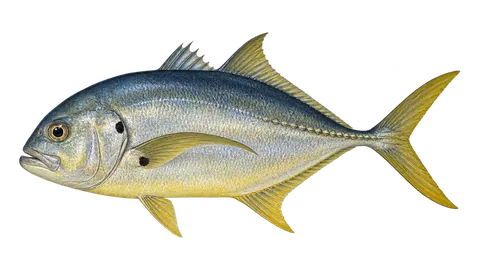
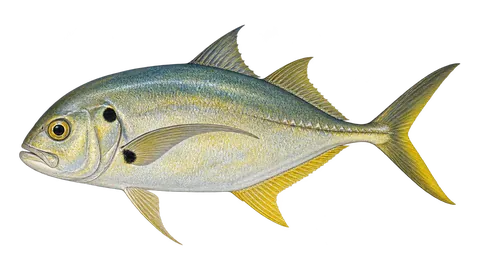
sources and references (5)
The season weights (months), the time of day and the sensitivities (cold, pressure, moon, wind, rain, tide, strong light, murky water and noise) are the app's editorial estimates, based on the literature below and on the field experience of anglers and guides. They are not official data nor a measurement made for this species, and they may vary by region and year. Closed seasons and legal rules appear in the rules section, with the norm and a link.
- scientific FishBase — Nematistius pectoralis (ficha da espécie)Names, distribution, biology, length-weight relationship, country list and references. Page checked on Oct 13, 2026.
- scientific IUCN Red List — Nematistius pectoralis (avaliação global: Pouco Preocupante, LC, 23/02/2024)Global assessment. Link given on the FishBase entry (Red List, version 2025-2).
- scientific Sepulveda, C. A.; Aalbers, S. A.; Bernal, D. (2015). Post release survival and movement patterns of roosterfish (Nematistius pectoralis) off the Central American coastline. Latin American Journal of Aquatic Research 43(1): 162-175.DOI checked in Crossref.
- scientific Ortega-Garcia, S. et al. (2017). Age, growth, and length-weight relationship of roosterfish (Nematistius pectoralis) in the eastern Pacific Ocean. Fishery Bulletin 115(1): 117-124.DOI checked in Crossref.
- official México — Modificación a la Norma Oficial Mexicana NOM-017-PESC-1994, para regular las actividades de pesca deportivo-recreativa (DOF)Official text in the Diario Oficial de la Federación. Items 0.3 (species reserved for sport fishing) and 4.9 (catch limits) checked on Oct 13, 2026.
how we calculatewhere each number comes from
The weather comes from three independent global models, cross-checked hour by hour: when they agree, confidence goes up; when they diverge, the band between them shows on the chart. Beyond 16 days, we use the GEFS ensemble of 31 simulations: if 20 of the 31 predict rain, the chance of rain is 65%. Sun and moon are calculated astronomically, with no uncertainty.
The index adds up, weighted for each species: time of day (species curve anchored to real sunrise and sunset), moon (transits, rise and set, phase), pressure (3 h trend and 24 h swing), water temperature (in rivers, estimated from air temperature; at sea, estimated by an ocean model), wind, rain, clouds, tide and the month in the species' cycle.
sources for this lookup
how accurate the forecast is
Accuracy measured in the reference project (4 regions, 93 days, forecast vs. observed): maximum temperature is off by 0.6 °C on average the next day and 1.7 °C at 7 days; rain of 5 mm or more is detected 76% of the time the next day and 57% at 7 days. Detection isn't everything: the false alarm rate isn't published here yet, and 93 days in 4 regions is still a small sample. We now also measure every day, at the app's destinations: