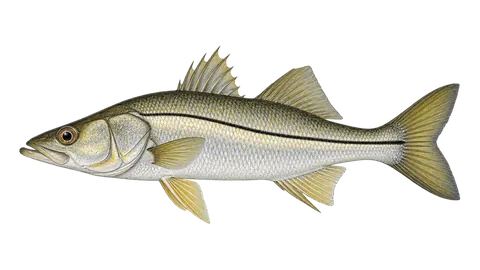
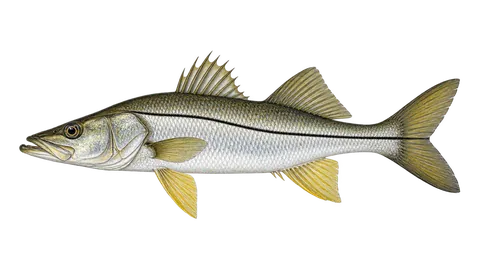
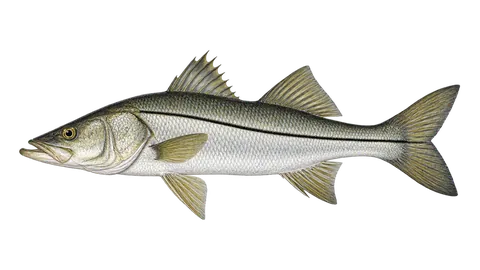
The smallest of the Atlantic snooks, of estuaries, channels and rivers, with a long spine on the anal fin. It takes shrimp and small plugs near mangrove roots and banks, and enters fresh water.
Also called: robalo-espada, camurim (nome comum a vários robalos), robalo, swordspine snook, long-spined snook
The robalo-espada is a small snook of the western Atlantic: FishBase gives a maximum of 36.2 cm and 1 kg, with the common size around 25 cm. It occurs from southern Florida and the Antilles to the Caribbean coasts, Central America and northern South America, down to Rio de Janeiro. It lives in coastal waters, estuaries and lagoons and goes up rivers to fresh water, where it prefers slightly salty or fresh water and soft bottoms. Juveniles stay in mangroves and irrigation canals. It eats small fish such as sardines and anchovies, and crustaceans, mainly shrimp. It has a small-scale commercial fishery and interests light-tackle sport anglers. In Brazil, all snooks (Centropomus spp.) fall under the Espírito Santo and Bahia closed seasons.
fun facts
The English name, swordspine snook, comes from the second anal fin spine, greatly enlarged.
It goes up rivers to fresh water and juveniles live in mangroves and irrigation canals.
FishBase calls it an amphidromous species: it spends part of its life at sea and part in fresh water.
how to recognize it
identification
Elongated, silvery body, yellowish-brown on the back, with a dark lateral line and yellow pectoral and pelvic fins; the other fins are dark. The field mark is the second spine of the anal fin, greatly enlarged, like a sword, which gives it its English name (swordspine snook). Snooks look alike; this is the smallest of them, barely exceeding 36 cm according to FishBase. For a safe identification, check the anal spine and the counts in a guide.
how swordspine snook fishing looks
Loading the next 7 days…
Each card shows the day's index (0 to 100) and, below it, a strip with the index for each hour, from 0h to 23h. from poor to excellent.
Estuaries, mangroves, channels and lower rivers of the North, Northeast and Southeast coast, down to Rio de Janeiro according to FishBase. Outside Brazil, it ranges from southern Florida and the Antilles to the Caribbean coasts, Central America and northern South America.
Habitat: Estuaries, river mouths, mangroves, channels and soft-bottomed lagoons, in brackish or fresh water; juveniles use mangroves and channels.
coast
North CoastNortheast CoastSoutheast Coastcoastal
calendar and clock
when to fish
best season
time of yearbest: Oct–Jan
JanFebSeaAprMayJunJulAugSepOctNovDec
The warm months, with rain and more brackish water, are best. In Espírito Santo and Bahia, snook fishing is banned from May to July; see the rules.
best time of day
Night and twilight. Most active at dusk, at night and at dawn, with the tide running.
weather, water and behavior
what affects the swordspine snook
sensitivity The little bars show how much each factor affects this species. Five full: it feels it a lot.
cold and cold fronts
Water below about 20 °C makes snook disappear from the banks; cold fronts knock fishing down.
atmospheric pressure
Stable pressure helps; a cold front brings rough sea and murky water and gets in the way.
moon
Moon phase and spring tides increase the current and activity at channel mouths.
rain
Light rain helps; heavy runoff leaves the water fresh and muddy and scatters the fish.
water level
Low river concentrates fish in the holes; high water spreads it through the mangroves.
noise
Very wary in clear water: approach by paddle or electric motor and keep your voice low.
wind
Strong wind ruins precise casts close to the mangrove.
tide
It is the main variable: a running tide, rising or falling, puts the fish in ambush at channel mouths and among the roots.
fluorocarbon 15 to 25 lb, 60 to 100 cm (the gill cover edge of snook is sharp)
hook
hook no. 1 to 1/0 or small treble hook of the plug
lures
mid-water plug, 6 to 9 cm
5 to 8 cm shad on a 1/8 oz jig head
small midwater lure
small streamer on fly
natural baits
live shrimp
small live sardine or manjuba
small mullet
accessories
long-nose pliers
thin glove
polarized glasses
tip from an angler
Cast close to the mangrove roots and banks, with the current, and let the bait drift; the strike comes as it passes the edge of the shade.
what the law says
rules for the swordspine snook
Summary of the regulations we found, with the source for each. Rules change; before keeping or transporting fish, check with the state environmental agency. Conservation: Not on the Brazilian national list (Portaria GM/MMA nº 1.667/2026). The snook closed season (Centropomus spp.) applies in Espírito Santo and Bahia.
Espírito Santo: snook closed season from May 1 to Jun 30
fishing prohibited from May 1 to June 3001/05 to 30/06ESSoutheast Coast
On the coast and in the inland waters of Espírito Santo, it is prohibited to fish for snook, white snook and camurim (Centropomus parallelus, C. undecimalis and Centropomus spp.) with any gear from May 1 to June 30. The robalo-espada falls under 'Centropomus spp.'. Fishing competitions targeting snook are also prohibited from May 1 to August 31. Landing is tolerated until May 2.
fishing banned from May 15 to Jul 3115/05 to 31/07BANortheast Coast
On the coast and in the inland waters of Bahia, it is prohibited to fish for snook, white snook and camurim (Centropomus parallelus, C. undecimalis and Centropomus spp.) from May 15 to July 31. The robalo-espada falls under 'Centropomus spp.'. Landing is tolerated until May 16, and transport, sale and processing of snook caught in the period are prohibited.
On the Caribbean coast of Nicaragua, the robalo-espada (swordspine snook) may not be caught below 30 cm total length. The rule sets minimum catch sizes for fish and mollusks, without separating commercial from sport fishing in the section consulted.
Mexico (Gulf): the snook closed season from Jul 1 to Aug 15 does not mention this species
closed season from Jul 1 to Aug 15 for robalo blanco, robalo prieto and chucumiteconfirm with the agency
In federal waters of Tamaulipas, Veracruz, Tabasco and Campeche, the 2025 agreement bans fishing from July 1 to August 15 for robalo blanco (C. undecimalis), robalo prieto (C. poeyi) and chucumite (C. parallelus). The robalo-espada is not mentioned. Since snooks look alike and share the same places, the safest course is not to fish for any snook in those waters and on those dates.
Mexico: up to 5 per species and 10 saltwater fish per day
5 specimens of the species per angler per day, within the limit of 10 saltwater fish
In recreational sport fishing in Mexican federal waters, each angler may keep up to 10 marine fish per day, no more than 5 of the same species. The robalo-espada has no limit of its own in the rule. Fish above the limit must be returned alive to the water, and fish kept may not be sold. Anglers fishing from a boat need a Conapesca permit.
catch and release Releasing the fish alive, quickly and with a wet hand. During a closed season it isn't always allowed: what the regulation says applies.
The edge of the gill cover on snook is sharp: wet your hands, hold it by the lower lip or use pliers, without putting your finger in the gill. Take a quick photo and release it facing the current; the closed season prohibits keeping snook during the period.
in the kitchen
White, fine flesh, good baked, in moqueca or fried. It is small-scale fishing for small fish: it yields little fillet.
calculator
how much it weighs without taking it out of the water
Length-weight relationship W = a·Lb (a = 0.00741, b = 3.08; FishBase (relação peso-comprimento bayesiana, estimativa da própria espécie)). It's an average: a fat or lean fish can vary by 10% to 20%.
estimated weight
—
sources and references
Seasonal weights (months), timing and sensitivities (cold, pressure, moon, wind, rain, tide, bright light, murky water and noise) are the app's editorial estimates, based on the literature below and on field experience from anglers and guides. They are not official data or measurements made for this species and may vary by region and year. Closed seasons and legal rules appear in the rules section, with the regulation and link. Common sizes and weights are ranges around the common length reported by FishBase, with weight calculated from the length-weight relationship. The depth shown is FishBase's (up to 22 m).
scientificFishBase: nomes populares de Centropomus ensiferusNames by country and language. No popular name in Brazilian Portuguese is registered for this species: the app uses robalo-espada (a translation of the English name) and the Spanish name robalo de espolón. Camurim is the general term for snook in the Northeast.