

- common size
- 20–30 cm
- maximum
- 36 cm
- common weight
- 0.1–0.3 kg
- record/max.
- 1.0 kg
- depth
- 0–22 m
- ideal water
- 25–31 °C

the right time
to be on the water
Choose the place and the species. The index, from 0 to 100, combines weather, sun, moon and tide with each fish's habits. Up to 28 days, with each day's confidence.
Loading the forecast…
—
Looking for alerts within 30 km…
Looking for what anglers have logged near here…
what you need to fish herelicense, certification and boat documents
fish likely at this spot
Tap a fish to see its forecast.
hour by hour
slide your finger or mouse over the chart to see each hoursee hour-by-hour table
why this index at —?
choose the day
the fishing month at a glance
what's the best window for the crew?
Choose how many fishing days. We compare each stretch by its average index, discount days with a warning or closed season, and show the 3 best.
trend for the coming weeks
Line: the middle value of 31 simulations of the American GEFS model. Band: where 8 out of 10 fall. Narrow, firm trend; wide, high uncertainty.
everything about the swordspine snook
how to recognize it
Elongated, silvery body, yellowish-brown on the back, with a dark lateral line and yellow pectoral and pelvic fins; the other fins are dark. The field mark is the second spine of the anal fin, greatly enlarged, like a sword, which gives it its English name (swordspine snook). Snooks look alike; this is the smallest of them, barely exceeding 36 cm according to FishBase. For a safe identification, check the anal spine and the counts in a guide.
Also called: robalo-espada, camurim (nome comum a vários robalos), robalo, swordspine snook, long-spined snook
don't confuse with:
where found
open on the large mapWhere to look: Estuaries, river mouths, mangroves, channels and soft-bottomed lagoons, in brackish or fresh water; juveniles use mangroves and channels.
Estuaries, mangroves, channels and lower rivers of the North, Northeast and Southeast coast, down to Rio de Janeiro according to FishBase. Outside Brazil, it ranges from southern Florida and the Antilles to the Caribbean coasts, Central America and northern South America.
coast
when to fish
best season
The warm months, with rain and more brackish water, are best. In Espírito Santo and Bahia, snook fishing is banned from May to July; see the rules.
best time of day
Night and twilight. Most active at dusk, at night and at dawn, with the tide running.
what affects the swordspine snook
cold and cold fronts
Water below about 20 °C makes snook disappear from the banks; cold fronts knock fishing down.
atmospheric pressure
Stable pressure helps; a cold front brings rough sea and murky water and gets in the way.
moon
Moon phase and spring tides increase the current and activity at channel mouths.
rain
Light rain helps; heavy runoff leaves the water fresh and muddy and scatters the fish.
water level
Low river concentrates fish in the holes; high water spreads it through the mangroves.
noise
Very wary in clear water: approach by paddle or electric motor and keep your voice low.
wind
Strong wind ruins precise casts close to the mangrove.
tide
It is the main variable: a running tide, rising or falling, puts the fish in ambush at channel mouths and among the roots.
depth
Usually 0.5 to 3 m; FishBase gives up to 22 m.
how to fish
lures
- mid-water plug, 6 to 9 cm
- 5 to 8 cm shad on a 1/8 oz jig head
- small midwater lure
- small streamer on fly
natural baits
- live shrimp
- small live sardine or manjuba
- small mullet
tip from an angler
Cast close to the mangrove roots and banks, with the current, and let the bait drift; the strike comes as it passes the edge of the shade.
- rod
- 6'0" to 7'0", 6 to 14 lb, fast action
- spinning / baitcasting reel
- spinning reel 2000 to 3000 or small baitcaster
- line
- braid 8 to 15 lb
- leader
- fluorocarbon 15 to 25 lb, 60 to 100 cm (the gill cover edge of snook is sharp)
- hook
- hook no. 1 to 1/0 or small treble hook of the plug
accessories
- long-nose pliers
- thin glove
- polarized glasses
catch and release
The edge of the gill cover on snook is sharp: wet your hands, hold it by the lower lip or use pliers, without putting your finger in the gill. Take a quick photo and release it facing the current; the closed season prohibits keeping snook during the period.
rules for the swordspine snook
Rules change; before keeping or transporting fish, check with the state environmental agency.
Espírito Santo: snook closed season from May 1 to Jun 30
fishing prohibited from May 1 to June 3001/05 to 30/06ES details
On the coast and in the inland waters of Espírito Santo, it is prohibited to fish for snook, white snook and camurim (Centropomus parallelus, C. undecimalis and Centropomus spp.) with any gear from May 1 to June 30. The robalo-espada falls under 'Centropomus spp.'. Fishing competitions targeting snook are also prohibited from May 1 to August 31. Landing is tolerated until May 2.
Source: Instrução Normativa Ibama nº 10, of Apr 27, 2009, arts. 1º, 3º and 5º (Ibama)
Bahia: snook closed season from May 15 to Jul 31
fishing banned from May 15 to Jul 3115/05 to 31/07BA details
On the coast and in the inland waters of Bahia, it is prohibited to fish for snook, white snook and camurim (Centropomus parallelus, C. undecimalis and Centropomus spp.) from May 15 to July 31. The robalo-espada falls under 'Centropomus spp.'. Landing is tolerated until May 16, and transport, sale and processing of snook caught in the period are prohibited.
Source: Portaria Ibama nº 49-N, of May 13, 1992, art. 1º and §§ (Ibama)
Nicaragua (Caribbean): minimum size of 30 cm
30 cm (total length)confirm with the agency details
On the Caribbean coast of Nicaragua, the robalo-espada (swordspine snook) may not be caught below 30 cm total length. The rule sets minimum catch sizes for fish and mollusks, without separating commercial from sport fishing in the section consulted.
Source: Resolución Ejecutiva PA nº 003-2012 (INPESCA, Nicaragua), item First; La Gaceta nº 66
Mexico (Gulf): the snook closed season from Jul 1 to Aug 15 does not mention this species
closed season from Jul 1 to Aug 15 for robalo blanco, robalo prieto and chucumiteconfirm with the agency details
In federal waters of Tamaulipas, Veracruz, Tabasco and Campeche, the 2025 agreement bans fishing from July 1 to August 15 for robalo blanco (C. undecimalis), robalo prieto (C. poeyi) and chucumite (C. parallelus). The robalo-espada is not mentioned. Since snooks look alike and share the same places, the safest course is not to fish for any snook in those waters and on those dates.
Mexico: up to 5 per species and 10 saltwater fish per day
5 specimens of the species per angler per day, within the limit of 10 saltwater fish details
In recreational sport fishing in Mexican federal waters, each angler may keep up to 10 marine fish per day, no more than 5 of the same species. The robalo-espada has no limit of its own in the rule. Fish above the limit must be returned alive to the water, and fish kept may not be sold. Anglers fishing from a boat need a Conapesca permit.
Conservation: Not on the Brazilian national list (Portaria GM/MMA nº 1.667/2026). The snook closed season (Centropomus spp.) applies in Espírito Santo and Bahia.
how much it weighs without taking it out of the water
estimated weight
—
how we calculate
Length-weight relationship W = a·Lb (a = 0.00741, b = 3.08; FishBase (relação peso-comprimento bayesiana, estimativa da própria espécie)). It's an average: a fat or lean fish can vary by 10% to 20%.
more about the swordspine snook
The robalo-espada is a small snook of the western Atlantic: FishBase gives a maximum of 36.2 cm and 1 kg, with the common size around 25 cm. It occurs from southern Florida and the Antilles to the Caribbean coasts, Central America and northern South America, down to Rio de Janeiro. It lives in coastal waters, estuaries and lagoons and goes up rivers to fresh water, where it prefers slightly salty or fresh water and soft bottoms. Juveniles stay in mangroves and irrigation canals. It eats small fish such as sardines and anchovies, and crustaceans, mainly shrimp. It has a small-scale commercial fishery and interests light-tackle sport anglers. In Brazil, all snooks (Centropomus spp.) fall under the Espírito Santo and Bahia closed seasons.
Family: Centropomidae · predator
fun facts
- The English name, swordspine snook, comes from the second anal fin spine, greatly enlarged.
- It goes up rivers to fresh water and juveniles live in mangroves and irrigation canals.
- FishBase calls it an amphidromous species: it spends part of its life at sea and part in fresh water.
in the kitchen
White, fine flesh, good baked, in moqueca or fried. It is small-scale fishing for small fish: it yields little fillet.
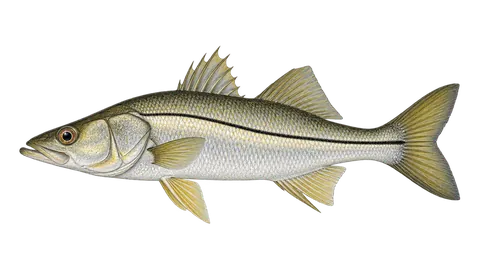
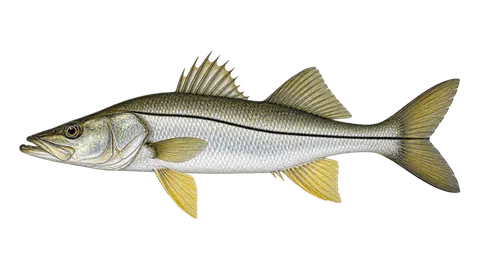
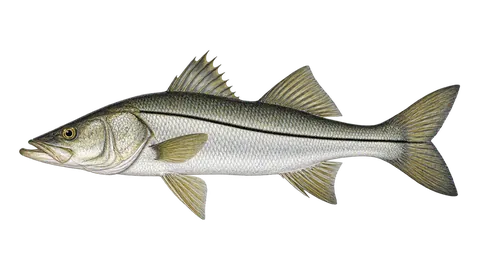
similar species

sources and references (10)
Seasonal weights (months), timing and sensitivities (cold, pressure, moon, wind, rain, tide, bright light, murky water and noise) are the app's editorial estimates, based on the literature below and on field experience from anglers and guides. They are not official data or measurements made for this species and may vary by region and year. Closed seasons and legal rules appear in the rules section, with the regulation and link. Common sizes and weights are ranges around the common length reported by FishBase, with weight calculated from the length-weight relationship. The depth shown is FishBase's (up to 22 m).
- scientific FishBase: Centropomus ensiferus (ficha da espécie)Size, length-weight, depth, habitat, distribution, biology, and IUCN status. Page checked on Oct 13, 2026.
- scientific FishBase: nomes populares de Centropomus ensiferusNames by country and language. No popular name in Brazilian Portuguese is registered for this species: the app uses robalo-espada (a translation of the English name) and the Spanish name robalo de espolón. Camurim is the general term for snook in the Northeast.
- official Portaria GM/MMA nº 1.667, de 27 de abril de 2026: Lista Nacional Oficial de Espécies da Fauna Ameaçadas de Extinção (peixes e invertebrados aquáticos)The species is not on the list. Checked in the DOU of April 28, 2026.
- official Instrução Normativa Ibama nº 10, de 27 de abril de 2009: defeso do robalo no Espírito SantoText published in the Official Gazette (DOU) on April 30, 2009. Applies to Centropomus parallelus, C. undecimalis and Centropomus spp., with any gear. Checked on October 13, 2026.
- official Portaria Ibama nº 49-N, de 13 de maio de 1992: defeso do robalo na Bahia (e, até 2009, no Espírito Santo)Text published in the DOU on May 14, 1992, in a digitized copy. Period May 15 to Jul 31, also checked against the Ibama table of marine closed seasons on October 13, 2026.
- official Ibama: Defesos marinhos (tabela de períodos de defeso e normas)Official list of current marine closed seasons. Checked on October 13, 2026.
- official Nicarágua: Resolução Executiva PA nº 003-2012 (INPESCA), tamanhos mínimos de captura para peixes e moluscos, La Gaceta nº 66Signed in Managua on Jan 31, 2012. Item Primero sets the minimum sizes for the Caribbean coast. Digitized copy from FAOLEX, checked on Oct 13, 2026; we found no later text amending it. Swordspine snook (Centropomus ensiferus) appears under item Primero, Caribbean coast, at 30 cm.
- official DOF: Acordo que modifica o Aviso de épocas e zonas de veda de 16/03/1994 (veda de robalo blanco, robalo prieto e chucumite), DOF de 02/12/2025Closed season from Jul 1 to Aug 15 in federal waters of Tamaulipas, Veracruz, Tabasco and Campeche; it names only three snook species. Checked on October 13, 2026.
- official DOF: Modificação da NOM-017-PESC-1994, para regular a pesca deportivo-recreativa em águas de jurisdição federal do México (DOF de 25/11/2013)Daily quotas at sea (item 4.9.1), return of the excess (4.9.5), ban on selling the fish (4.11) and ban on fishing in closed zones and seasons (4.10 a). Text checked Oct 13, 2026.
- scientific Figueiredo-Filho, J. M.; Marceniuk, A. P.; Feijó, A.; et al. (2021). Taxonomy of Centropomus Lacépède, 1802, with focus on the Atlantic species of the genus. Zootaxa 4942(3): 301-338Recognizes six Centropomus species in the Atlantic (ensiferus, irae, parallelus, pectinatus, poeyi and undecimalis) and treats C. mexicanus as a synonym of C. parallelus. Summary checked on October 13, 2026.
how we calculatewhere each number comes from
The weather comes from three independent global models, cross-checked hour by hour: when they agree, confidence goes up; when they diverge, the band between them shows on the chart. Beyond 16 days, we use the GEFS ensemble of 31 simulations: if 20 of the 31 predict rain, the chance of rain is 65%. Sun and moon are calculated astronomically, with no uncertainty.
The index adds up, weighted for each species: time of day (species curve anchored to real sunrise and sunset), moon (transits, rise and set, phase), pressure (3 h trend and 24 h swing), water temperature (in rivers, estimated from air temperature; at sea, estimated by an ocean model), wind, rain, clouds, tide and the month in the species' cycle.
sources for this lookup
how accurate the forecast is
Accuracy measured in the reference project (4 regions, 93 days, forecast vs. observed): maximum temperature is off by 0.6 °C on average the next day and 1.7 °C at 7 days; rain of 5 mm or more is detected 76% of the time the next day and 57% at 7 days. Detection isn't everything: the false alarm rate isn't published here yet, and 93 days in 4 regions is still a small sample. We now also measure every day, at the app's destinations: