Skip to content
catalog Cichlidae · predator

blue peacock bass

Cichla piquiti

Freshwater

Five-bar peacock bass from the Tocantins-Araguaia, strong and aggressive, now spread across large reservoirs in the Southeast and Center-West.

Also called: tucunaré-azul, azul

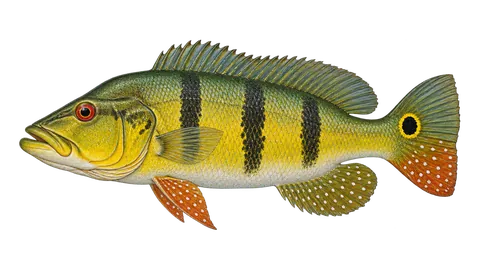
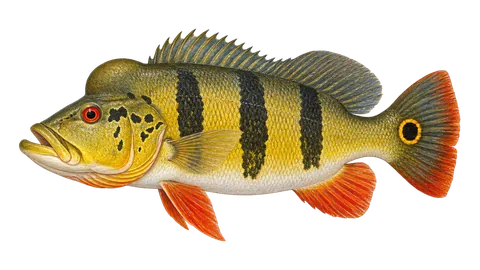
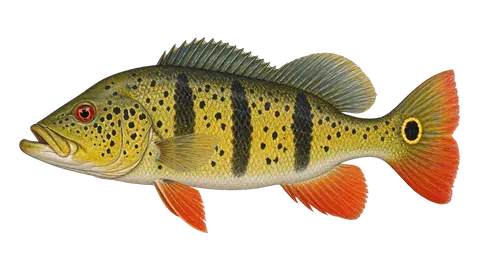
Scientific illustration of Blue peacock bass
common size
35–60 cm
maximum
80 cm
common weight
1–4 kg
record/max.
8.0 kg
depth
1–8 m
ideal water
26–30 °C
overview

who is the blue peacock bass

Native to the Tocantins-Araguaia basin, the blue peacock bass was introduced to reservoirs in Paraná and São Francisco, where it became the main target of many fishing trips. It prefers clear water deeper than the yellow: rocky bottoms, island points, stake fields on banks and channel edges. It hunts lambari, small curimba and other peacock bass, alone or in small groups. It fights with strong bursts and tends to dive to the bottom instead of jumping. Like the yellow, it depends on warm water: below 20 °C it almost stops eating. In Southeast reservoirs the season is the warm period; in Tocantins, the winter dry season.

fun facts

  • In Paraná reservoirs it arrived through releases by anglers and fish farms and changed regional fishing.
  • Pairs dig nests on hard bottom and defend the young by attacking any lure.
how to recognize it

identification

Five dark, narrow vertical bars on the flank, separated by light bands, and a black ocellus with a golden ring at the base of the tail. Greenish to bluish back. Lower fins orange. The yellow has three bars and white spots on the ventral and anal fins. The açu also has three bars. Counting the bars settles it: five is blue.

how blue peacock bass fishing looks

Loading the next 7 days…

Each card shows the day's index (0 to 100) and, below it, a strip with the index for each hour, from 0h to 23h. from poor to excellent.

distribution

where found

open on the large map

Native to the Tocantins and lower Araguaia, including reservoirs such as Serra da Mesa, Lajeado and Tucuruí. Introduced to reservoirs on the Grande, Paranaíba, Tietê and Paraná rivers, and to the São Francisco.

Habitat: Rocky bottoms, island points, stake fields and timber on banks, channel edges and reservoir coves with clear water.

native to the basins

Tocantins-Araguaia

introduced in

ParanáSão Francisco

states

Tocantins, Goiás, Pará, Maranhão, Mato Grosso, São Paulo, Minas Gerais, Mato Grosso do Sul, Paraná, Bahia

calendar and clock

when to fish

best season

time of yearbest: Aug–Nov
JanFebSeaAprMayJunJulAugSepOctNovDec

In Tocantins the best period is the dry season, from July to October. In Southeast reservoirs it fishes well from September to March and drops off sharply in winter.

best time of day

0h6h12h18h sunrise ~6amsunset ~6pm

Daytime, with peaks at dawn and dusk. Feeds by day. The first hours of morning and late afternoon are the best times at the surface; at midday with the sun overhead it drops to rocky bottom and channel.

weather, water and behavior

what affects the blue peacock bass
sensitivity The little bars show how much each factor affects this species. Five full: it feels it a lot.

cold and cold fronts

A cold front on a Southeast reservoir shuts down fishing for days. Below 20 °C in the water, it almost never strikes.

atmospheric pressure

Stable pressure and several warm days in a row make the ideal scenario.

moon

Small effect.

rain

Heavy rain muddies the water and hurts surface fishing.

water level

A falling reservoir exposes rocky bottoms and points: the fish become easier to find.

noise

Sensitive to motor noise in shallow, clear water. Turn it off before reaching the spot.

wind

Light chop helps at the surface. Strong wind on a big reservoir hurts and is dangerous.

depth

Shallow in the morning and afternoon; 3 to 8 m on rocky bottom and channel in the hot hours.

technique, gear and bait

how to fish

rod
5'6'' to 6'6'', fast action, 12 to 25 lb
spinning / baitcasting reel
low-profile baitcasting reel size 100 to 200 or spinning reel 3000
line
braid 30 to 40 lb
leader
fluorocarbon 30 to 40 lb, 60 to 80 cm
hook
treble hooks 1/0 to 3/0, reinforced; offset hook 3/0 to 5/0 for soft plastics

lures

  • zara 9 to 12 cm
  • single or double prop bait
  • feather jig 1/4 to 1/2 oz
  • silicone shad on jig head 1/4 to 1/2 oz
  • mid-water jerkbait

natural baits

  • live lambari or tuvira

accessories

  • alicate
  • boga-grip
  • polarized glasses
  • sonar to find rocky bottom

tip from an angler

When the blue won't come up, drop the lure: a shad or jig bouncing on the rocky bottom catches big fish at midday.

what the law says

rules for the blue peacock bass

Summary of the regulations we found, with the source for each. Rules change; before keeping or transporting fish, check with the state environmental agency.
Conservation: Not on the national list (Portaria GM/MMA 1.667/2026). Outside the Tocantins-Araguaia it is an exotic species that pressures native fish.

Size window in Tocantins

30 cm (maximum 50 cm)TOTocantins-Araguaia

In Tocantins it is only allowed to keep blue peacock bass between 30 and 50 cm, measured from the tip of the snout to the end of the tail. Fish outside the window go back into the water. Under Portaria NATURATINS nº 44/2026, until February 2029 amateur and sport anglers may only transport one native fish per angler.

Source: Portaria NATURATINS/GABIN nº 47/2026 (annexes amended by Portaria nº 105/2026)

Zero transport in Mato Grosso

catch and release mandatory; transport, storage and sale bannedMT

Until December 31, 2028, peacock bass (Cichla spp.) caught in Mato Grosso rivers may not be transported, stored or sold. Amateur anglers may only practice catch and release; the on-site consumption quota does not apply to the 12 species on the list. The law is being challenged at the STF (ADIs 7471, 7514 and 7590), but the injunction was denied in 2024.

Source: Lei estadual nº 12.434/2024 (MT), arts. 19-B and 19-C of Lei 9.096/2009

Mato Grosso: Zero Transport for 12 species

MTParaguay (Pantanal)AmazonTocantins-Araguaia

Transport, storage and sale are fully prohibited for 5 years from Jan 1, 2024 for: cachara, caparari, dorado, jaú, matrinchã (Brycon spp.), pintado/surubim (Pseudoplatystoma spp.), piraíba, piraputanga, pirarara, arapaima (pirarucu), trairão and peacock bass (tucunaré, Cichla spp.). For recreational anglers: catch and release only. These 12 species may not even be eaten on site, since the 2 kg or 1 fish limit excludes the art. 19-B list. The law cites jaú as Zungaro zungaro; we also include the Pantanal jaú (Z. jahu) out of caution. The list may still change: § 2 (exotic and predatory species), § 3 (review through study) and the 3-year assessment planned for 2027. A TJMT news report of Jun 2, 2026 confirms the 12 prohibited species. The STF denied a preliminary injunction in the ADIs against the law in 2024; we found no merits ruling.

Source: Lei estadual MT nº 9.096/2009, arts. 19-A, 19-B and 19-C, as amended by Leis nº 12.197/2023 and 12.434/2024

Roraima: peacock bass in rivers of the lower Rio Branco

RRAmazon

Commercial and recreational peacock bass fishing is prohibited in the Água Boa do Univini, Itapará, Xeruini, Jufari and Jauaperi rivers and their tributaries. Only sport fishing, by companies licensed by Femarh with a maximum of 2 barbless hooks per bait, and subsistence fishing by riverside residents, are allowed.

Source: Lei estadual RR nº 1.540/2021, amended by Lei nº 2.112/2025

piracema closures in the basins where the species lives

Closed season in Goiás (state rule)

01/11 to 28/02GO

Allowed: Sport and guided fishing only in reservoirs, catch and release with barbless hooks (no keeping, transporting or eating). Subsistence: up to 5 kg per day, for household consumption only.

Source: IN Semad-GO nº 17/2026, arts. 8º to 11

Spawning closure (piracema) in Mato Grosso (all basins)

01/10 to 31/01MT

Allowed: All fishing modalities are prohibited in rivers, including catch and release (Law 9.096/2009, art. 19-A). Exceptions: subsistence fishing from shore (3 kg or 1 fish, no transport or sale) and scientific fishing. Law 13.159/2025 now allows licensed sport fishing in UHE/PCH hydropower reservoirs, natural lakes and border rivers, subject to a scientific study and a license from the environmental agency. We have not confirmed whether these licenses are already being issued.

Source: IN Interministerial MAPA/MMA nº 10/2017; Resolução Cepesca-MT nº 1/2026; Lei estadual MT nº 9.096/2009, arts. 19-A and 27 (Leis 12.434/2024 and 13.159/2025)

Spawning closure (piracema) in the Araguaia River basin

01/11 to 28/02GOTOPAMT

Allowed: Recreational fishing only in reservoirs, with handline, rod, or spinning or baitcasting reel. Fish may only be eaten on site, not transported. Competitions prohibited. Subsistence: 3 kg + 1 fish. State rules (GO and TO) may be stricter.

Source: IN Interministerial MPA/MMA nº 12/2011

Spawning closure (piracema) in the Tocantins and Gurupi river basins

01/11 to 28/02TOPAMAGO

Allowed: Recreational fishing only in reservoirs, with on-site consumption. Subsistence: 5 kg + 1 fish. State rules may be stricter.

Source: IN Interministerial MPA/MMA nº 13/2011

catch and release
catch and release Releasing the fish alive, quickly and with a wet hand. During a closed season it isn't always allowed: what the regulation says applies.

Lip grip (boga) in the mouth and hand under the belly, quick photo. In a deep reservoir, a fish brought up from more than 8 m can suffer decompression: release it quickly and hold it until it swims.

in the kitchen

White, firm, tasty flesh. Fried fillet, grilled over coals or moqueca (fish stew).

calculator

how much it weighs without taking it out of the water

Length-weight relationship W = a·Lb (a = 0.01479, b = 3.04; FishBase (bayesiano, espécie + gênero)). It's an average: a fat or lean fish can vary by 10% to 20%.

estimated weight

—

sources and references

The season weights (months), the time of day and the sensitivities (cold, pressure, moon, wind, rain, tide, strong light, murky water and noise) are the app's editorial estimates, based on the literature below and on the field experience of anglers and guides. They are not official data nor a measurement made for this species, and they may vary by region and year. Closed seasons and legal rules appear in the rules section, with the norm and a link.

  1. scientific FishBase — Cichla piquiti (ficha da espécie)Names, distribution, biology, length-weight relationship and references. Page checked on October 13, 2026.
  2. official Portaria GM/MMA nº 1.667, de 27 de abril de 2026 — Lista Nacional Oficial de Espécies da Fauna Ameaçadas de Extinção (peixes e invertebrados aquáticos)Most recent national list. The species is not on it (search by scientific name in the text published in the DOU, checked on October 13, 2026).
  3. official ICMBio/SALVE — Ficha de Cichla piquiti (avaliação nacional do risco de extinção)ICMBio national assessment, published in 2025. DOI checked on Crossref.
  4. scientific IUCN Red List — Cichla piquiti (avaliação global: Pouco Preocupante, LC, 07/11/2018)Global assessment. Link given on the FishBase entry (Red List, version 2025-2).
  5. scientific Kullander, S. O.; Ferreira, E. J. G. (2006). A review of the South American cichlid genus Cichla, with descriptions of nine new species. Ichthyological Exploration of Freshwaters 17(4): 289–398.Revision of the genus Cichla (describes C. kelberi, C. piquiti and C. pinima, among others). Journal without a DOI; the URL is the bibliographic record on FishBase.
  6. scientific Ota, R. R.; Deprá, G. C.; Graça, W. J.; Pavanelli, C. S. (2018). Peixes da planície de inundação do alto rio Paraná e áreas adjacentes: revised, annotated and updated. Neotropical Ichthyology 16(2): e170094.Annotated list of species of the upper Paraná River, indicating native and non-native ones. Open access; species name checked in the text.
don't confuse

similar species