overview
who is the ladyfish
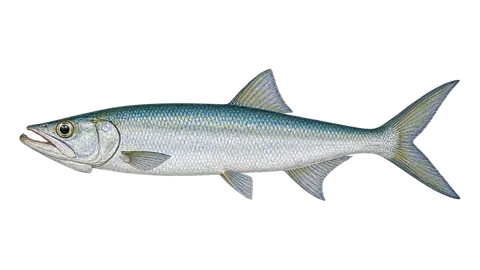
The ladyfish (Elops saurus, ubarana-do-golfo) is a silvery, slender fish of the tarpon family, with a large mouth and a forked tail. Until 2010 it was the only Elops in the western Atlantic; the description of Elops smithi split the records, and Brazilian ubaranas are now assigned to E. smithi, the species in the ubarana entry. According to the species lists consulted, E. saurus mainly occupies the Gulf of Mexico and the US East Coast, overlapping with the other species in some areas. Adults live in shallow water over mud bottoms and enter estuaries; juveniles are common in hypersaline lagoons and bays. They form large schools near shore and eat crustaceans and small fish. Spawning takes place offshore; the ribbon-shaped larvae return to the coast and develop. It reaches 1 m and 10.1 kg, with a common size around 60 cm. It is famous for leaping out of the water and running along the surface when hooked.
fun facts
- It is famous for leaping out of the water and running in short jumps near the surface when hooked.
- The ribbon-shaped larvae undergo major changes in shape and pass through a stage in which they shrink before growing.
- It was the only Elops in the western Atlantic until 2010, when McBride and colleagues described Elops smithi.
how to recognize it
identification
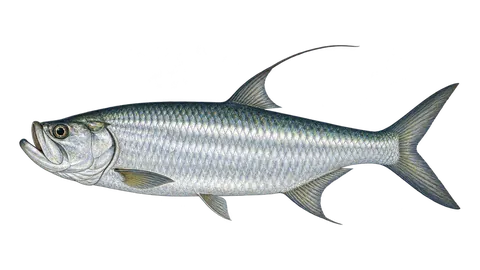
Elongated, rounded body, silver with a bluish back, small scales (more than 100 on the lateral line), large terminal mouth, a narrow bony plate between the jaw branches, and a deeply forked tail. It lacks the filamentous last dorsal ray of the tarpon, and its scales are much smaller. Separating it from Elops smithi is difficult: the 2010 review does so only by counting vertebrae (79 to 87 in saurus, 73 to 80 in smithi), which cannot be seen in the field.
how ladyfish fishing looks
Loading the next 7 days…
Each card shows the day's index (0 to 100) and, below it, a strip with the index for each hour, from 0h to 23h. from poor to excellent.