wahoo
Acanthocybium solandri
The sprinter of the sea. Strikes trolling baits at high speed, cuts line with its teeth, and is one of the best table fish.
Also called: cavala-empinge, cavala-aipim, wahoo

- common size
- 100–170 cm
- maximum
- 250 cm
- common weight
- 10–30 kg
- record/max.
- 83.0 kg
- depth
- 0–60 m
- ideal water
- 24–28 °C
who is the wahoo
The cavala-empinge, known worldwide as wahoo, is one of the fastest fish in the ocean. It lives in open sea, alone or in small groups, near shelf edges, seamounts, oceanic islands, and floating objects. It strikes with a brutal burst, and the first run can strip 200 m of line in seconds. Its thin, very sharp teeth cut monofilament easily, so wire leader is required. In Brazil it is most common in the Northeast and at the oceanic islands, and it appears in the warm-water season in Espírito Santo and southern Bahia. Its white, firm flesh is among the most valued.
fun facts
- It can reach close to 75 km/h in short bursts.
- It has no gill rakers, typical of a predator that swallows large prey.
- The blue bars light up when the fish is hunting.
identification
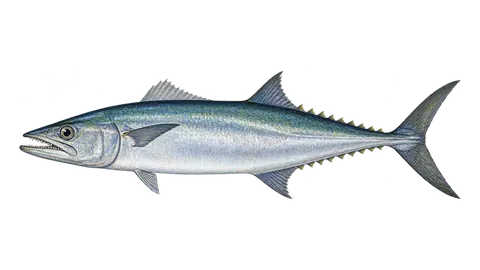
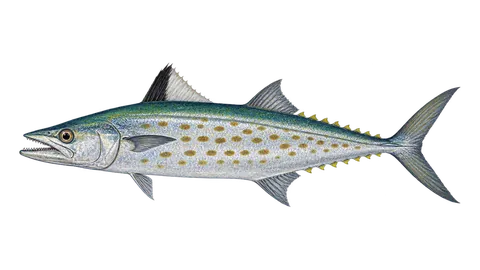
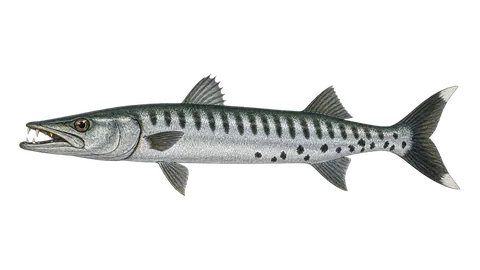
Very elongated, cigar-shaped body. Long, pointed snout with triangular, sharp teeth. Long, low first dorsal fin. Blue-green back and silver flanks with 24 to 30 vertical cobalt-blue bars that vanish after death. The cavala has a shorter snout, no bars, and its lateral line drops suddenly under the second dorsal. The barracuda has a projecting lower jaw, two separate dorsal fins, and black spots.
Loading the next 7 days…
Each card shows the day's index (0 to 100) and, below it, a strip with the index for each hour, from 0h to 23h. from poor to excellent.
where found
Tropical oceanic waters and shelf edge, most common from the Northeast to Espírito Santo. Known spots: Natal-RN, Recife-PE, Fernando de Noronha-PE (outside the Marine National Park), Royal Charlotte bank and the area around Abrolhos-BA (outside the park), Vitória-ES. It also occurs at the oceanic islands and becomes rarer south of Cabo Frio-RJ.
Habitat: Open sea and shelf edge, 0 to 60 m of water column, near breaks, seamounts, rocky heads, oceanic islands, and floating objects.
coast
states
Maranhão, Piauí, Ceará, Rio Grande do Norte, Paraíba, Pernambuco, Alagoas, Sergipe, Bahia, Espírito Santo, Rio de Janeiro, São Paulo
famous destinations
when to fish
best season
In the Northeast it can be fished all year. In Espírito Santo and southern Bahia the best period follows warm water, from October to April.
best time of day
Daytime, with peaks at dawn and dusk. It strikes best at dawn and in the early morning, and again in late afternoon. Tide and current turns near the breaks tend to activate the fish.
what affects the wahoo
sensitivity The little bars show how much each factor affects this species. Five full: it feels it a lot.
cold and cold fronts
Below 22 °C it becomes rare. Follow the warm, clean water.
atmospheric pressure
Moderate effect; after a cold front wait for the blue water to return to the break.
moon
Northeast anglers report more strikes near the full and new moons, during strong tide changes.
rain
Light rain doesn't bother. Thunderstorm with lightning: head back.
water level
Not applicable at sea. The equivalent is the color and clarity of the water: look for blue, clean water and current lines.
noise
It is not bothered by the motor; fast trolling works precisely with the boat moving quickly.
wind
Choppy seas make fast trolling and safety aboard difficult.
tide
Strong tidal currents at the breaks and rocky heads concentrate bait and activate the wahoo.
depth
Surface down to about 60 m. Baits sunk with trolling lead catch fish that don't rise.
how to fish
- rod
- trolling 30 to 50 lb, 5'6" to 6'6"; jigging PE 3 to 5
- spinning / baitcasting reel
- 30 to 50 lb trolling baitcaster with good capacity; 8000 to 14000 spinning reel for jigging
- line
- 30 to 50 lb monofilament for trolling; braided PE 3 to 5 for jigging
- leader
- 90 to 150 lb wire leader, 30 to 60 cm, joined to 2 m of 100 to 150 lb monofilament
- hook
- 8/0 to 10/0 single or hook pair on wire
lures
- high-speed lead heads (bullets) with skirt
- deep-diving lipped plugs for fast trolling
- 150 to 250 g jigs
natural baits
- whole bonito
- agulhinha rigged on wire
accessories
- 0.5 to 2 kg trolling lead
- bicheiro
- luvas
- long-nose pliers
tip from an angler
Fast trolling at 12 to 16 knots, with baits sunk by trolling lead, covers a lot of water and selects the wahoo. Be careful when landing: its teeth cut deep.
rules for the wahoo
Summary of the regulations we found, with the source for each. Rules change; before keeping or transporting fish, check with the state environmental agency.
We found no species-specific rule beyond the region's general rules.
catch and release
catch and release Releasing the fish alive, quickly and with a wet hand. During a closed season it isn't always allowed: what the regulation says applies.
Use long pliers and gloves: the mouth is dangerous. If you are going to release it, do it quickly and with the fish in the water.
in the kitchen
White, firm, delicate flesh. Grilled in steaks, sashimi, or ceviche. Don't overcook it: it dries out fast.
how much it weighs without taking it out of the water
Length-weight relationship W = a·Lb (a = 0.00288, b = 3.16; FishBase (estimativa bayesiana, comprimento total)). It's an average: a fat or lean fish can vary by 10% to 20%.
estimated weight
—
sources and references
The season weights (months), the time of day and the sensitivities (cold, pressure, moon, wind, rain, tide, strong light, murky water and noise) are the app's editorial estimates, based on the literature below and on the field experience of anglers and guides. They are not official data nor a measurement made for this species, and they may vary by region and year. Closed seasons and legal rules appear in the rules section, with the norm and a link.
- scientific FishBase — Acanthocybium solandri (ficha da espécie)Names, distribution, biology, length-weight relationship and references. Page checked on October 13, 2026.
- official Portaria GM/MMA nº 1.667, de 27 de abril de 2026 — Lista Nacional Oficial de Espécies da Fauna Ameaçadas de Extinção (peixes e invertebrados aquáticos)Most recent national list. The species is not on it (search by scientific name in the text published in the DOU, checked on October 13, 2026).
- official ICMBio/SALVE — Ficha de Acanthocybium solandri (avaliação nacional do risco de extinção)ICMBio national assessment, published in 2026. DOI checked on Crossref.
- scientific IUCN Red List — Acanthocybium solandri (avaliação global: Pouco Preocupante, LC, 01/03/2022)Global assessment. Link given on the FishBase entry (Red List, version 2025-2).
- scientific Collette, B. B.; Nauen, C. E. (1983). FAO species catalogue. Vol. 2. Scombrids of the world. FAO Fisheries Synopsis 125(2). Roma: FAO.
- technical ICCAT Manual, cap. 2.1.10.10 — Wahoo (Acanthocybium solandri). International Commission for the Conservation of Atlantic Tunas.Biology and fishery of the species in the Atlantic.
- scientific Carpenter, K. E. (org.) (2002). The living marine resources of the Western Central Atlantic. Vol. 3: Bony fishes part 2 (Opistognathidae to Molidae). FAO Species Identification Guide for Fishery Purposes. Roma: FAO.Scombridae chapter (Collette, B. B.).