

king mackerel
Scomberomorus cavalla
The largest cavala on the coast, strong and sharp-toothed. Widely caught by trolling and in the artisanal fishing of the Northeast, and excellent eating.
- common size
- 60–110 cm
- maximum
- 184 cm
- common weight
- 3–12 kg
- record/max.
- 45.0 kg
- depth
- 2–80 m
- ideal water
- 23–28 °C
how to recognize it
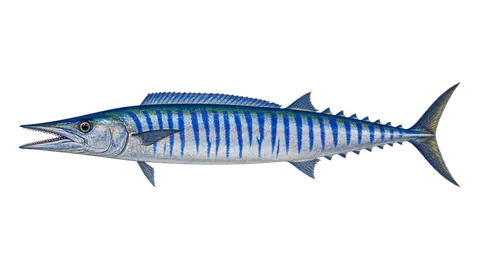
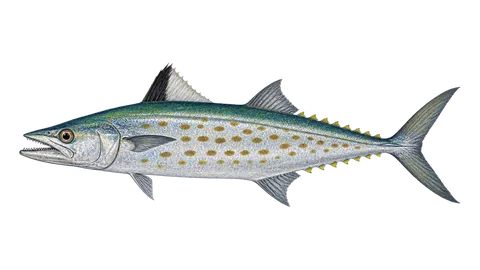
Elongated, silver body, blue-green back to iron gray, adults without spots. The lateral line drops sharply below the second dorsal fin. Gray first dorsal fin, no black spot. The sororoca is smaller, with yellow-bronze spots on the flanks and a lateral line that slopes gently. The wahoo has a long snout and blue bars. Young cavala can have spots: check the lateral line.
Also called: cavala, cavala-verdadeira, king mackerel
don't confuse with:
where found
open on the large mapWhere to look: Continental shelf, 2 to 80 m, over gravel bottoms, submerged reefs, reef edges, and channel edges. Large fish stay on the outer shelf.
From Amapá to the Southeast, most abundant in the Northeast. Known spots: the coast of Ceará and Rio Grande do Norte (Natal and Touros), Recife-PE, Alagoas, and Bahia. In Espírito Santo and Rio de Janeiro it appears in summer.
coast
states
Amapá, Pará, Maranhão, Piauí, Ceará, Rio Grande do Norte, Paraíba, Pernambuco, Alagoas, Sergipe, Bahia, Espírito Santo, Rio de Janeiro, São Paulo
when to fish
next 7 days
Loading the next 7 days…
best season
In the Northeast it occurs all year, with local seasons tied to clean water and bait schools. In the Southeast it appears only in summer.
best time of day
Daytime, with peaks at dawn and dusk. It feeds best early in the morning and late in the afternoon. A moving tide and clean water help.
what affects the king mackerel
cold and cold fronts
Below 21 °C it migrates or sinks. In the Southeast it appears only with warm water.
atmospheric pressure
Stable pressure and calm seas help; a cold front muddies the water and knocks out fishing.
moon
Moderate effect: spring tides stir bait and cavala along the edges.
rain
Heavy rain muddies coastal water and gets in the way.
water level
Not applicable at sea. The equivalent is the color and clarity of the water: look for blue, clean water and current lines.
noise
In shallow, clear water, a loud motor spooks them. Slow down near the submerged reefs.
wind
Light swell helps trolling; strong wind muddies coastal water.
tide
Moving tide concentrates bait at reef edges and channels.
depth
2 to 80 m. Large fish stay on the outer shelf, 20 to 60 m.
how to fish
lures
- 12 to 18 cm lipped plugs
- trolling spoons
- 40 to 100 g jigs
natural baits
- live or dead agulhinha
- sardinha
- lula
tip from an angler
On natural bait, put an extra hook (stinger) in the middle of the bait: the cavala bites the back end and cuts without touching the front hook.
- rod
- 6'6" to 7'0", 15 to 30 lb
- spinning / baitcasting reel
- 4000 to 6000 spinning reel or 20 to 30 lb trolling baitcaster
- line
- 20 to 40 lb braided or 20 to 30 lb monofilament
- leader
- fine wire leader 30 to 60 lb, 20 to 40 cm
- hook
- 3/0 to 6/0 single, or hook pair with stinger on natural bait
accessories
- long-nose pliers
- bicheiro
catch and release
Use pliers and watch the teeth. Release quickly, with the fish in the water; cavala lose scales and get hurt easily.
kits and guides
rules for the king mackerel
Rules change; before keeping or transporting fish, check with the state environmental agency.
We found no species-specific rule beyond the region's general rules.
how much it weighs without taking it out of the water
estimated weight
—
how we calculate
Length-weight relationship W = a·Lb (a = 0.00912, b = 3.02; FishBase (estimativa bayesiana, comprimento total)). It's an average: a fat or lean fish can vary by 10% to 20%.
more about the king mackerel
The cavala is the largest of the Brazilian cavalas and an important fish in Northeast artisanal fishing, where it is caught by trolling, handline, and nets. It lives on the shelf, from coastal waters to the slope edge, hunting sardines, agulhinhas, squid, and shrimp. Adults travel in small groups and migrate along the coast following warm water. In sport fishing it strikes plugs and natural baits on slow trolling and makes strong runs, sometimes jumping when hooked. Its teeth cut line, so use fine wire leader. The flesh is highly prized, but large specimens accumulate mercury.
Family: Scombridae · predator
fun facts
- Schools migrate along the coast following warm water.
- It often jumps out of the water when striking surface baits.
in the kitchen
Tasty flesh, excellent in fried steaks, grilled, and in moqueca. Eat large specimens in moderation because of mercury risk.
similar species
sources and references (7)
The season weights (months), the time of day and the sensitivities (cold, pressure, moon, wind, rain, tide, strong light, murky water and noise) are the app's editorial estimates, based on the literature below and on the field experience of anglers and guides. They are not official data nor a measurement made for this species, and they may vary by region and year. Closed seasons and legal rules appear in the rules section, with the norm and a link.
- scientific FishBase — Scomberomorus cavalla (ficha da espécie)Names, distribution, biology, length-weight relationship and references. Page checked on October 13, 2026.
- official Portaria GM/MMA nº 1.667, de 27 de abril de 2026 — Lista Nacional Oficial de Espécies da Fauna Ameaçadas de Extinção (peixes e invertebrados aquáticos)Most recent national list. The species is not on it (search by scientific name in the text published in the DOU, checked on October 13, 2026).
- official ICMBio/SALVE — Ficha de Scomberomorus cavalla (avaliação nacional do risco de extinção)ICMBio national assessment, published in 2025. DOI checked on Crossref.
- scientific IUCN Red List — Scomberomorus cavalla (avaliação global: Pouco Preocupante, LC, 18/10/2022)Global assessment. Link given on the FishBase entry (Red List, version 2025-2).
- scientific Collette, B. B.; Nauen, C. E. (1983). FAO species catalogue. Vol. 2. Scombrids of the world. FAO Fisheries Synopsis 125(2). Roma: FAO.
- technical ICCAT Manual, cap. 2.1.10.4 — King mackerel (Scomberomorus cavalla). International Commission for the Conservation of Atlantic Tunas.Biology and fishery of the species in the Atlantic.
- scientific Carpenter, K. E. (org.) (2002). The living marine resources of the Western Central Atlantic. Vol. 3: Bony fishes part 2 (Opistognathidae to Molidae). FAO Species Identification Guide for Fishery Purposes. Roma: FAO.Scombridae chapter (Collette, B. B.).