Skip to content
fishing forecast

smallmouth bass

Micropterus dolomieu · Centrarchidae · predator

Freshwater

A relative of the largemouth bass, but of colder, clearer water: body with vertical bars and a reddish eye, it hunts crayfish among rocks. In the region it appears only as an introduced species, in Mexico and Belize.

Also called: black bass de boca pequena, smallmouth bass, bass de boca pequena

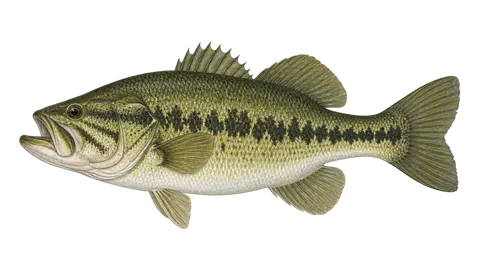
Scientific illustration of Smallmouth bass
common size
25–45 cm
maximum
69 cm
common weight
0.2–1.2 kg
record/max.
5.4 kg
depth
1–7 m
ideal water
18–24 °C
location

Sample location: choose yours to see the forecast for where you fish.

period

Reading the weather across 3 global models and 31 simulations…

the species

everything about the smallmouth bass

overview

who is the smallmouth bass

Elongated centrarchid, a cousin of the largemouth bass (Micropterus salmoides), but typical of colder, clearer waters with rock and gravel bottoms. It is native to eastern North America, the Great Lakes, and the Mississippi basin, and has been moved to many countries for sport fishing. FishBase records introductions in Mexico (1975, established population) and Belize (1969, probably established), and Conabio treats it as an exotic species present in Mexico, with invasion risk rated very high in 2017. It occupies stretches of flowing river and clear, deep lakes, where it hunts crayfish, insects, and fish and shelters among rocks. Males build nests on sand, gravel, or rock bottoms and guard eggs and fry. It reaches 69 cm and 5.4 kg and can live 26 years, but the common fish caught measures 25 to 45 cm. We found no current source on populations or targeted fishing for the species in Mexico or Belize.

fun facts

  • A successful nest can produce from 1,000 to more than 5,000 young, guarded by the male until they disperse.
  • It can live more than 20 years: FishBase records a maximum age of 26 years.
  • Conabio's assessment notes that, as a voracious predator, the species can reduce native fish and affect recreational fishing.
how to recognize it

identification

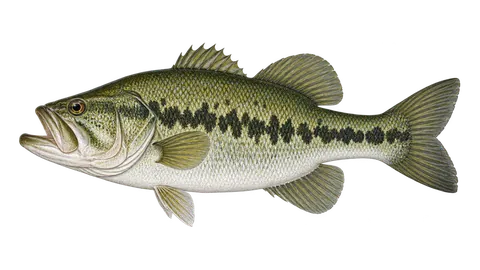
Elongated, slightly compressed body, olive-green to bronze on the back and yellowish white below, with 9 to 16 brown vertical bars on the flanks and an orange-red eye. The mouth is large, but the maxilla reaches at most to below the eye, and the two dorsal fin parts have only a shallow notch between them. The largemouth bass (M. salmoides) has a continuous dark lateral stripe, a larger mouth, and a deep notch between the dorsal fins; the spotted bass (M. punctulatus) also has a lateral stripe.

distribution

where found

open on the large map

Not found in Brazil. Native to North America, from the Great Lakes and the St. Lawrence to the Mississippi basin and the Atlantic and Gulf drainages. Introduced, according to FishBase, to Mexico (1975) and Belize (1969). Conabio cites Mexico as the destination of an introduction from the USA, without detailing the current water bodies.

Habitat: Clear, flowing rivers with rock and gravel bottoms, pools below rapids, cold, clear lakes and reservoirs; rocks, fallen logs, and undercut banks.

calendar and clock

when to fish

best season

time of yearbest: Mar–May and Sep–Oct
JanFebSeaAprMayJunJulAugSepOctNovDec

Bites best in spring, when the water reaches 15 to 25 °C and males build shallow nests, and in autumn. Summer heat and water below about 10 to 15 °C leave the fish inactive.

best time of day

0h6h12h18h sunrise ~6amsunset ~6pm

Daytime, with peaks at dawn and dusk. Active by day, most active at dawn and dusk; in strong sun and heat, it moves down to rocks and deeper bottoms.

weather, water and behavior

what affects the smallmouth bass
sensitivity The little bars show how much each factor affects this species. Five full: it feels it a lot.

cold and cold fronts

It goes inactive below about 10 to 15 °C; the arrival of a cold front shuts off the fishing.

atmospheric pressure

Stable, overcast weather helps; a rapid pressure drop ahead of a front usually brings a brief peak in bites.

moon

Small effect.

rain

Light rain and overcast skies help; a flash flood muddies the clear water the species needs.

water level

Stable level and clear water; a flood muddies the river and scatters the fish.

noise

Wary in clear water; approach slowly and cast from a distance.

wind

Light chop and wind on the rocky shore make the fish more active.

depth

From 1 to 7 m, next to rocks and gravel; on hot days, deeper.

technique, gear and bait

how to fish

rod
6'6" to 7'2", fast action, 6 to 14 lb
spinning / baitcasting reel
spinning reel 2500 to 3000 or low-profile baitcasting reel 100 to 150
line
braided line 10 to 20 lb or fluorocarbon 8 to 12 lb
leader
fluorocarbon 8 to 12 lb, 1 to 1.5 m (clear water)
hook
size 2 to 3/0 in a jig head and drop shot

lures

  • tube jig 3 to 4 inches
  • drop shot with a 4-inch worm
  • suspending jerkbait
  • shallow to medium diving crankbait
  • crayfish-shaped lure

natural baits

  • minhoca

accessories

  • long-nose pliers
  • boga-grip
  • polarized glasses

tip from an angler

Imitate the crayfish: drag the jig slowly along the rock bottom. In Ontario, crayfish made up 60 to 90% of the volume of what adults ate.

what the law says

rules for the smallmouth bass

Summary of the regulations we found, with the source for each. Rules change; before keeping or transporting fish, check with the state environmental agency.
Conservation: Assessed on Mar 1, 2012 as Least Concern, for its native range in North America. Conabio (2017) rates the invasion risk in Mexico as very high, due to its effect on native fish.

Mexico: up to 5 freshwater fish per day, one rod, and no live fish as bait

5 fish per angler per day; one rod in use; no live fish as bait

In Mexico's federal inland waters, recreational fishing for freshwater species is limited to 5 fish per angler per day (this applies to the smallmouth bass, which the bass rules of the inland waters standard do not name). Each reservoir's committee may lower the bag limit and set sizes. Only one rod per angler may be in use, and using live fish as bait is prohibited. Fish kept may not be sold, and any fish over the limit must be returned alive to the water. No permit is required to fish from the bank; a permit is required from a boat.
Source: Amendment to NOM-017-PESC-1994, DOF Nov 25, 2013, items 4.3, 4.6 b, 4.7 c, 4.9.2, 4.9.5 and 4.11 (Sagarpa/Conapesca)

Mexico: releasing or stocking live fish in natural water requires authorization

introducing live aquatic species only with authorization from Conapesca and a technical opinion from Inapescaconfirm with the agency

The introduction of live aquatic species, at any life stage, for aquaculture or stocking may only be allowed by Conapesca, with a technical opinion from Inapesca, and also requires an environmental resolution from Semarnat and a health resolution from the competent authorities. Moving live fish from one body of water to another, or releasing fish from ponds or aquariums into rivers and reservoirs, counts as introduction and would require that process.

Source: NOM-060-SAG/PESC-2014, items 4.13 and 4.14, DOF May 27, 2014 (Sagarpa/Conapesca)

catch and release
catch and release Releasing the fish alive, quickly and with a wet hand. During a closed season it isn't always allowed: what the regulation says applies.

A cold, clear-water fish that suffers in heat: in summer, keep the fight short and release it quickly, with the fish in the water and without squeezing its body. Where the species is exotic, do not move live fish to another water body.

in the kitchen

FishBase describes it as an excellent table fish; white, firm flesh.

calculator

how much it weighs without taking it out of the water

Length-weight relationship W = a·Lb (a = 0.01072, b = 3.04; FishBase (relação peso-comprimento bayesiana, estimativa da própria espécie)). It's an average: a fat or lean fish can vary by 10% to 20%.

estimated weight

—

sources and references

The season factors (months), the time of day, and the sensitivities (cold, pressure, moon, wind, rain, tide, strong light, murky water, and noise) are editorial estimates by the app, based on the literature cited below and on field experience of anglers and guides. They are not official data or measurements made for this species and may vary by region and year. Closed seasons and legal rules appear in the rules section, with the standard and link. Gear and baits are editorial recommendations, based on the species' habits and on largemouth bass fishing; there is no source on targeted fishing for it in Mexico or Belize.

  1. scientific FishBase: Micropterus dolomieu (ficha da espécie)Size, length-weight, depth, habitat, distribution, biology, and IUCN status. Page checked on Oct 13, 2026.
  2. scientific FishBase: nomes populares de Micropterus dolomieuNames by country and language.
  3. scientific IUCN Red List: Micropterus dolomieu (avaliação global: Pouco Preocupante, LC, 01/03/2012)Global assessment. Link given on the FishBase entry (Red List, version 2025-2).
  4. scientific FishBase: introduções de Micropterus dolomieuIn Latin America, the table lists only Belize (1969, from U.S. origin, probably established) and Mexico (1975, from U.S. origin, established), with no reason or effect recorded. Page checked on Oct 13, 2026.
  5. official Conabio: Método de Evaluación Rápida de Invasividad (MERI), Micropterus dolomieu (2017)Mexican name (lobina de boca pequeña), description, introduction to Mexico from the USA in 1975, and very high invasion risk (value 0.7734). The text mentions a report from areas of a "Reserva Amistad" without saying which water body. Page checked on Oct 13, 2026.
  6. scientific Fishes of Texas: Micropterus dolomieu (smallmouth bass)Identification (bars, reddish eye, difference from the largemouth bass and the spotted bass), size, habitat, diet (crayfish in Ontario), spawning, and longevity. Page checked on Oct 13, 2026.
  7. scientific USGS: Nonindigenous Aquatic Species, Micropterus dolomieu (smallmouth bass)Native range and maximum size (69 cm). The page covers introductions in the USA and does not mention Mexico or Belize. Page checked on Oct 13, 2026.
  8. official DOF: Modificação da NOM-017-PESC-1994, que regula a pesca esportivo-recreativa em águas de jurisdição federal do México (publicada em 25/11/2013)Items 4.3, 4.4, 4.6 b, 4.7 c, 4.9.2, 4.9.5, and 4.11: permit, one rod per angler in inland waters, ban on live fish as bait, limit of 5 freshwater fish per day, release of the fish over the limit, and ban on sale. Text checked on Oct 13, 2026.
  9. official DOF: NOM-060-SAG/PESC-2014, pesca responsável em corpos de água continentais de jurisdição federal do México (publicada em 27/05/2014)Items 4.13 and 4.14 (introduction of live species). The standard's bass rules (limit of 5, minimum of 35 cm, release of egg-bearing females) name the largemouth bass and the Florida bass (Micropterus salmoides) and do not mention M. dolomieu; for that reason they were not applied to this species. For Belize we did not confirm a specific rule. Text checked on Oct 13, 2026.
don't confuse

similar species