

- maximum
- 47 cm
- record/max.
- 3.7 kg

the right time
to be on the water
Choose the place and the species. The index, from 0 to 100, combines weather, sun, moon and tide with each fish's habits. Up to 28 days, with each day's confidence.
Loading the forecast…
—
Looking for alerts within 30 km…
Looking for what anglers have logged near here…
what you need to fish herelicense, certification and boat documents
fish likely at this spot
Tap a fish to see its forecast.
hour by hour
slide your finger or mouse over the chart to see each hoursee hour-by-hour table
why this index at —?
choose the day
the fishing month at a glance
what's the best window for the crew?
Choose how many fishing days. We compare each stretch by its average index, discount days with a warning or closed season, and show the 3 best.
trend for the coming weeks
Line: the middle value of 31 simulations of the American GEFS model. Band: where 8 out of 10 fall. Narrow, firm trend; wide, high uncertainty.
everything about the redeye bass
how to recognize it
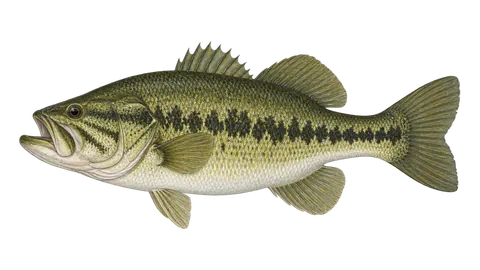
Sturdy-bodied black bass. The species' mark is red on the rear half of the second dorsal fin, the caudal and anal fins, and along all the rays of the pectoral fins; in its relatives in the same group, this tone is green, greenish-yellow or orange and covers a smaller area. The row of dark spots along the middle of the body is often partial or absent. It has a patch of teeth in its mouth.
Also called: black bass de olho vermelho, lobina ojicolorada, redeye bass
don't confuse with:
where found
open on the large mapWhere to look: Rocky rapids and pools of small to medium streams and rivers.
Southeastern United States, in the Savannah and Chattahoochee basins and Mobile Bay basin; in Puerto Rico it is exotic.
how to fish
lures
- small spinnerbait
- soft plastic imitating crayfish on a light jig head
- small popper and zara
- crankbait imitating crayfish
- popping bug (fly)
natural baits
- live lambari
tip from an angler
Stream fish of clear, rocky water: look behind the rocks, where the current is weaker. It often strikes on the first or second well-made cast; keep covering water instead of insisting on one spot.
- rod
- 1.8 m (6'), light action; fly: rod 2 to 4
- spinning / baitcasting reel
- spinning reel 1000 to 2000
- line
- monofilament 4 lb
- leader
- optional
- hook
- #10 to 8; 1/0 to 2/0 only with large live bait
catch and release
The fin spines cut, and the black bass has a patch of teeth in its mouth: hold it carefully by the jaw and return it promptly.
rules for the redeye bass
Rules change; before keeping or transporting fish, check with the state environmental agency.
We found no species-specific rule beyond the region's general rules.
how much it weighs without taking it out of the water
estimated weight
—
how we calculate
Length-weight relationship W = a·Lb (a = 0.01047, b = 3.05; FishBase (relação peso-comprimento bayesiana, estimativa da própria espécie)). It's an average: a fat or lean fish can vary by 10% to 20%.
more about the redeye bass
The redeye bass is a centrarchid and reaches 47 cm and 3.7 kg. Native to the southeastern United States, in the Savannah and Chattahoochee river basins and the Mobile Bay basin, it was introduced to Puerto Rico, where it is exotic. It lives in rocky rapids and pools of small to medium streams and rivers, and also in headwater streams. It spawns in shallow water, in defined pairs. It is a sport fish and also a subsistence fish.
Family: Centrarchidae · predator
fun facts
- The row of dark spots along the middle of the body is partial or missing in 76% of specimens.
in the kitchen
It is used for subsistence, so it is eaten by the people who catch it.
similar species
sources and references (3)
Essential profile: size, weight-length, depth, countries and conservation come from FishBase and the cited regulations, and the texts were written from those sources. Technique, baits and hook come from the cited fishing source; rod, spinning reel and line, when the source does not say, were estimated from the size of the species. Season, time of day and sensitivities are not included yet, because we did not find a good source for this species.
- scientific FishBase: Micropterus coosae (ficha da espécie)Size, length-weight, depth, habitat, distribution, biology, and IUCN status. Page checked on Oct 13, 2026.
- scientific FishBase: nomes populares de Micropterus coosaeNames by country and language.
- pesca Guidesly: redeye bass6-foot rod, 4 lb line and #10 to 8 hooks (1/0 to 2/0 with large live bait) come from this page, in the search summary; the artificial lures come from a guide cited in an Alabama article (not checked: the page opened with an error).
how we calculatewhere each number comes from
The weather comes from three independent global models, cross-checked hour by hour: when they agree, confidence goes up; when they diverge, the band between them shows on the chart. Beyond 16 days, we use the GEFS ensemble of 31 simulations: if 20 of the 31 predict rain, the chance of rain is 65%. Sun and moon are calculated astronomically, with no uncertainty.
The index adds up, weighted for each species: time of day (species curve anchored to real sunrise and sunset), moon (transits, rise and set, phase), pressure (3 h trend and 24 h swing), water temperature (in rivers, estimated from air temperature; at sea, estimated by an ocean model), wind, rain, clouds, tide and the month in the species' cycle.
sources for this lookup
how accurate the forecast is
Accuracy measured in the reference project (4 regions, 93 days, forecast vs. observed): maximum temperature is off by 0.6 °C on average the next day and 1.7 °C at 7 days; rain of 5 mm or more is detected 76% of the time the next day and 57% at 7 days. Detection isn't everything: the false alarm rate isn't published here yet, and 93 days in 4 regions is still a small sample. We now also measure every day, at the app's destinations: