Skip to content
fishing forecast

chilean bonito

Sarda chiliensis · Scombridae · predator

Sea

The skipjack (bonito listrado) of the Humboldt Current: fast schools that burst at the surface after anchoveta. A strong fighter on light tackle, with a minimum size in Peru.

Also called: bonito-do-pacífico, bonito, bonito-chileno

Scientific illustration of Chilean bonito
common size
45–65 cm
maximum
102 cm
common weight
1.5–4 kg
record/max.
11.3 kg
depth
0–50 m
ideal water
17–23 °C
location

Sample location: choose yours to see the forecast for where you fish.

period

Reading the weather across 3 global models and 31 simulations…

the species

everything about the chilean bonito

overview

who is the chilean bonito

The Pacific bonito (bonito-do-pacífico) is a scombrid, from the family of tunas and mackerels, in the southeastern Pacific, from northern Peru to Talcahuano, Chile. The northern Pacific form, from California to Mexico, is now treated as a separate species, Sarda lineolata. It lives near the coast in schools separated by size; the larger ones stay farther out. It eats small schooling fish such as anchoveta, squid and shrimp. It matures at two years and reaches 1 m and 11 kg. It is one of the most important fish in Peruvian artisanal fishing and a sport target from boats, piers and rocks, using surface lures, metal jigs and corrico.

fun facts

  • It has no swim bladder: it must keep swimming to avoid sinking.
  • Forms schools by size; larger fish live farther from the coast than the juveniles.
how to recognize it

identification

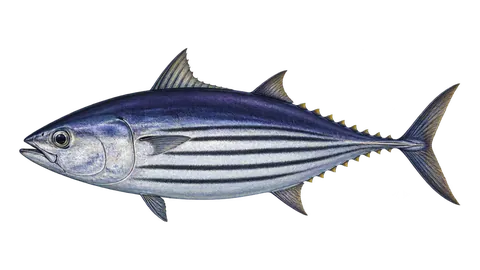
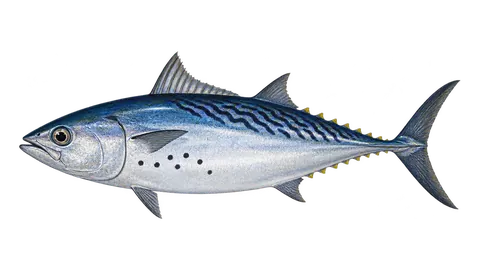
Spindle-shaped, robust body, dark blue back with oblique dark stripes, silvery flanks and belly without stripes. Large mouth with conical teeth, two dorsal fins close together, finlets behind the dorsal and anal fins, and a crescent tail. Body covered with very small scales. It differs from the skipjack, which has stripes on the belly, and from the bacoreta (bonito-pintado), with dark spots below the pectoral fin.

distribution

where found

open on the large map

Does not occur in Brazil. Southeastern Pacific, from Ecuador and northern Peru to Talcahuano (Chile).

Habitat: Coastal strip and shelf, in schools near the surface, over anchoveta areas, rocky points and islands.

calendar and clock

when to fish

best season

time of yearbest: Dec–Apr
JanFebSeaAprMayJunJulAugSepOctNovDec

In Peru, schools are more accessible in summer and early autumn; availability changes a lot with sea temperature and El Niño.

best time of day

0h6h12h18h sunrise ~6amsunset ~6pm

Daytime, with peaks at dawn and dusk. Hunts by day, with peaks at dawn and at dusk, when bait schools rise.

weather, water and behavior

what affects the chilean bonito
sensitivity The little bars show how much each factor affects this species. Five full: it feels it a lot.

cold and cold fronts

Very cold upwelling water pushes the schools away from the coast.

atmospheric pressure

Stable weather favors surface hunting.

moon

Little effect.

rain

Little effect at sea.

water level

Not applicable at sea.

noise

A school at the surface sinks with the motor at high revs: approach from the side and cut the engine.

wind

Light swell helps; strong wind scatters the schools.

tide

Currents at rocky points and islands concentrate bait and bonitos.

depth

From the surface to 20 m.

technique, gear and bait

how to fish

rod
7'0" to 8'0", 15 to 30 lb, fast action
spinning / baitcasting reel
spinning reel 4000 to 6000 with smooth, steady drag
line
braid 20 to 30 lb
leader
fluorocarbon 0.45 to 0.60 mm
hook
reinforced treble hooks or single hook 2/0 to 4/0

lures

  • metal jig, 30 to 80 g
  • stickbait and popper 10 to 14 cm
  • corrico spoon

natural baits

  • live anchoveta or sardine
  • squid strips (slow corrico)

accessories

  • alicate
  • small gaff or landing net

tip from an angler

Cast in front of the school and retrieve quickly: the bonito chases bait that flees and strikes at speed.

what the law says

rules for the chilean bonito

Summary of the regulations we found, with the source for each. Rules change; before keeping or transporting fish, check with the state environmental agency.
Conservation: In Peru there is a minimum size and catch limits for the artisanal fleet. We found no specific rule for amateur fishing in Chile and Ecuador.

Peru: minimum size 46 cm (fork length)

46 cm (fork length)confirm with the agency

In Peru the minimum catch size for bonito is 46 cm fork length (from the tip of the snout to the fork of the tail), with a 20% juvenile tolerance, a value found in the current Ministry of Production table. Ministerial Resolution R.M. nº 321-2019-PRODUCE reduced the original 52 cm from R.M. nº 209-2001-PE; we did not confirm the act that made the change permanent, which was published as a temporary measure.

Source: R.M. nº 321-2019-PRODUCE, which amends R.M. nº 209-2001-PE (Peru); PRODUCE minimum size table

catch and release
catch and release Releasing the fish alive, quickly and with a wet hand. During a closed season it isn't always allowed: what the regulation says applies.

Fights to exhaustion: end the fight quickly, remove the hook in the water and revive the fish by moving it forward until it swims off on its own.

in the kitchen

Dark, tasty flesh; very good in ceviche, tiradito, grilled and canned. Bleed and chill right after capture.

calculator

how much it weighs without taking it out of the water

Length-weight relationship W = a·Lb (a = 0.00933, b = 3.06; FishBase (estimativa bayesiana, comprimento total)). It's an average: a fat or lean fish can vary by 10% to 20%.

estimated weight

—

sources and references

The season weights (months), the time of day and the sensitivities (cold, pressure, moon, wind, rain, tide, strong light, murky water and noise) are the app's editorial estimates, based on the literature below and on the field experience of anglers and guides. They are not official data nor a measurement made for this species, and they may vary by region and year. Closed seasons and legal rules appear in the rules section, with the norm and a link.

  1. scientific FishBase — Sarda chiliensis (ficha da espécie)Names, distribution, biology, length-weight relationship, country list and references. Page checked on 13/10/2026. FishBase treats the northern Pacific form as Sarda lineolata and lists S. chiliensis only for Chile, Ecuador and Peru.
  2. scientific IUCN Red List — Sarda chiliensis (avaliação global: Pouco Preocupante, LC, 15/11/2021)Global assessment. Link given on the FishBase entry (Red List, version 2025-2).
  3. official Resolução Ministerial nº 321-2019-PRODUCE (Peru) — medidas para a pesca do bonitoRecord of the rule in the FAOLEX/LEAP database, checked on 13/10/2026: minimum size 46 cm and 20% tolerance, published as a temporary measure in 2019.
  4. official Ministério da Produção do Peru (PRODUCE) — Pesca y Consumo Responsable: tallas mínimas de capturaOfficial minimum size table for consumers, checked on 13/10/2026. The page does not indicate the rule behind each value.
  5. official Resolução Ministerial nº 209-2001-PE (Peru) — tamanhos mínimos de captura e tolerância de juvenis dos principais peixes marinhosCopy of the original text in the FAOLEX database, checked on 13/10/2026. Several values in Annex I were later changed by specific resolutions.
don't confuse

similar species