pacific sierra
Scomberomorus sierra
The Pacific Spanish mackerel, a cousin of the Atlantic Spanish mackerel (sororoca). It travels in schools close to the coast from Mexico to Peru and strikes spoons and fast lures.
Also called: sierra-do-pacífico, serra-do-pacífico, Pacific sierra

- common size
- 45–65 cm
- maximum
- 99 cm
- common weight
- 1–3 kg
- record/max.
- 8.2 kg
- depth
- 0–60 m
- ideal water
- 24–29 °C
who is the pacific sierra
Mackerel of the genus Scomberomorus, the same genus as the Atlantic Spanish mackerel (sororoca) and the Brazilian Spanish mackerel, from southern California to the Galápagos and northern Peru. It travels in schools near the surface, from the surf to the edge of the shelf, chasing anchovies, sardines and other schooling fish. According to FishBase, it is the most abundant sport fish on the Pacific coast of Mexico and Central America. It is caught on light trolling close to shore, with spoons and jigs cast to schools, and from beaches, piers and rocks. Its teeth cut line: use a heavy wire leader or thick leader. The meat is very good and widely used in ceviche.
fun facts
- For a long time it was confused with the Atlantic spotted Spanish mackerel (Scomberomorus maculatus) of the North Atlantic, but it is a species of its own in the Pacific.
- Excellent table fish, it supports commercial fishing along the whole tropical Pacific coast.
identification
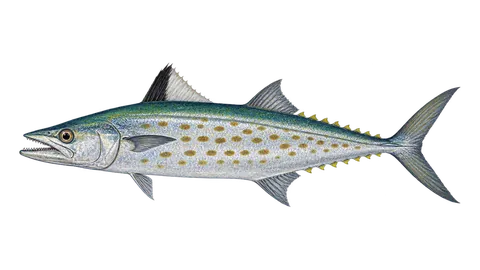
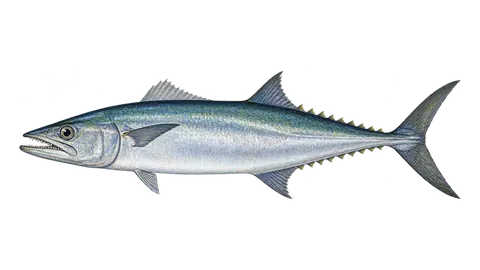
Elongated, compressed silvery body with many round orange-to-brown spots on the flanks, in rows above and below the lateral line. First dorsal fin dark on top with a white base. Lateral line gently curving down. The Atlantic Spanish mackerel (sororoca) has similar spots; the king mackerel (Scomberomorus cavalla) has no spots as an adult.
Loading the next 7 days…
Each card shows the day's index (0 to 100) and, below it, a strip with the index for each hour, from 0h to 23h. from poor to excellent.
where found
Does not occur in Brazil. Eastern Pacific, from southern California to the Galápagos and Paita in northern Peru; there is a recent record at Antofagasta, Chile. Very common along the Pacific coast of Mexico and Central America.
Habitat: Coastal waters, from the surf to shelf bottoms down to about 60 m; bays, points and the edges of bait schools.
when to fish
best season
On the Mexican Pacific, winter and spring (December to April) are usually the best season near shore; in Central America it appears throughout the year, depending on bait.
best time of day
Daytime. Feeds by day, mainly in the early morning, when bait schools are close to shore.
what affects the pacific sierra
sensitivity The little bars show how much each factor affects this species. Five full: it feels it a lot.
cold and cold fronts
Cold upwelling water pushes the schools away from shore.
atmospheric pressure
Little direct effect.
moon
Small effect.
rain
Heavy rain and muddy river water drive the fish away from the shore.
water level
Does not apply at sea. The equivalent is clear water with bait at the surface.
noise
The school sinks with the engine overhead; approach from the side.
wind
Light swell helps; rough sea prevents fishing near the rock.
tide
A rising tide brings clear water and bait to the points and bays.
depth
From the surface down to about 10 m over bottoms of 5 to 40 m.
how to fish
- rod
- 7' to 8', 10 to 20 lb; on the beach, 9' to 10'
- spinning / baitcasting reel
- spinning reel 3000 to 5000 with fast retrieve
- line
- braided line 15 to 30 lb
- leader
- fine wire leader 10 to 20 cm or fluorocarbon 40 lb
- hook
- treble or single hook 1/0 to 3/0
lures
- silver spoon 15 to 30 g
- metal jig 20 to 60 g
- short-lipped minnow for trolling
natural baits
- live sardine or anchovy
- fish fillet on slow trolling
accessories
- long-nose pliers
- insulated cooler with ice
tip from an angler
Retrieve fast and without pausing: the Spanish mackerel strikes fleeing bait. Without fine wire, expect to lose some cut baits.
rules for the pacific sierra
Summary of the regulations we found, with the source for each. Rules change; before keeping or transporting fish, check with the state environmental agency.
Conservation: Supports an important artisanal and commercial fishery in Mexico and Central America.
We found no species-specific rule beyond the region's general rules.
catch and release
catch and release Releasing the fish alive, quickly and with a wet hand. During a closed season it isn't always allowed: what the regulation says applies.
Watch the teeth; use pliers. Release quickly, without keeping it out of the water for long.
in the kitchen
White to pink meat, very tasty; classic in ceviche, grilled or escabeche. Chill it right after catch.
how much it weighs without taking it out of the water
Length-weight relationship W = a·Lb (a = 0.00617, b = 2.93; FishBase). It's an average: a fat or lean fish can vary by 10% to 20%.
estimated weight
—
sources and references
The season weights (months), the time of day and the sensitivities (cold, pressure, moon, wind, rain, tide, strong light, murky water and noise) are the app's editorial estimates, based on the literature below and on the field experience of anglers and guides. They are not official data nor a measurement made for this species, and they may vary by region and year. Closed seasons and legal rules appear in the rules section, with the norm and a link.
- scientific FishBase — Scomberomorus sierra (ficha da espécie)Names, distribution, biology, length-weight relationship, country list and references. Page checked on Oct 13, 2026.
- scientific IUCN Red List — Scomberomorus sierra (avaliação global: Pouco Preocupante, LC, 01/09/2022)Global assessment. Link given on the FishBase entry (Red List, version 2025-2).
- scientific Collette, B. B.; Nauen, C. E. (1983). FAO species catalogue. Vol. 2. Scombrids of the world. FAO Fisheries Synopsis 125(2). Roma: FAO.
- scientific Aguirre-Villaseñor, H. et al. (2006). Biological indicators for the Pacific sierra (Scomberomorus sierra) fishery in the southern Gulf of California, Mexico. Ciencias Marinas 32(3): 471-484.DOI checked in Crossref.
- scientific Lucano-Ramírez, G. et al. (2011). Reproductive biology of the Pacific sierra Scomberomorus sierra (Pisces, Scombridae) in the central Mexican Pacific. Ciencias Marinas 37(3): 249-260.DOI checked in Crossref.