

- common size
- 25–45 cm
- maximum
- 72 cm
- common weight
- 0.2–1 kg
- record/max.
- 7.0 kg
- depth
- 2–40 m
- ideal water
- 15–21 °C

the right time
to be on the water
Choose the place and the species. The index, from 0 to 100, combines weather, sun, moon and tide with each fish's habits. Up to 28 days, with each day's confidence.
Loading the forecast…
—
Looking for alerts within 30 km…
Looking for what anglers have logged near here…
what you need to fish herelicense, certification and boat documents
fish likely at this spot
Tap a fish to see its forecast.
hour by hour
slide your finger or mouse over the chart to see each hoursee hour-by-hour table
why this index at —?
choose the day
the fishing month at a glance
what's the best window for the crew?
Choose how many fishing days. We compare each stretch by its average index, discount days with a warning or closed season, and show the 3 best.
trend for the coming weeks
Line: the middle value of 31 simulations of the American GEFS model. Band: where 8 out of 10 fall. Narrow, firm trend; wide, high uncertainty.
everything about the kelp bass
how to recognize it
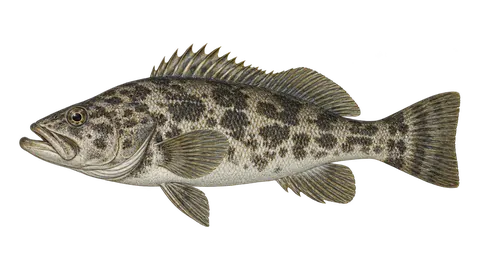
Elongated, slightly compressed body, olive-brown to greenish back with square pale spots that form a checkerboard pattern, pale belly. The third and fourth dorsal spines are nearly the same length. The barred sand bass (P. nebulifer) has a much longer third spine and dark bars; the spotted sand bass (P. maculatofasciatus) is covered in spots. The Peru and Chile cabrilla is another species (P. humeralis).
Also called: cabrilha-sargaceira, calico bass, kelp bass
don't confuse with:
where found
open on the large mapWhere to look: Kelp forests, rocky shores and shallow rocky reefs; the big ones on deeper rocks.
Not found in Brazil. Northeastern Pacific, from the Columbia River (USA) to southern Baja California; in Mexico, the Pacific coast of the Baja California peninsula, more common in the north.
when to fish
best season
Best in warm water, from late spring to early autumn. In winter it stays deeper and slower.
best time of day
Daytime, with peaks at dawn and dusk. Feeds by day, with peaks at dawn and dusk near the kelp; in clear water and strong sun it drops into the middle of the kelp.
what affects the kelp bass
cold and cold fronts
Cold upwelling shuts down activity for a few days.
atmospheric pressure
Little direct effect.
moon
Little effect.
rain
Little effect at sea; runoff muddies the shore.
water level
Does not apply at sea. The equivalent is the current through the kelp.
noise
Kelp fish are wary when a boat is overhead; cast from the edge of the kelp.
wind
Choppy seas hinder precise casting in the kelp.
tide
Current that leans the kelp activates fish at the edge of the algae.
depth
From 2 to 20 m in the kelp; the largest down to 40 m on rocks.
how to fish
lures
- 10 to 15 cm swimbait on a jig head
- jerkbait
- light spoon
- popper at dawn
natural baits
- live anchovy and sardine
- lula
tip from an angler
Cast close to the edge of the kelp and reel slowly over the top of the algae: the calico bass comes out from the middle and runs back; pull firmly during the first seconds.
- rod
- 7' to 7'6", fast action, 12 to 25 lb
- spinning / baitcasting reel
- low-profile baitcasting reel or spinning reel 3000 to 4000
- line
- braid 30 to 50 lb
- leader
- fluorocarbon 20 to 30 lb
- hook
- jig head 1/4 to 1 oz; single hook 1/0 to 2/0 on live bait
accessories
- alicate
- descender for fish from deep rock
catch and release
Release the big ones: they are old and rare. Remove the hook with pliers, hold it by the mouth and return it quickly; fish brought up from deep rock may need a descender.
rules for the kelp bass
Rules change; before keeping or transporting fish, check with the state environmental agency.
Mexico: up to 5 per species and 10 saltwater fish per day
5 specimens of the species per angler per day, within the limit of 10 saltwater fish details
In recreational sport fishing in Mexican federal waters, each angler may keep up to 10 saltwater fish per day, no more than 5 of the same species. The calico bass (cabrilla sargacera) is not among the species reserved for sport fishing under art. 68 of the General Law of Sustainable Fishing and Aquaculture, and has no quota of its own. Fish over the limit must be returned alive to the water, and sport-caught fish may not be sold. Anglers fishing from a boat need a Conapesca permit.
Conservation: It grows slowly and can live 34 years; large specimens are vulnerable to fishing.
how much it weighs without taking it out of the water
estimated weight
—
how we calculate
Length-weight relationship W = a·Lb (a = 0.00933, b = 3.05; FishBase). It's an average: a fat or lean fish can vary by 10% to 20%.
more about the kelp bass
Serranid of the northeastern Pacific, from the Columbia River (USA) to southern Baja California. It lives in and near kelp forests and rocky reefs, usually between 2 and 21 m; the largest ones are deeper. Juveniles eat bottom crustaceans, and adults eat fish and squid. It grows slowly and can live past 30 years, so large specimens are few and valuable. It is one of the mainstays of sport fishing in southern California and northern Baja California, from boats, kayaks and rocky shores, with swimbaits, silicone lures, jigs and live anchovy. Known for a short, strong run toward the kelp.
Family: Serranidae · predator
fun facts
- FishBase records specimens up to 34 years old.
- The English name, calico, comes from the checkered pattern that resembles printed fabric.
in the kitchen
White, delicate flesh, good fried or grilled.
similar species
sources and references (5)
The season weights (months), the time of day and the sensitivities (cold, pressure, moon, wind, rain, tide, strong light, murky water and noise) are the app's editorial estimates, based on the literature below and on the field experience of anglers and guides. They are not official data nor a measurement made for this species, and they may vary by region and year. Closed seasons and legal rules appear in the rules section, with the norm and a link.
- scientific FishBase — Paralabrax clathratus (ficha da espécie)Names, distribution, biology, length-weight relationship, country list and references. Page checked on Oct 13, 2026.
- scientific IUCN Red List — Paralabrax clathratus (avaliação global: Pouco Preocupante, LC, 01/05/2008)Global assessment. Link given on the FishBase entry (Red List, version 2025-2).
- scientific Love, M. S.; Brooks, A.; Busatto, D.; Stephens, J.; Gregory, P. A. (1996). Aspects of the life histories of the kelp bass, Paralabrax clathratus, and barred sand bass, P. nebulifer, from the southern California Bight. Fishery Bulletin 94: 472-481.FishBase reference for the usual depth range. PDF checked on the NOAA website.
- scientific Heemstra, P. C. (1995). Serranidae. In: Fischer, W. et al. (eds.). Guía FAO para la identificación de especies para los fines de la pesca. Pacífico centro-oriental. Roma: FAO.FishBase reference for feeding and use as a sport fish.
- official DOF — Modificação da NOM-017-PESC-1994, para regular a pesca deportivo-recreativa em águas de jurisdição federal do México (publicada em 25/11/2013)Daily limits at sea (item 4.9.1) and in fresh water (4.9.2), one rod in inland waters (4.6 b), ban on live fish as bait in inland waters (4.7 c) and on fishing in closed areas and seasons (4.10).
how we calculatewhere each number comes from
The weather comes from three independent global models, cross-checked hour by hour: when they agree, confidence goes up; when they diverge, the band between them shows on the chart. Beyond 16 days, we use the GEFS ensemble of 31 simulations: if 20 of the 31 predict rain, the chance of rain is 65%. Sun and moon are calculated astronomically, with no uncertainty.
The index adds up, weighted for each species: time of day (species curve anchored to real sunrise and sunset), moon (transits, rise and set, phase), pressure (3 h trend and 24 h swing), water temperature (in rivers, estimated from air temperature; at sea, estimated by an ocean model), wind, rain, clouds, tide and the month in the species' cycle.
sources for this lookup
how accurate the forecast is
Accuracy measured in the reference project (4 regions, 93 days, forecast vs. observed): maximum temperature is off by 0.6 °C on average the next day and 1.7 °C at 7 days; rain of 5 mm or more is detected 76% of the time the next day and 57% at 7 days. Detection isn't everything: the false alarm rate isn't published here yet, and 93 days in 4 regions is still a small sample. We now also measure every day, at the app's destinations: