Skip to content
fishing forecast

tiger shovelnose catfish

Pseudoplatystoma tigrinum · Pimelodidae · predator

Freshwater

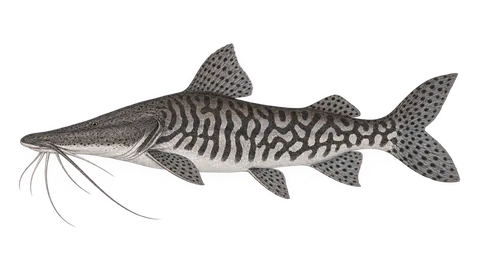
Sorubim with a tiger-like pattern, stripes forming loops on the flank. Night hunter of shorelines and lake mouths.

Also called: caparari, surubim-tigre, pintado-tigre

Scientific illustration of Tiger shovelnose catfish
common size
50–90 cm
maximum
130 cm
common weight
3–10 kg
record/max.
17.0 kg
depth
1–12 m
ideal water
26–30 °C
location

Sample location: choose yours to see the forecast for where you fish.

period

Reading the weather across 3 global models and 31 simulations…

the species

everything about the tiger shovelnose catfish

overview

who is the tiger shovelnose catfish

The caparari is one of the Amazon's sorubims, with a long, flat, spade-shaped head and a pattern of dark stripes forming loops and bows along the flank. At night it hunts fish such as sarapó, curimatãs and jaraquis along grassy shorelines, lake mouths, beaches and channels. By day it stays on the bottom of pools and channels. It makes spawning migrations at the start of the high water. It is a highly valued commercial fish and is also sought in sport fishing, with natural bait on the bottom or mid-water lures at night. It fights with strong runs and head shakes.

fun facts

  • Each caparari's pattern is unique, like a fingerprint.
  • It is one of the most valued catfish in the markets of Manaus.
how to recognize it

identification

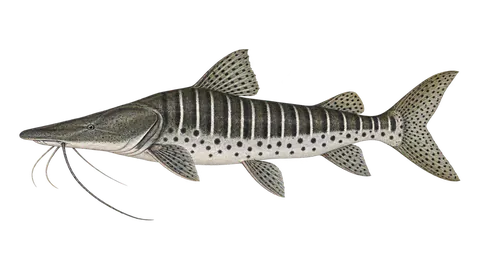
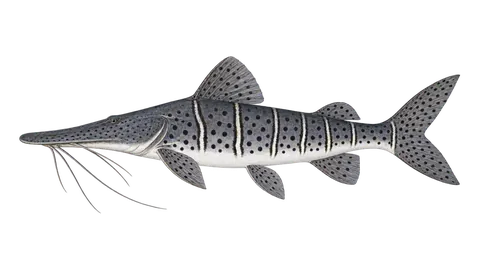
Long, flat head, grey to olive body with dark vertical stripes that curve and join to form loops, like tiger skin; white belly. The Amazon sorubim has straight, narrow stripes alternating with pale bands and no loops. The cachara of the Pantanal has straight bars, and the pintado has spots. In the Amazon, where both sorubims occur together, the loops identify the caparari.

distribution

where found

open on the large map

Main channel of the Solimões-Amazon and large whitewater tributaries such as the Madeira, Purus and Juruá, including the upper Madeira and Guaporé.

Habitat: Shorelines with floating grass, lake and igarapé (creek) mouths, beaches and channels; deep pools during the day.

native to the basins

Amazon

states

Amazonas, Pará, Acre, Rondônia, Mato Grosso, Roraima, Amapá

calendar and clock

when to fish

best season

time of yearbest: Jul–Oct
JanFebSeaAprMayJunJulAugSepOctNovDec

Falling water and dry season, July to October, concentrate fish in channels and lake mouths.

best time of day

0h6h12h18h sunrise ~6amsunset ~6pm

Nighttime. Hunts from dusk until dawn, often in shallow shorelines. By day it only takes bait on the channel bottom.

weather, water and behavior

what affects the tiger shovelnose catfish
sensitivity The little bars show how much each factor affects this species. Five full: it feels it a lot.

cold and cold fronts

A cold snap (friagem) reduces night hunting.

atmospheric pressure

A pressure drop before rain tends to trigger it.

moon

Dark nights produce more at the shallows; on full-moon nights it stays deeper.

rain

Little effect.

water level

Draining lake: wait for the fish at the lake mouth, where the water flows out.

noise

Moderate; a strong light aimed at the water scares it off.

wind

Little effect.

depth

Shallow shoreline at night, 1 to 3 m; channel bottom by day.

technique, gear and bait

how to fish

rod
6'0'' to 7'0'', medium-heavy, 20 to 40 lb
spinning / baitcasting reel
baitcasting reel 200 to 300 or 5000 spinning reel
line
braided line 40 to 50 lb
leader
monofilament or fluorocarbon 60 to 80 lb
hook
circle hook 6/0 to 8/0; sinker 30 to 80 g

lures

  • long-skirted mid-water lure at night
  • shad with jig head on the bottom

natural baits

  • live sarapó or tuvira
  • piau or curimatã cut bait
  • minhocuçu

accessories

  • alicate
  • luvas
  • headlamp with red light

tip from an angler

At dusk, position yourself at the mouth of the draining lake and leave the live bait on the bottom at the water's passage.

what the law says

rules for the tiger shovelnose catfish

Summary of the regulations we found, with the source for each. Rules change; before keeping or transporting fish, check with the state environmental agency.
Conservation: Not on the national list (Portaria GM/MMA 1.667/2026).

Caparari closed season in Amazonas

fishing, landing, storage, transport and sale banned15/11 to 15/03AMAmazon

In Amazonas the caparari has a spawning closed season from Nov 15 to Mar 15. Riverine residents may take up to 5 kg a day for subsistence. Enforcement is by Ipaam.

Source: Resolução CEMAAM nº 18/2014 (AM)

Closed season in Acre and the Madeira (RO)

fishing banned15/11 to 15/03ACROAmazon

In Acre and the Madeira basin in Rondônia, the caparari is on the list of species with fishing banned from Nov 15 to Mar 15.

Source: Portaria IBAMA nº 48/2007, Annexes I and II

Closed season in the Amazon basin in Acre

15/11 to 15/03ACAmazon

Annual closed season in AC for the species in Annex II: dourada, piraíba, pirapitinga, caparari, aruanã, jaraqui, mapará, sardine, matrinxã and pacu. On the Acre River, the closed season applies to all species (IN IBAMA 205/2008).

Source: Portaria IBAMA nº 48/2007; IN IBAMA nº 205/2008 (Acre River)

Amazon basin closed season in Rondônia

15/11 to 15/03ROAmazon

On the Madeira River, the closed season protects pescada, surubim, caparari, pirapitinga and jatuarana. In the Guaporé-Mamoré sub-basin it applies to all species, except those listed in the rule.

Source: Portaria IBAMA nº 48/2007

Mato Grosso: Zero Transport for 12 species

MTParaguay (Pantanal)AmazonTocantins-Araguaia

Transport, storage and sale are fully prohibited for 5 years from Jan 1, 2024 for: cachara, caparari, dorado, jaú, matrinchã (Brycon spp.), pintado/surubim (Pseudoplatystoma spp.), piraíba, piraputanga, pirarara, arapaima (pirarucu), trairão and peacock bass (tucunaré, Cichla spp.). For recreational anglers: catch and release only. These 12 species may not even be eaten on site, since the 2 kg or 1 fish limit excludes the art. 19-B list. The law cites jaú as Zungaro zungaro; we also include the Pantanal jaú (Z. jahu) out of caution. The list may still change: § 2 (exotic and predatory species), § 3 (review through study) and the 3-year assessment planned for 2027. A TJMT news report of Jun 2, 2026 confirms the 12 prohibited species. The STF denied a preliminary injunction in the ADIs against the law in 2024; we found no merits ruling.

Source: Lei estadual MT nº 9.096/2009, arts. 19-A, 19-B and 19-C, as amended by Leis nº 12.197/2023 and 12.434/2024

piracema closures in the basins where the species lives

Spawning closure (piracema) in Mato Grosso (all basins)

01/10 to 31/01MT

Allowed: All fishing modalities are prohibited in rivers, including catch and release (Law 9.096/2009, art. 19-A). Exceptions: subsistence fishing from shore (3 kg or 1 fish, no transport or sale) and scientific fishing. Law 13.159/2025 now allows licensed sport fishing in UHE/PCH hydropower reservoirs, natural lakes and border rivers, subject to a scientific study and a license from the environmental agency. We have not confirmed whether these licenses are already being issued.

Source: IN Interministerial MAPA/MMA nº 10/2017; Resolução Cepesca-MT nº 1/2026; Lei estadual MT nº 9.096/2009, arts. 19-A and 27 (Leis 12.434/2024 and 13.159/2025)

Closed season in the rivers of Marajó Island (PA)

01/01 to 30/04PA

Allowed: The same recreational-angler exceptions as in Portaria 48/2007 apply (handline or rod, 5 kg + 1 fish), unless a stricter state rule applies.

Source: Portaria IBAMA nº 48/2007

Closed season in the Amazon basin in Amapá

15/11 to 15/03AP

Allowed: Recreational anglers with handline or rod, line and hook are outside the Annex II prohibitions, with a bag limit of 5 kg + 1 fish, unless a stricter state rule applies.

Source: Portaria IBAMA nº 48/2007

Border rivers MT/RO and MT/PA

05/11 to 28/02MTROPA

Allowed: See the exceptions in Portaria 48/2007 and the state rules for each bank.

Source: Portaria IBAMA nº 48/2007

catch and release
catch and release Releasing the fish alive, quickly and with a wet hand. During a closed season it isn't always allowed: what the regulation says applies.

Watch out for the spines on the pectoral and dorsal fins. Hold it by the mouth with a glove and support the body; don't hang it by the head.

in the kitchen

White, firm, boneless flesh, among the best in the Amazon: fried steaks, moqueca, stew.

calculator

how much it weighs without taking it out of the water

Length-weight relationship W = a·Lb (a = 0.00589, b = 3.1; FishBase (estimado pela forma do corpo da família)). It's an average: a fat or lean fish can vary by 10% to 20%.

estimated weight

—

sources and references

The season weights (months), the time of day and the sensitivities (cold, pressure, moon, wind, rain, tide, strong light, murky water and noise) are the app's editorial estimates, based on the literature below and on the field experience of anglers and guides. They are not official data nor a measurement made for this species, and they may vary by region and year. Closed seasons and legal rules appear in the rules section, with the norm and a link.

  1. scientific FishBase — Pseudoplatystoma tigrinum (ficha da espécie)Names, distribution, biology, length-weight relationship and references. Page checked on October 13, 2026.
  2. official Portaria GM/MMA nº 1.667, de 27 de abril de 2026 — Lista Nacional Oficial de Espécies da Fauna Ameaçadas de Extinção (peixes e invertebrados aquáticos)Most recent national list. The species is not on it (search by scientific name in the text published in the DOU, checked on October 13, 2026).
  3. official ICMBio/SALVE — Ficha de Pseudoplatystoma tigrinum (avaliação nacional do risco de extinção)National assessment by ICMBio, published in 2024. DOI verified on Crossref.
  4. scientific IUCN Red List — Pseudoplatystoma tigrinum (avaliação global: Pouco Preocupante, LC, 22/12/2020)Global assessment. Link given on the FishBase entry (Red List, version 2025-2).
  5. scientific Buitrago-Suárez, U. A.; Burr, B. M. (2007). Taxonomy of the catfish genus Pseudoplatystoma Bleeker (Siluriformes: Pimelodidae) with recognition of eight species. Zootaxa 1512: 1–38.Includes P. corruscans, P. reticulatum, P. tigrinum and P. punctifer, among others.
  6. scientific Ferreira, E. J. G.; Zuanon, J. A. S.; Santos, G. M. (1998). Peixes comerciais do médio Amazonas: região de Santarém, Pará. Brasília: Ibama. 211 p.Printed work; the URL is the bibliographic record on FishBase, which cites this work for the species.
  7. scientific Goulding, M. (1980). The fishes and the forest: explorations in Amazonian natural history. Berkeley: University of California Press. 280 p.Printed work; the URL is the bibliographic record on FishBase, which cites this work for the species.
don't confuse

similar species