

- common size
- 25–40 cm
- maximum
- 64 cm
- common weight
- 0.1–0.6 kg
- record/max.
- 2.9 kg
- depth
- 50–200 m
- ideal water
- 15–20 °C

the right time
to be on the water
Choose the place and the species. The index, from 0 to 100, combines weather, sun, moon and tide with each fish's habits. Up to 28 days, with each day's confidence.
Loading the forecast…
—
Looking for alerts within 30 km…
Looking for what anglers have logged near here…
what you need to fish herelicense, certification and boat documents
fish likely at this spot
Tap a fish to see its forecast.
hour by hour
slide your finger or mouse over the chart to see each hoursee hour-by-hour table
why this index at —?
choose the day
the fishing month at a glance
what's the best window for the crew?
Choose how many fishing days. We compare each stretch by its average index, discount days with a warning or closed season, and show the 3 best.
trend for the coming weeks
Line: the middle value of 31 simulations of the American GEFS model. Band: where 8 out of 10 fall. Narrow, firm trend; wide, high uncertainty.
everything about the pacific chub mackerel
how to recognize it
Fusiform, slightly compressed body. Back with fine, wavy zigzag stripes; silvery flanks; belly without marks in the Pacific population (in the Atlantic, with wavy lines). Two dorsal fins separated by a gap equal to or smaller than the base of the first, five finlets above and below the base of the tail, and a small single keel between the pelvic fins. No well-developed corselet. The anal spine is clearly visible, separate from the rays and joined to them by a membrane. A belly with wavy lines indicates the Atlantic chub mackerel (Scomber colias).
Also called: cavalinha-do-pacífico, cavalinha, caballa, chub mackerel, Pacific chub mackerel
don't confuse with:
where found
open on the large mapWhere to look: Coastal and shelf waters, in the water column, from 0 to 300 m and usually 50 to 200 m; schools organized by size.
Anti-tropical in the Indo-Pacific: from South Africa and Madagascar to the Philippines, north to Russia and the Gulf of Alaska, and south to Chile. In Latin America, in the Pacific, from Mexico to Chile, including El Salvador, Honduras, Nicaragua, Costa Rica, Panama, Colombia, Ecuador and Peru. FishBase attributes the Atlantic records (including Argentina) to Scomber colias.
when to fish
best season
The sources consulted give no fishing season by country. Spawning occurs in water between 15 and 20 °C, and abundance on the coast varies with the year and region.
best time of day
Night and twilight. Adults stay near the bottom by day and rise at night to feed, which makes dusk and night the best hours near the surface. By day, lower the bait.
what affects the pacific chub mackerel
cold and cold fronts
It tolerates 10 to 27 °C; the school follows the water within the range where it spawns (15 to 20 °C).
atmospheric pressure
Effect poorly documented in the sources consulted.
moon
Moderate effect; the night rise to the surface changes with the brightness of the moon.
rain
Little effect in open sea.
water level
Does not apply at sea. Look for bait and birds on the surface.
noise
An engine over the school makes it sink; approach from the outside.
wind
A light chop helps hide the line; strong wind makes it hard to see the school.
tide
Little effect; upwelling and tidal currents concentrate bait at points and channels.
depth
Near the bottom by day (50 to 200 m) and at the surface at night.
how to fish
lures
- sabiki (row of feathered hooks)
- small spoon of 10 to 30 g
- jig 20 to 40 g
natural baits
- sardine strips
- lula
- shrimp
tip from an angler
Add a sinker to the sabiki, cast and retrieve in a back-and-forth motion at the depth of the school; usually more than one fish comes up per cast.
- rod
- 6'0" to 7'0", light, 6 to 12 lb
- spinning / baitcasting reel
- spinning reel 2500 to 3500
- line
- 10 to 15 lb braided line
- leader
- fluorocarbon 15 lb, 60 cm
- hook
- sabiki No. 6 to 10 or single hook No. 2 to 1/0
accessories
- sinker of 30 to 60 g for the sabiki
- bucket of seawater
- alicate
- spare sabiki
catch and release
A schooling fish with delicate skin: if you are not going to eat it, release it quickly, with a wet hand and without delay out of the water.
rules for the pacific chub mackerel
Rules change; before keeping or transporting fish, check with the state environmental agency.
Mexico: up to 5 per species and 10 saltwater fish per day
5 specimens of the species per angler per day, within the limit of 10 saltwater fish details
In recreational sport fishing in Mexican federal waters, each angler may keep up to 10 marine fish per day, with a maximum of 5 of the same species. The Pacific chub mackerel (macarela) is not among the species with their own limit (billfish, sharks, giant croaker, tarpon, dorado, roosterfish and baya). Anything over the limit goes back alive into the water, and sport-caught fish may not be sold. Fishing from a boat requires a permit, and sport fishing is banned in closed zones and seasons.
Peru: minimum size for caballa of 32 cm
32 cm (total length), equivalent to 29 cm fork length; 30% tolerance details
Annex I of RM 209-2001-PE sets the minimum size for caballa (Scomber japonicus) at 32 cm total length, and the regulation for jurel and caballa (DS 011-2007-PRODUCE) refers to 29 cm fork length, the same size. The maximum tolerance is 30% of specimens below it. Article 3 of RM 209-2001-PE prohibits extracting, receiving, transporting, processing and selling fish below the sizes in the annex. Sport anglers should release anything under 32 cm.
how much it weighs without taking it out of the water
estimated weight
—
how we calculate
Length-weight relationship W = a·Lb (a = 0.00741, b = 3.05; FishBase (relação peso-comprimento bayesiana, estimativa da própria espécie)). It's an average: a fat or lean fish can vary by 10% to 20%.
more about the pacific chub mackerel
The Pacific chub mackerel (cavalinha-do-pacífico), the caballa of Spanish-speaking countries, is a coastal pelagic schooling fish, living at 0 to 300 m, usually 50 to 200 m, in waters of 10 to 27 °C. On a global scale it ranges from South Africa and the western Pacific to Alaska and Chile. Atlantic records, including the Mediterranean, belong to another species, Scomber colias, the Atlantic chub mackerel. Adults stay near the bottom by day and rise at night to feed on copepods, crustaceans, fish and squid. They spawn in batches, with water between 15 and 20 °C, and each female releases 100,000 to 400,000 eggs. It matures at 26 cm, reaches 64 cm and 2.9 kg and lives up to 18 years. It is heavily fished commercially, farmed in Japan and used as bait.
Family: Scombridae · forage fish
fun facts
- Schools organize by size from about 3 cm and can mix with Pacific bonito, jack and Pacific sardine.
- The mackerel caught in the Atlantic, including in Brazil, is now Scomber colias, according to FishBase.
- It lives up to 18 years, according to FishBase, and is already commercially farmed in Japan.
in the kitchen
Sold fresh, frozen, smoked and salted, sometimes canned; it is fried, grilled or baked. Dark, oily flesh: bleed and chill it quickly.
similar species
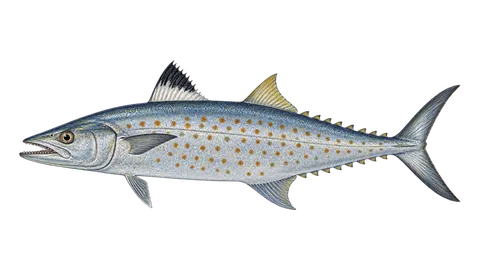
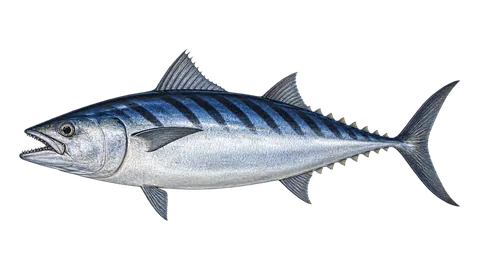
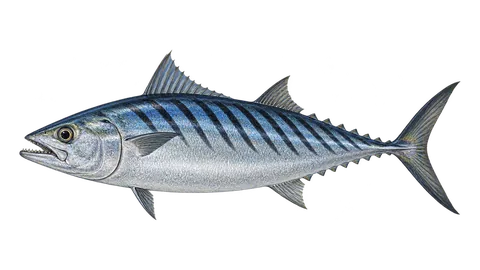
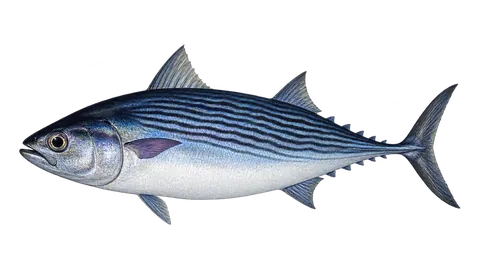
sources and references (5)
The season weights (months), the time of day and the sensitivities (cold, pressure, moon, wind, rain, tide, strong light, murky water and noise) are the app's editorial estimates, based on the literature below and on field experience from anglers and guides. They are not official data or measurements made for this species and may vary by region and year. Closed seasons and legal rules appear in the rules section, with the rule and link. The fishing depth range, the common size and the ideal water temperature range, when FishBase does not give a value, are editorial estimates based on the species' biology.
- scientific FishBase: Scomber japonicus (ficha da espécie)Size, length-weight, depth, habitat, distribution, biology, and IUCN status. Page checked on Oct 13, 2026.
- scientific FishBase: nomes populares de Scomber japonicusNames by country and language. The name cavalinha-do-pacífico was adopted in this profile from English (Pacific chub mackerel), to set the species apart from the Atlantic mackerel (Scomber colias).
- official NOM-017-PESC-1994, Para regular las actividades de pesca deportivo-recreativa en las aguas de jurisdicción federal de los Estados Unidos Mexicanos (modificação de 2013)Daily limit of 10 marine fish and 5 per species (item 4.9.1), return of the excess (4.9.5), closed seasons (4.10) and sales ban (4.11). Text checked in the DOF on Oct 13, 2026.
- official Resolución Ministerial N° 209-2001-PE: tallas mínimas de captura de peces marinos e invertebrados (Peru)Annex I: caballa (Scomber japonicus peruanus), 32 cm total length. Art. 3: prohibition below the size.
- official Resolución N° 336-2021-PRODUCE/CONAS-UT (Peru)Decision of the Sanctions Appeals Council citing the 32 cm size, the 30% tolerance and art. 7, No. 6, of DS 011-2007-PRODUCE (29 cm fork length).
how we calculatewhere each number comes from
The weather comes from three independent global models, cross-checked hour by hour: when they agree, confidence goes up; when they diverge, the band between them shows on the chart. Beyond 16 days, we use the GEFS ensemble of 31 simulations: if 20 of the 31 predict rain, the chance of rain is 65%. Sun and moon are calculated astronomically, with no uncertainty.
The index adds up, weighted for each species: time of day (species curve anchored to real sunrise and sunset), moon (transits, rise and set, phase), pressure (3 h trend and 24 h swing), water temperature (in rivers, estimated from air temperature; at sea, estimated by an ocean model), wind, rain, clouds, tide and the month in the species' cycle.
sources for this lookup
how accurate the forecast is
Accuracy measured in the reference project (4 regions, 93 days, forecast vs. observed): maximum temperature is off by 0.6 °C on average the next day and 1.7 °C at 7 days; rain of 5 mm or more is detected 76% of the time the next day and 57% at 7 days. Detection isn't everything: the false alarm rate isn't published here yet, and 93 days in 4 regions is still a small sample. We now also measure every day, at the app's destinations: