overview
who is the chilean bonito
The Pacific bonito (bonito-do-pacífico) is a scombrid, from the family of tunas and mackerels, in the southeastern Pacific, from northern Peru to Talcahuano, Chile. The northern Pacific form, from California to Mexico, is now treated as a separate species, Sarda lineolata. It lives near the coast in schools separated by size; the larger ones stay farther out. It eats small schooling fish such as anchoveta, squid and shrimp. It matures at two years and reaches 1 m and 11 kg. It is one of the most important fish in Peruvian artisanal fishing and a sport target from boats, piers and rocks, using surface lures, metal jigs and corrico.
fun facts
- It has no swim bladder: it must keep swimming to avoid sinking.
- Forms schools by size; larger fish live farther from the coast than the juveniles.
how to recognize it
identification
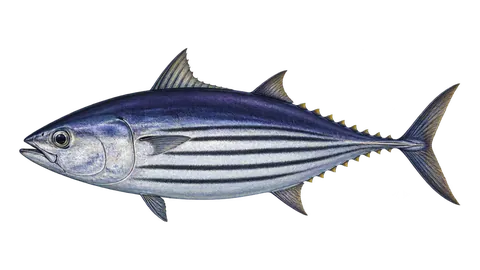
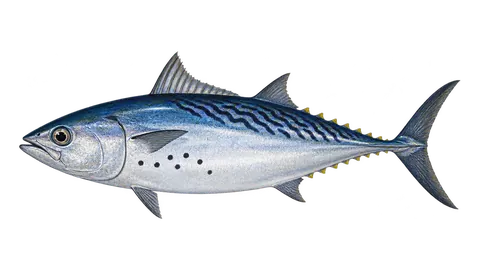
Spindle-shaped, robust body, dark blue back with oblique dark stripes, silvery flanks and belly without stripes. Large mouth with conical teeth, two dorsal fins close together, finlets behind the dorsal and anal fins, and a crescent tail. Body covered with very small scales. It differs from the skipjack, which has stripes on the belly, and from the bacoreta (bonito-pintado), with dark spots below the pectoral fin.
how chilean bonito fishing looks
Loading the next 7 days…
Each card shows the day's index (0 to 100) and, below it, a strip with the index for each hour, from 0h to 23h. from poor to excellent.