

- common size
- 35–55 cm
- maximum
- 60 cm
- common weight
- 1–3.5 kg
- record/max.
- 6.8 kg
- depth
- 0.5–8 m
- ideal water
- 24–30 °C

the right time
to be on the water
Choose the place and the species. The index, from 0 to 100, combines weather, sun, moon and tide with each fish's habits. Up to 28 days, with each day's confidence.
Loading the forecast…
—
Looking for alerts within 30 km…
Looking for what anglers have logged near here…
what you need to fish herelicense, certification and boat documents
fish likely at this spot
Tap a fish to see its forecast.
hour by hour
slide your finger or mouse over the chart to see each hoursee hour-by-hour table
why this index at —?
choose the day
the fishing month at a glance
what's the best window for the crew?
Choose how many fishing days. We compare each stretch by its average index, discount days with a warning or closed season, and show the 3 best.
trend for the coming weeks
Line: the middle value of 31 simulations of the American GEFS model. Band: where 8 out of 10 fall. Narrow, firm trend; wide, high uncertainty.
everything about the curimatã-pacu
how to recognize it
Tall, silver body with a bluish back and dark-edged scales forming fine lines. Sucker mouth. It grows larger and has a taller body than the curimatã-pioa (Prochilodus costatus), which shares the river with it. In the São Francisco, a sucker-mouthed fish over 40 cm is almost always curimatã-pacu.
Also called: curimatã-pacu, curimatá-pacu, curimatã, grumatã, xira
don't confuse with:
where found
open on the large mapWhere to look: River channel, slack water with muddy bottoms, oxbow lakes and reservoirs; rapids during migration.
Endemic to the São Francisco basin, from the upper river in Minas Gerais to the lower course. FishBase records introductions in rivers of the Northeast.
native to the basins
introduced in
states
Minas Gerais, Bahia, Pernambuco, Alagoas, Sergipe
famous destinations
when to fish
best season
Concentrated at the start of the rains, when the river rises to spawn (the piracema, a spawning closure, runs from November to February). Otherwise it is good on groundbait in the warm months.
best time of day
Daytime, with peaks at dawn and dusk. Feeds during the day on the bottom; schools move most early in the morning and late in the afternoon.
what affects the curimatã-pacu
cold and cold fronts
Strong cold keeps the fish still on the bottom.
atmospheric pressure
Little effect.
moon
Little known effect.
rain
The first heavy spring rains trigger the migration.
water level
A rising river pulls the school upriver.
noise
Tolerant, but it sinks with a motor nearby.
wind
Little effect.
depth
Bottom, 1 to 6 m.
how to fish
natural baits
- flour dough and cornmeal
- bread dough
- feed dough
tip from an angler
Steady groundbait at the same spot and firm dough. Big fish: set the drag before you start.
- rod
- 6' to 7', medium action, 12 to 25 lb
- spinning / baitcasting reel
- spinning reel 3000 to 4000
- line
- monofilament 0.30 to 0.40 mm
- leader
- optional
- hook
- #1 to 2/0, short shank
accessories
- spring feeder for dough
- bran chum
catch and release
Heavy fish with a delicate mouth: use a landing net, support the belly and release it quickly.
rules for the curimatã-pacu
Rules change; before keeping or transporting fish, check with the state environmental agency.
MG: minimum 40 cm
40 cmMG details
Minimum size for the curimatã-pacu in Minas Gerais (the IEF table cites Prochilodus marggravii, the former name of P. argenteus).
Source: Portaria IEF-MG nº 111/2003 (IEF minimum size table)
piracema and closed seasons
Each bar is the period when fishing is prohibited or restricted. The green line is today. Tap the name to see what is still allowed.
Spawning closure (piracema) in Minas Gerais (state rule)
Allowed: Only exotic or hybrid species, 3 kg plus one fish per day or outing, with handline, rod or pole with spinning or baitcasting reel (at most 5 per angler). Nets prohibited. Respect the minimum distances from dams, waterfalls and rapids and the marginal lagoons.
Source: Portarias IEF nº 154/2011 (São Francisco), 155/2011 (East) and 156/2011 (Grande/Paranaíba)
Closed season in Goiás (state rule)
Allowed: Sport and guided fishing only in reservoirs, catch and release with barbless hooks (no keeping, transporting or eating). Subsistence: up to 5 kg per day, for household consumption only.
Spawning closure (piracema) in the São Francisco River basin (rivers and reservoirs)
Allowed: Recreational fishing from a boat or from shore with handline, rod, spinning or baitcasting reel, up to 5 kg + 1 fish. Prohibited within 1,000 m of dams, waterfalls and rapids, and within 500 m of confluences. Floodplain lakes have a longer closed season (see next item).
Source: Portaria IBAMA nº 50/2007
São Francisco: floodplain lakes
Allowed: No fishing in the floodplain lakes during the period.
Source: Portaria IBAMA nº 50/2007
Conservation: Not on the national list (Portaria GM/MMA 1.667/2026).
how much it weighs without taking it out of the water
estimated weight
—
how we calculate
Length-weight relationship W = a·Lb (a = 0.01445, b = 2.97; FishBase). It's an average: a fat or lean fish can vary by 10% to 20%.
more about the curimatã-pacu
Found only in the São Francisco basin, the curimatã-pacu is the largest in its family and exceeds 6 kg. It eats mud and organic matter from the bottom and forms large migratory schools that run upriver to spawn at the start of the rains. It is one of the most important species in the river's commercial fishing, alongside the curimatã-pioa. Studies at Três Marias showed that, inside the reservoir, the species' breeding process collapses: like other migrants, it depends on stretches of free-flowing river to spawn. On the hook, it is caught with dough and a small hook, over groundbait; it fights hard and needs a well-set drag.
Family: Prochilodontidae · detritivore
fun facts
- It is the largest member of the family Prochilodontidae.
- The species' breeding studies were done in the São Francisco river just below the Três Marias dam and inside the reservoir.
in the kitchen
Fatty, tasty meat with bones. Whole, grilled over coals or in fried steaks.
similar species
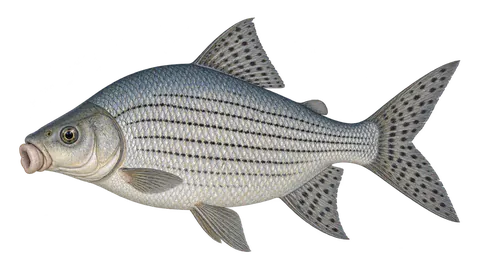
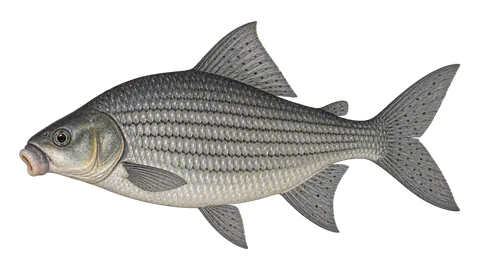
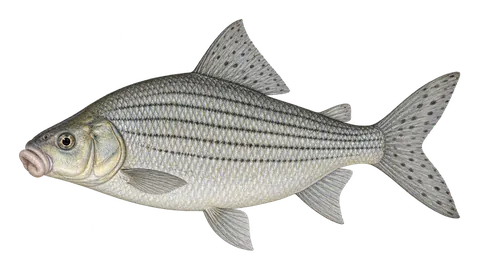
sources and references (8)
The season weights (months), the time of day and the sensitivities (cold, pressure, moon, wind, rain, tide, strong light, murky water and noise) are the app's editorial estimates, based on the literature below and on the field experience of anglers and guides. They are not official data nor a measurement made for this species, and they may vary by region and year. Closed seasons and legal rules appear in the rules section, with the norm and a link.
- scientific FishBase — Prochilodus argenteus (ficha da espécie)Names, distribution, biology, length-weight relationship and references. Page checked on October 13, 2026.
- official Portaria GM/MMA nº 1.667, de 27 de abril de 2026 — Lista Nacional Oficial de Espécies da Fauna Ameaçadas de Extinção (peixes e invertebrados aquáticos)Most recent national list. The species is not on it (search by scientific name in the text published in the DOU, checked on October 13, 2026).
- official ICMBio/SALVE — Ficha de Prochilodus argenteus (avaliação nacional do risco de extinção)National assessment by ICMBio, published in 2024. DOI verified on Crossref.
- scientific IUCN Red List — Prochilodus argenteus (avaliação global: Pouco Preocupante, LC, 07/11/2018)Global assessment. Link given on the FishBase entry (Red List, version 2025-2).
- scientific Castro, R. M. C.; Vari, R. P. (2004). Detritivores of the South American fish family Prochilodontidae (Teleostei: Ostariophysi: Characiformes): a phylogenetic and revisionary study. Smithsonian Contributions to Zoology 622: 1–189.Revision of the family, with the distribution of Prochilodus argenteus. DOI checked in Crossref.
- scientific Arantes, F. P.; Santos, H. B.; Rizzo, E.; Sato, Y.; Bazzoli, N. (2010). Profiles of sex steroids, fecundity, and spawning of the curimatã-pacu Prochilodus argenteus in the São Francisco River, downstream from the Três Marias Dam, Southeastern Brazil. Animal Reproduction Science 118(2-4): 330–336.DOI checked in Crossref.
- scientific Arantes, F. P.; Santos, H. B.; Rizzo, E.; Sato, Y.; Bazzoli, N. (2011). Collapse of the reproductive process of two migratory fish (Prochilodus argenteus and Prochilodus costatus) in the Três Marias Reservoir, São Francisco River, Brazil. Journal of Applied Ichthyology 27(3): 847–853.DOI checked in Crossref.
- scientific Pessali, T. C. et al. (2022). Length-weight relationships of 78 fish species from São Francisco River basin, Brazil. Journal of Applied Ichthyology.Length-weight relationship and maximum size used in FishBase for the species.
how we calculatewhere each number comes from
The weather comes from three independent global models, cross-checked hour by hour: when they agree, confidence goes up; when they diverge, the band between them shows on the chart. Beyond 16 days, we use the GEFS ensemble of 31 simulations: if 20 of the 31 predict rain, the chance of rain is 65%. Sun and moon are calculated astronomically, with no uncertainty.
The index adds up, weighted for each species: time of day (species curve anchored to real sunrise and sunset), moon (transits, rise and set, phase), pressure (3 h trend and 24 h swing), water temperature (in rivers, estimated from air temperature; at sea, estimated by an ocean model), wind, rain, clouds, tide and the month in the species' cycle.
sources for this lookup
how accurate the forecast is
Accuracy measured in the reference project (4 regions, 93 days, forecast vs. observed): maximum temperature is off by 0.6 °C on average the next day and 1.7 °C at 7 days; rain of 5 mm or more is detected 76% of the time the next day and 57% at 7 days. Detection isn't everything: the false alarm rate isn't published here yet, and 93 days in 4 regions is still a small sample. We now also measure every day, at the app's destinations: