

- common size
- 150–300 cm
- maximum
- 455 cm
- common weight
- 40–150 kg
- record/max.
- 650.0 kg
- depth
- 0–550 m
- ideal water
- 18–22 °C

the right time
to be on the water
Choose the place and the species. The index, from 0 to 100, combines weather, sun, moon and tide with each fish's habits. Up to 28 days, with each day's confidence.
Loading the forecast…
—
Looking for alerts within 30 km…
Looking for what anglers have logged near here…
what you need to fish herelicense, certification and boat documents
fish likely at this spot
Tap a fish to see its forecast.
hour by hour
slide your finger or mouse over the chart to see each hoursee hour-by-hour table
why this index at —?
choose the day
the fishing month at a glance
what's the best window for the crew?
Choose how many fishing days. We compare each stretch by its average index, discount days with a warning or closed season, and show the 3 best.
trend for the coming weeks
Line: the middle value of 31 simulations of the American GEFS model. Band: where 8 out of 10 fall. Narrow, firm trend; wide, high uncertainty.
everything about the swordfish
how to recognize it
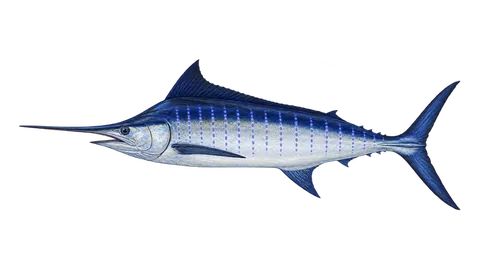
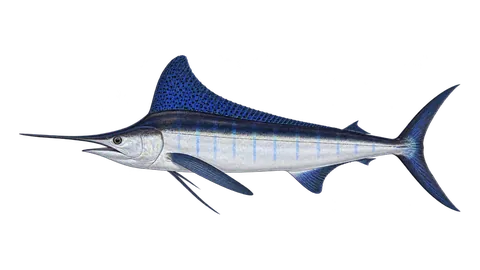
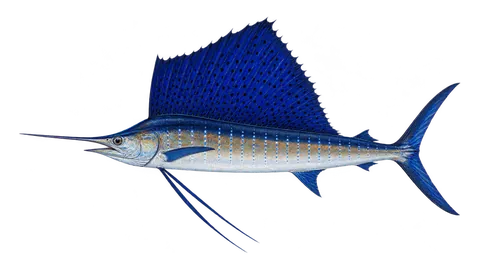
Elongated, rounded body, no scales as an adult, dark brown to black on the back, fading toward the belly. Long, flat, smooth bill, like a blade. Tall, stiff first dorsal fin that does not fold down; no pelvic fins; a single large keel on each side of the tail base. Differs from the marlins and the sailfish, which have a round bill and pelvic fins.
Also called: espadarte, meca, agulhão-espadarte, swordfish
don't confuse with:
where found
open on the large mapWhere to look: Open sea and slope; by day at great depths, at night near the surface; thermal fronts and seamounts.
Open sea along the whole coast, over the slope, seamounts, and oceanic fronts.
coast
states
Amapá, Pará, Maranhão, Piauí, Ceará, Rio Grande do Norte, Paraíba, Pernambuco, Alagoas, Sergipe, Bahia, Espírito Santo, Rio de Janeiro, São Paulo, Paraná, Santa Catarina, Rio Grande do Sul
when to fish
best season
Present all year in open sea; trips depend on calm seas.
best time of day
Nighttime. At night it rises to hunt near the surface; by day it stays hundreds of meters down.
what affects the swordfish
cold and cold fronts
Tolerates cold water at depth.
atmospheric pressure
A cold front brings rough seas.
moon
On full-moon nights, night hunting tends to be deeper; dark nights are preferred for surface fishing.
rain
Not very sensitive.
water level
Follows thermal fronts and slope breaks.
noise
Not very sensitive in open sea.
wind
Rough seas prevent drift fishing.
tide
No significant tide in the ocean; current is what matters.
depth
By day, 300 m or more; at night, 0 to 100 m.
how to fish
lures
- silicone squid with light
natural baits
- whole squid
- whole mackerel or bonito
tip from an angler
At night, drift with baits at several depths and chemical light near the hook; the bite usually comes as a sudden slack in the line.
- rod
- stand-up 50 to 80 lb or deep drop rod
- spinning / baitcasting reel
- 50 to 80 lb baitcaster or electric reel (deep drop)
- line
- braided 80 to 130 lb or monofilament 80 lb
- leader
- monofilament 200 to 300 lb, 5 to 10 m
- hook
- circle 10/0 to 14/0
accessories
- chemical light or depth LED
- 2 to 6 kg sinker with breakaway line (deep drop)
- fighting belt and harness
- bicheiro
- luvas
catch and release
Release it in the water, without bringing it aboard: cut the leader near the hook if you cannot remove it safely. The bill can injure: never hold it by the bill while the fish is still active.
rules for the swordfish
Rules change; before keeping or transporting fish, check with the state environmental agency.
Minimum size 125 cm or 25 kg
125 cm (lower jaw to fork) or 25 kgNorth CoastNortheast CoastSoutheast CoastSouth Coastconfirm with the agency details
Catching swordfish is prohibited on the Brazilian coast when weighing less than 25 kg or measuring less than 125 cm, measured from the lower jaw to the tail fork. The ordinance tolerates up to 15% of fish below the size limit in the total catch. We have not found an act that revokes it, but confirm that it is in force with the competent agency.
Conservation: Not on the national list (Portaria GM/MMA 1.667/2026). Global assessment: Near Threatened (IUCN, 2021). The South Atlantic stock is managed by ICCAT. IUCN global: NT · near threatened.
how much it weighs without taking it out of the water
estimated weight
—
how we calculate
Length-weight relationship W = a·Lb (a = 0.0038, b = 3.14; FishBase (estimativa bayesiana por forma do corpo na família, comprimento total)). It's an average: a fat or lean fish can vary by 10% to 20%.
more about the swordfish
The espadarte, or swordfish, is the only member of the family Xiphiidae: an oceanic fish with a long, flat bill, no pelvic fins, and no scales as an adult, exceeding 4 m and hundreds of kilograms. It lives in all oceans, from tropical to temperate waters, and makes long migrations. It descends to great depths by day and rises near the surface at night, hunting fish and squid, which it can strike with its bill. Large fish accumulate a lot of mercury in their flesh. In Brazil it is a traditional target of pelagic longline, and the South Atlantic stock is managed by ICCAT. Sport fishing is done at night, with squid baits drifting, or by day, with baits hundreds of meters deep.
Family: Xiphiidae · predator
fun facts
- Adults have no scales or pelvic fins.
- Warms its eyes and brain with a special tissue, which helps it hunt in cold, dark water.
in the kitchen
Firm flesh, excellent in grilled steaks. Large fish accumulate mercury, so consumption should be moderate, especially for pregnant women and children.
similar species
sources and references (8)
The season weights (months), the time of day and the sensitivities (cold, pressure, moon, wind, rain, tide, strong light, murky water and noise) are the app's editorial estimates, based on the literature below and on the field experience of anglers and guides. They are not official data nor a measurement made for this species, and they may vary by region and year. Closed seasons and legal rules appear in the rules section, with the norm and a link.
- scientific FishBase — Xiphias gladius (ficha da espécie)Names, distribution, biology, length-weight relationship and references. Page checked on October 13, 2026.
- official Portaria GM/MMA nº 1.667, de 27 de abril de 2026 — Lista Nacional Oficial de Espécies da Fauna Ameaçadas de Extinção (peixes e invertebrados aquáticos)Most recent national list. The species is not on it (search by scientific name in the text published in the DOU, checked on October 13, 2026).
- official ICMBio/SALVE — Ficha de Xiphias gladius (avaliação nacional do risco de extinção)ICMBio national assessment, published in 2026. DOI checked on Crossref.
- scientific IUCN Red List — Xiphias gladius (avaliação global: Quase Ameaçada, NT, 01/05/2021)Global assessment. Link given on the FishBase entry (Red List, version 2025-2).
- official Portaria IBAMA nº 56, de 2 de agosto de 1995 — tamanho mínimo de captura do espadarteCopy of the text in Cetesb's legislation repository, checked October 13, 2026.
- scientific Nakamura, I. (1985). FAO species catalogue. Vol. 5. Billfishes of the world. FAO Fisheries Synopsis 125(5). Roma: FAO.
- technical ICCAT Manual, cap. 2.1.9 — Swordfish (Xiphias gladius). International Commission for the Conservation of Atlantic Tunas.Biology and fishery of the species in the Atlantic.
- scientific Figueiredo, J. L.; Menezes, N. A. (2000). Manual de peixes marinhos do sudeste do Brasil. VI. Teleostei (5). São Paulo: Museu de Zoologia da USP. 116 p.Printed work; the URL is the bibliographic record on FishBase, which cites this work for the species.
how we calculatewhere each number comes from
The weather comes from three independent global models, cross-checked hour by hour: when they agree, confidence goes up; when they diverge, the band between them shows on the chart. Beyond 16 days, we use the GEFS ensemble of 31 simulations: if 20 of the 31 predict rain, the chance of rain is 65%. Sun and moon are calculated astronomically, with no uncertainty.
The index adds up, weighted for each species: time of day (species curve anchored to real sunrise and sunset), moon (transits, rise and set, phase), pressure (3 h trend and 24 h swing), water temperature (in rivers, estimated from air temperature; at sea, estimated by an ocean model), wind, rain, clouds, tide and the month in the species' cycle.
sources for this lookup
how accurate the forecast is
Accuracy measured in the reference project (4 regions, 93 days, forecast vs. observed): maximum temperature is off by 0.6 °C on average the next day and 1.7 °C at 7 days; rain of 5 mm or more is detected 76% of the time the next day and 57% at 7 days. Detection isn't everything: the false alarm rate isn't published here yet, and 93 days in 4 regions is still a small sample. We now also measure every day, at the app's destinations: