

- common size
- 35–60 cm
- maximum
- 95 cm
- common weight
- 0.5–2.7 kg
- record/max.
- 5.8 kg
- depth
- 5–80 m
- ideal water
- 20–28 °C

the right time
to be on the water
Choose the place and the species. The index, from 0 to 100, combines weather, sun, moon and tide with each fish's habits. Up to 28 days, with each day's confidence.
Loading the forecast…
—
Looking for alerts within 30 km…
Looking for what anglers have logged near here…
what you need to fish herelicense, certification and boat documents
fish likely at this spot
Tap a fish to see its forecast.
hour by hour
slide your finger or mouse over the chart to see each hoursee hour-by-hour table
why this index at —?
choose the day
the fishing month at a glance
what's the best window for the crew?
Choose how many fishing days. We compare each stretch by its average index, discount days with a warning or closed season, and show the 3 best.
trend for the coming weeks
Line: the middle value of 31 simulations of the American GEFS model. Band: where 8 out of 10 fall. Narrow, firm trend; wide, high uncertainty.
everything about the pacific red snapper
how to recognize it
Red to pink with a silvery sheen on the flank and reddish fins, no black spot on the back. In adults, the bone below the eye (preorbital) is very wide, and large ones have a groove from the front of the eye to the nostrils. The scale rows on the back rise diagonally above the lateral line. The colorado snapper (pargo colorado) looks similar, but is a more uniform red without the silvery sheen; the spotted rose snapper (pargo lunarejo) has the dark spot on its back.
Also called: huachinango-do-pacífico, huachinango, pargo-seda, Pacific red snapper
don't confuse with:
where found
open on the large mapWhere to look: Hard bottoms, reefs and coastal and shelf shoals, down to at least 80 m.
Not found in Brazil. Eastern Pacific, from Mexico (including the Gulf of California) to Peru.
when to fish
best season
Fishable all year. Calm sea and moderate current over the shoal decide the fishing.
best time of day
Dawn and dusk. Feeds more at dawn and dusk; on deep rocks it also bites during the day.
what affects the pacific red snapper
cold and cold fronts
Cold upwelling drives the schools away from the shallow rocks.
atmospheric pressure
A front with the sea turning rough hampers bottom fishing.
moon
Strong moons move more water over the shoals.
rain
Little effect on the bottom.
water level
Not applicable at sea.
noise
Less wary on deep rocks; even so, anchor upstream.
wind
Strong wind makes it hard to keep the line vertical at depth.
tide
Moderate current is best; very strong current carries the bait away from the rock.
depth
From 20 to 80 m over shoals and rocks.
how to fish
lures
- metal jig 80 to 200 g
- slow jig
- artificial squid (octopus)
natural baits
- whole or strip squid
- sardinha
- caranguejo
tip from an angler
When you find the school on the sonar, drop the jig to the bottom and lift it with short jerks in the first 10 m: the snappers rise behind the lure.
- rod
- 6'6" to 7', 20 to 40 lb; slow jig rod
- spinning / baitcasting reel
- baitcasting reel 300 to 400 or spinning reel 5000 to 6000
- line
- braid 30 to 50 lb
- leader
- fluorocarbon 40 to 60 lb, 1.5 m
- hook
- circle 3/0 to 6/0; assist hooks on the jig
accessories
- sinker 100 to 250 g
- descender (fish descender)
- alicate
catch and release
Deep-rock fish rises with an inflated swim bladder: use a descender to return it to depth. Do not puncture the bladder.
rules for the pacific red snapper
Rules change; before keeping or transporting fish, check with the state environmental agency.
Mexico: up to 5 per species and 10 saltwater fish per day
5 specimens of the species per angler per day, within the limit of 10 saltwater fish details
In recreational sport fishing in Mexican federal waters, each angler may keep up to 10 saltwater fish per day, no more than 5 of the same species. The Pacific red snapper (huachinango) is not among the species reserved for sport fishing under art. 68 of the General Law of Sustainable Fishing and Aquaculture, and has no quota of its own. Fish over the limit must be returned alive to the water, and sport-caught fish may not be sold. Anglers fishing from a boat need a Conapesca permit.
Costa Rica: minimum size of 34 cm
34 cm (total length)confirm with the agency details
Incopesca set, in AJDIP/026-2018 (which repealed AJDIP/102-2017), 28 cm total length for the Pacific red snapper (pargo seda) during the first two years (until February 2020). Transitional provision 2, as worded in AJDIP/098-2018, raises the minimum to 34 cm after that and provides for a review to see whether the first-maturity size of 43 cm will apply. 34 cm applies until a new decision. The rule covers all fishing activity, prohibits selling and transporting fish below the size, and allows a 10% tolerance in number and weight, only from catch to landing. We did not find the result of the review; check with Incopesca.
El Salvador: minimum size of 30 cm (rule not confirmed in full)
30 cm (total length)confirm with the agency details
Document from El Salvador's Ministry of Agriculture and Livestock (MAG) that prohibits, in snapper fishing, catching Pacific red snapper (boca colorada) under 30 cm total length. We did not confirm the number, date or validity of the rule: check with Cendepesca before keeping small fish.
Conservation: Old global assessment; heavily exploited by artisanal fishing.
how much it weighs without taking it out of the water
estimated weight
—
how we calculate
Length-weight relationship W = a·Lb (a = 0.01479, b = 2.96; FishBase (estimativa bayesiana para o gênero e o formato do corpo)). It's an average: a fat or lean fish can vary by 10% to 20%.
more about the pacific red snapper
Eastern Pacific red snapper, from Mexico to Peru. It lives over hard bottoms and coastal reefs, down to at least 80 m, often in schools. It eats large invertebrates, such as squid and crabs, and fish. The flesh is excellent, and huachinango is one of the most expensive and sought-after fish on the Mexican Pacific coast, supporting artisanal fishing throughout the area. In sport fishing it is targeted from boats over shoals and deeper rocks, with metal jigs, slow jigs and natural bait, and sometimes it rises behind the jig in a school.
Family: Lutjanidae · predator
fun facts
- In Mexico, huachinango is a prestige name on the menu and also applies to other red snappers.
- Large specimens develop a groove between the eye and the nostrils, a useful sign for recognizing the species.
in the kitchen
Excellent-quality white flesh; in Mexico, huachinango a la veracruzana, fried whole or roasted.
similar species
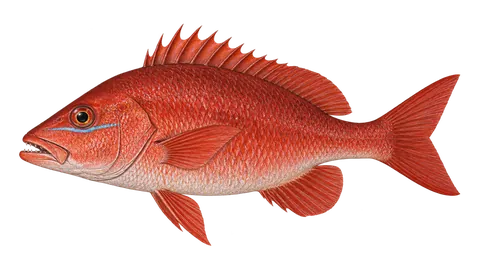
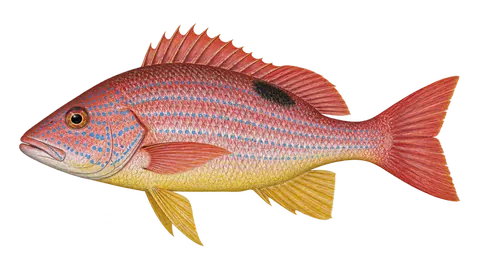
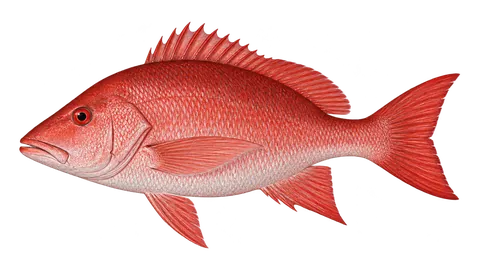
sources and references (9)
The season weights (months), the time of day and the sensitivities (cold, pressure, moon, wind, rain, tide, strong light, murky water and noise) are the app's editorial estimates, based on the literature below and on the field experience of anglers and guides. They are not official data nor a measurement made for this species, and they may vary by region and year. Closed seasons and legal rules appear in the rules section, with the norm and a link.
- scientific FishBase — Lutjanus peru (ficha da espécie)Names, distribution, biology, length-weight relationship, country list and references. Page checked on Oct 13, 2026.
- scientific IUCN Red List — Lutjanus peru (avaliação global: Pouco Preocupante, LC, 23/05/2007)Global assessment. Link given on the FishBase entry (Red List, version 2025-2).
- scientific Allen, G. R. (1985). FAO species catalogue. Vol. 6. Snappers of the world: an annotated and illustrated catalogue of lutjanid species known to date. FAO Fisheries Synopsis 125(6). Roma: FAO.
- scientific Hernández-Álvarez, C. et al. (2020). Phylogeography of the Pacific red snapper (Lutjanus peru) and spotted rose snapper (Lutjanus guttatus) in the inshore Tropical Eastern Pacific. Copeia 108(1): 61-71.DOI checked in Crossref.
- official Incopesca (Costa Rica) — Acordo AJDIP/026-2018 da Junta Diretiva: tamanhos legais de primeira captura (12/01/2018; La Gaceta nº 22, de 06/02/2018), que revogou o AJDIP/102-2017Table for art. 1 (silk snapper: 28 cm, with 10% tolerance; 43 cm first maturity) and art. 8, which repeals AJDIP/102-2017. Text checked 13/10/2026. The 34 cm minimum comes from Transitional Provision 2 as amended by AJDIP/098-2018. We did not find the result of the planned review or any later agreement on the species.
- official Incopesca (Costa Rica) — Acordo AJDIP/098-2018 da Junta Diretiva: modifica o AJDIP/026-2018 (Transitório 2, pargo seda; 26/02/2018)Sets 28 cm for two years and then 34 cm as the minimum size, with a review to check whether the 43 cm size should apply. Text checked 13/10/2026.
- official Procuraduría General de la República (Costa Rica), SCIJ — AJDIP/102-2017, registro de norma derrogadaThe record carries a notice that the rule was repealed by agreement AJDIP/026-2018, of January 12, 2018. Page checked 13/10/2026.
- official MAG/Cendepesca (El Salvador) — documento sobre a pesca de pargos publicado no Portal de Transparência do governoWe only checked the section that prohibits, in snapper fishing, sizes below 23 cm (L. guttatus) and 30 cm (L. peru) total length. Number, date and validity of the rule not confirmed; the site blocks automatic access.
- official DOF — Modificação da NOM-017-PESC-1994, para regular a pesca deportivo-recreativa em águas de jurisdição federal do México (publicada em 25/11/2013)Daily limits at sea (item 4.9.1) and in fresh water (4.9.2), one rod in inland waters (4.6 b), ban on live fish as bait in inland waters (4.7 c) and on fishing in closed areas and seasons (4.10).
how we calculatewhere each number comes from
The weather comes from three independent global models, cross-checked hour by hour: when they agree, confidence goes up; when they diverge, the band between them shows on the chart. Beyond 16 days, we use the GEFS ensemble of 31 simulations: if 20 of the 31 predict rain, the chance of rain is 65%. Sun and moon are calculated astronomically, with no uncertainty.
The index adds up, weighted for each species: time of day (species curve anchored to real sunrise and sunset), moon (transits, rise and set, phase), pressure (3 h trend and 24 h swing), water temperature (in rivers, estimated from air temperature; at sea, estimated by an ocean model), wind, rain, clouds, tide and the month in the species' cycle.
sources for this lookup
how accurate the forecast is
Accuracy measured in the reference project (4 regions, 93 days, forecast vs. observed): maximum temperature is off by 0.6 °C on average the next day and 1.7 °C at 7 days; rain of 5 mm or more is detected 76% of the time the next day and 57% at 7 days. Detection isn't everything: the false alarm rate isn't published here yet, and 93 days in 4 regions is still a small sample. We now also measure every day, at the app's destinations: