


the right time
to be on the water
Choose the place and the species. The index, from 0 to 100, combines weather, sun, moon and tide with each fish's habits. Up to 28 days, with each day's confidence.
Loading the forecast…
—
hour by hour
slide your finger or mouse over the chart to see each hoursee hour-by-hour table
why this index at —?
choose the day
the fishing month at a glance
what's the best window for the crew?
Choose how many fishing days. We compare each stretch by its average index, discount days with a warning or closed season, and show the 3 best.
trend for the coming weeks
Line: the middle value of 31 simulations of the American GEFS model. Band: where 8 out of 10 fall. Narrow, firm trend; wide, high uncertainty.
everything about the matrinchã-do-são-francisco
how to recognize it
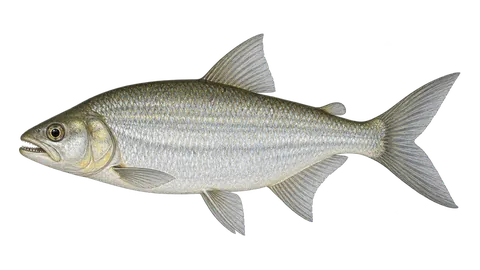
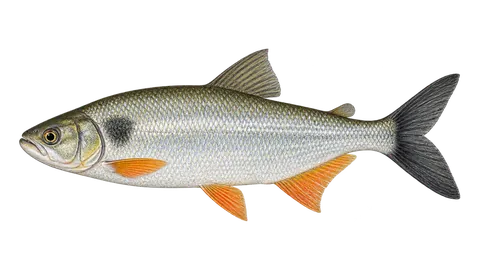
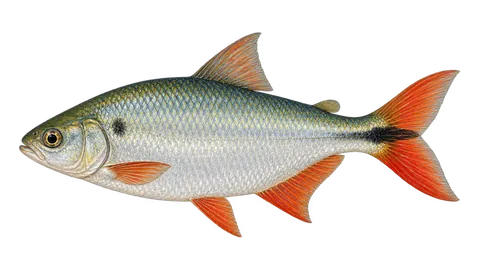
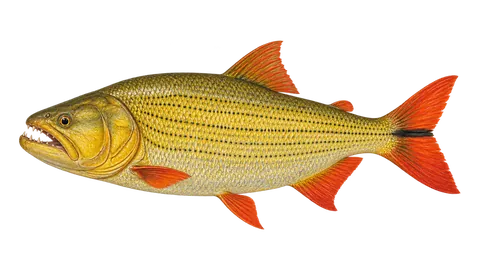
Deep, tall, silvery body with a dark back. Terminal mouth with several rows of teeth. Adipose fin and forked tail. It is the only large Brycon in the São Francisco; the golden dorado has a larger head and conical teeth, and the pirapitinga-do-sul does not occur in the river.
Also called: matrinchã, matrinxã, matrinchão, piracanjuba
don't confuse with:
where found
open on the large mapWhere to look: Rapids, rocky eddies, vegetated banks and riparian forest that drops fruit.
Endemic to the São Francisco basin: main channel and tributaries in Minas Gerais and Bahia, such as the stretch between Três Marias and Pirapora.
native to the basins
states
Minas Gerais, Bahia, Pernambuco, Alagoas, Sergipe
famous destinations
when to fish
best season
Best from March to October, with falling and clearing water. Spawning runs from October to January, coinciding with the spawning closure (piracema).
best time of day
Daytime, with peaks at dawn and dusk. Active by day, peaking early in the morning and late in the afternoon.
what affects the matrinchã-do-são-francisco
cold and cold fronts
Strong cold reduces activity.
atmospheric pressure
Stable pressure helps.
moon
Little effect.
rain
Muddy water after heavy rain hampers lure fishing.
water level
A falling, clearing river is the best scenario.
noise
Wary in clear water: approach quietly.
wind
Little effect.
depth
Shallow to mid-water, 0.5 to 3 m.
how to fish
lures
- colherzinha
- spinner
- small mid-water plug
- streamer
natural baits
- fruits from the riparian forest
- massa
- milho
- lambari
tip from an angler
Natural bait or fly drifting down the current next to vegetation. The strike is quick: soft drag, since it jumps a lot.
- rod
- 6' to 6'6", medium-fast action, 8 to 17 lb
- spinning / baitcasting reel
- spinning reel 2000 to 3000
- line
- braided line 15 to 20 lb or monofilament 0.25 to 0.30 mm
- leader
- fluorocarbon 20 to 30 lb
- hook
- #1 to 2/0, strong
accessories
- current float
- alicate
catch and release
Feisty and fragile: play it as little as possible, unhook it in the water and release it facing the current.
rules for the matrinchã-do-são-francisco
Rules change; before keeping or transporting fish, check with the state environmental agency.
MG: minimum 25 cm
25 cmMG details
Minimum size for matrinxã in Minas Gerais. The IEF table cites Brycon lundii, the former name of B. orthotaenia.
Source: Portaria IEF-MG nº 111/2003 (IEF minimum size table)
piracema and closed seasons
Each bar is the period when fishing is prohibited or restricted. The green line is today. Tap the name to see what is still allowed.
Spawning closure (piracema) in Minas Gerais (state rule)
Allowed: Only exotic or hybrid species, 3 kg + 1 fish per day, with handline, rod, simple pole, or spinning or baitcasting reel. Nets prohibited. Keep the minimum distances from dams and reservoirs.
Source: Portarias IEF nº 154/2011 (São Francisco), 155/2011 (East) and 156/2011 (Grande/Paranaíba)
Closed season in Goiás (state rule)
Allowed: Sport and guided fishing only in reservoirs, catch and release with barbless hooks (no keeping, transporting or eating). Subsistence: up to 5 kg per day, for household consumption only.
Spawning closure (piracema) in the São Francisco River basin (rivers and reservoirs)
Allowed: Recreational fishing from a boat or from shore with handline, rod, spinning or baitcasting reel, up to 5 kg + 1 fish. Prohibited within 1,000 m of dams, waterfalls and rapids, and within 500 m of confluences. Floodplain lakes have a longer closed season (see next item).
Source: Portaria IBAMA nº 50/2007
São Francisco: floodplain lakes
Allowed: No fishing in the floodplain lakes during the period.
Source: Portaria IBAMA nº 50/2007
Conservation: Not on the national list (Portaria GM/MMA 1.667/2026).
how much it weighs without taking it out of the water
estimated weight
—
how we calculate
Length-weight relationship W = a·Lb (a = 0.01413, b = 3.09; FishBase). It's an average: a fat or lean fish can vary by 10% to 20%.
more about the matrinchã-do-são-francisco
Endemic to the São Francisco basin and important to the river's commercial fishery. Like other Brycon, it is omnivorous: it eats fruit and seeds that fall into the water, insects and small fish. It lives in stretches of current, eddies and rapids, and makes spawning migrations. In the middle São Francisco, around Pirapora (MG), spawning runs from October to January; males mature at about 32 cm and females at about 40 cm total length. FishBase records up to 41 cm standard length (without the tail) and 1.6 kg. It is one of the river's most combative sport fish, with jumps and bursts.
Family: Bryconidae · omnivore
fun facts
- In parts of the São Francisco it is also called piracanjuba, a name that in the South belongs to another species (Brycon orbignyanus, threatened).
- The 2017 revision of the genus Brycon recognizes 21 species east of the Andes.
in the kitchen
Tasty, fatty meat with Y-shaped bones; grilled over embers or fried in thin cuts.
similar species
sources and references (7)
The season weights (months), the time of day and the sensitivities (cold, pressure, moon, wind, rain, tide, strong light, murky water and noise) are the app's editorial estimates, based on the literature below and on the field experience of anglers and guides. They are not official data nor a measurement made for this species, and they may vary by region and year. Closed seasons and legal rules appear in the rules section, with the norm and a link.
- scientific FishBase — Brycon orthotaenia (ficha da espécie)Names, distribution, biology, length-weight relationship and references. Page checked on October 13, 2026.
- official Portaria GM/MMA nº 1.667, de 27 de abril de 2026 — Lista Nacional Oficial de Espécies da Fauna Ameaçadas de Extinção (peixes e invertebrados aquáticos)Most recent national list. The species is not on it (search by scientific name in the text published in the DOU, checked on October 13, 2026).
- official ICMBio/SALVE — Ficha de Brycon orthotaenia (avaliação nacional do risco de extinção)National assessment by ICMBio, published in 2023. DOI verified on Crossref.
- scientific IUCN Red List — Brycon orthotaenia (avaliação global: Pouco Preocupante, LC, 07/11/2018)Global assessment. Link given on the FishBase entry (Red List, version 2025-2).
- scientific Gonçalves, T. L.; Bazzoli, N.; Brito, M. F. G. (2006). Gametogenesis and reproduction of the matrinxã Brycon orthotaenia (Günther, 1864) (Pisces: Characidae) in the São Francisco river, Minas Gerais, Brazil. Brazilian Journal of Biology 66(2a): 513–522.Spawning season and size at first maturity in the Pirapora region. DOI and abstract checked in Crossref.
- scientific Lima, F. C. T. (2017). A revision of the cis-andean species of the genus Brycon Müller & Troschel (Characiformes: Characidae). Zootaxa 4222(1).DOI checked in Crossref.
- scientific Pessali, T. C. et al. (2022). Length-weight relationships of 78 fish species from São Francisco River basin, Brazil. Journal of Applied Ichthyology.Length-weight relationship and maximum size used in FishBase for the species.
how we calculatewhere each number comes from
The weather comes from three independent global models, cross-checked hour by hour: when they agree, confidence goes up; when they diverge, the band between them shows on the chart. Beyond 16 days, we use the GEFS ensemble of 31 simulations: if 20 of the 31 predict rain, the chance of rain is 65%. Sun and moon are calculated astronomically, with no uncertainty.
The index adds up, weighted for each species: time of day (species curve anchored to real sunrise and sunset), moon (transits, rise and set, phase), pressure (3 h trend and 24 h swing), water temperature (in rivers, estimated from air temperature; at sea, estimated by an ocean model), wind, rain, clouds, tide and the month in the species' cycle.
sources for this lookup
how accurate the forecast is
Accuracy measured in the reference project (4 regions, 93 days, forecast vs. observed): maximum temperature is off by 0.6 °C on average the next day and 1.7 °C at 7 days; rain of 5 mm or more is detected 76% of the time the next day and 57% at 7 days. Detection isn't everything: the false alarm rate isn't published here yet, and 93 days in 4 regions is still a small sample. We now also measure every day, at the app's destinations: